

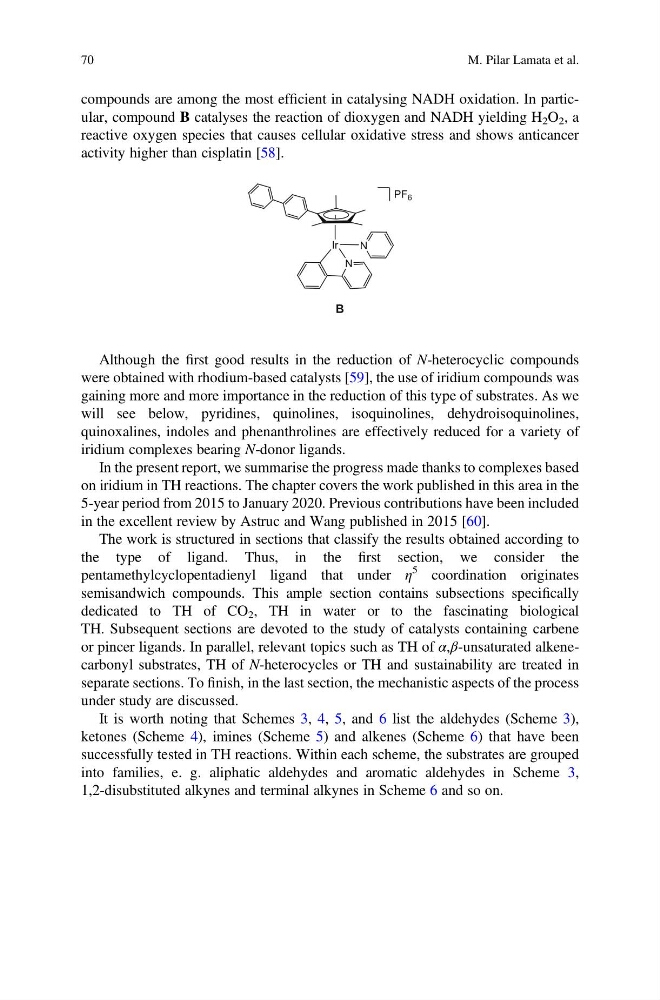
compounds are among the most efficient in catalysing NADH oxidation. In particular, compound B catalyses the reaction of dioxygen and NADH yielding H 2 O 2 , a
reactive oxygen species that causes cellular oxidative stress and shows anticancer
activity higher than cisplatin [58].
PF 6
Ir
B
N
N
Although the first good results in the reduction of N-heterocyclic compounds
were obtained with rhodium-based catalysts [59], the use of iridium compounds was
gaining more and more importance in the reduction of this type of substrates. As we
will see below, pyridines, quinolines, isoquinolines, dehydroisoquinolines,
quinoxalines, indoles and phenanthrolines are effectively reduced for a variety of
iridium complexes bearing N-donor ligands.
In the present report, we summarise the progress made thanks to complexes based
on iridium in TH reactions. The chapter covers the work published in this area in the
5-year period from 2015 to January 2020. Previous contributions have been included
in the excellent review by Astruc and Wang published in 2015 [60].
The work is structured in sections that classify the results obtained according to
the type of ligand. Thus, in the first section, we consider the
pentamethylcyclopentadienyl ligand that under η
5 coordination originates
semisandwich compounds. This ample section contains subsections specifically
dedicated to TH of CO 2 , TH in water or to the fascinating biological
TH. Subsequent sections are devoted to the study of catalysts containing carbene
or pincer ligands. In parallel, relevant topics such as TH of α,β-unsaturated alkenecarbonyl substrates, TH of N-heterocycles or TH and sustainability are treated in
separate sections. To finish, in the last section, the mechanistic aspects of the process
under study are discussed.
It is worth noting that Schemes 3, 4, 5, and 6 list the aldehydes (Scheme 3),
ketones (Scheme 4), imines (Scheme 5) and alkenes (Scheme 6) that have been
successfully tested in TH reactions. Within each scheme, the substrates are grouped
into families, e. g. aliphatic aldehydes and aromatic aldehydes in Scheme 3,
1,2-disubstituted alkynes and terminal alkynes in Scheme 6 and so on.
70
M. Pilar Lamata et al.
reactive oxygen species that causes cellular oxidative stress and shows anticancer
activity higher than cisplatin [58].
PF 6
Ir
B
N
N
Although the first good results in the reduction of N-heterocyclic compounds
were obtained with rhodium-based catalysts [59], the use of iridium compounds was
gaining more and more importance in the reduction of this type of substrates. As we
will see below, pyridines, quinolines, isoquinolines, dehydroisoquinolines,
quinoxalines, indoles and phenanthrolines are effectively reduced for a variety of
iridium complexes bearing N-donor ligands.
In the present report, we summarise the progress made thanks to complexes based
on iridium in TH reactions. The chapter covers the work published in this area in the
5-year period from 2015 to January 2020. Previous contributions have been included
in the excellent review by Astruc and Wang published in 2015 [60].
The work is structured in sections that classify the results obtained according to
the type of ligand. Thus, in the first section, we consider the
pentamethylcyclopentadienyl ligand that under η
5 coordination originates
semisandwich compounds. This ample section contains subsections specifically
dedicated to TH of CO 2 , TH in water or to the fascinating biological
TH. Subsequent sections are devoted to the study of catalysts containing carbene
or pincer ligands. In parallel, relevant topics such as TH of α,β-unsaturated alkenecarbonyl substrates, TH of N-heterocycles or TH and sustainability are treated in
separate sections. To finish, in the last section, the mechanistic aspects of the process
under study are discussed.
It is worth noting that Schemes 3, 4, 5, and 6 list the aldehydes (Scheme 3),
ketones (Scheme 4), imines (Scheme 5) and alkenes (Scheme 6) that have been
successfully tested in TH reactions. Within each scheme, the substrates are grouped
into families, e. g. aliphatic aldehydes and aromatic aldehydes in Scheme 3,
1,2-disubstituted alkynes and terminal alkynes in Scheme 6 and so on.
70
M. Pilar Lamata et al.