

synthesis of tetrahydro-1H-indoles by a similar type of reaction using Ir catalyst
71 [131].
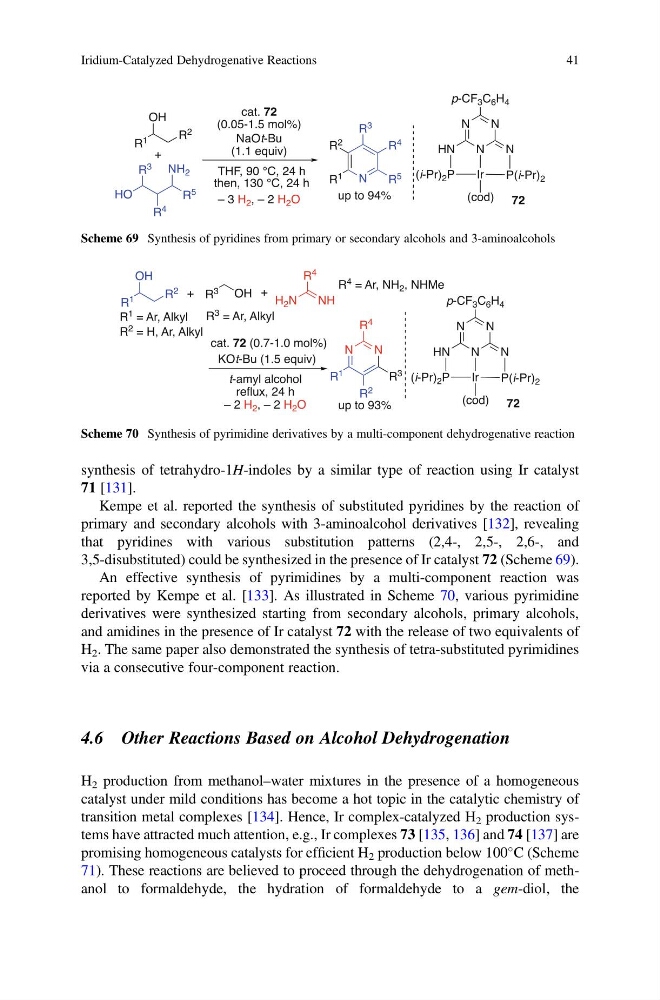
Kempe et al. reported the synthesis of substituted pyridines by the reaction of
primary and secondary alcohols with 3-aminoalcohol derivatives [132], revealing
that pyridines with various substitution patterns (2,4-, 2,5-, 2,6-, and
3,5-disubstituted) could be synthesized in the presence of Ir catalyst 72 (Scheme 69).
An effective synthesis of pyrimidines by a multi-component reaction was
reported by Kempe et al. [133]. As illustrated in Scheme 70, various pyrimidine
derivatives were synthesized starting from secondary alcohols, primary alcohols,
and amidines in the presence of Ir catalyst 72 with the release of two equivalents of
H 2 . The same paper also demonstrated the synthesis of tetra-substituted pyrimidines
via a consecutive four-component reaction.
4.6 Other Reactions Based on Alcohol Dehydrogenation
H 2 production from methanol–water mixtures in the presence of a homogeneous
catalyst under mild conditions has become a hot topic in the catalytic chemistry of
transition metal complexes [134]. Hence, Ir complex-catalyzed H 2 production systems have attracted much attention, e.g., Ir complexes 73 [135, 136] and 74 [137] are
promising homogeneous catalysts for efficient H 2 production below 100
C (Scheme
71). These reactions are believed to proceed through the dehydrogenation of methanol to formaldehyde, the hydration of formaldehyde to a gem-diol, the
Scheme 69 Synthesis of pyridines from primary or secondary alcohols and 3-aminoalcohols
Scheme 70 Synthesis of pyrimidine derivatives by a multi-component dehydrogenative reaction
Iridium-Catalyzed Dehydrogenative Reactions
41
71 [131].
Kempe et al. reported the synthesis of substituted pyridines by the reaction of
primary and secondary alcohols with 3-aminoalcohol derivatives [132], revealing
that pyridines with various substitution patterns (2,4-, 2,5-, 2,6-, and
3,5-disubstituted) could be synthesized in the presence of Ir catalyst 72 (Scheme 69).
An effective synthesis of pyrimidines by a multi-component reaction was
reported by Kempe et al. [133]. As illustrated in Scheme 70, various pyrimidine
derivatives were synthesized starting from secondary alcohols, primary alcohols,
and amidines in the presence of Ir catalyst 72 with the release of two equivalents of
H 2 . The same paper also demonstrated the synthesis of tetra-substituted pyrimidines
via a consecutive four-component reaction.
4.6 Other Reactions Based on Alcohol Dehydrogenation
H 2 production from methanol–water mixtures in the presence of a homogeneous
catalyst under mild conditions has become a hot topic in the catalytic chemistry of
transition metal complexes [134]. Hence, Ir complex-catalyzed H 2 production systems have attracted much attention, e.g., Ir complexes 73 [135, 136] and 74 [137] are
promising homogeneous catalysts for efficient H 2 production below 100
C (Scheme
71). These reactions are believed to proceed through the dehydrogenation of methanol to formaldehyde, the hydration of formaldehyde to a gem-diol, the
Scheme 69 Synthesis of pyridines from primary or secondary alcohols and 3-aminoalcohols
Scheme 70 Synthesis of pyrimidine derivatives by a multi-component dehydrogenative reaction
Iridium-Catalyzed Dehydrogenative Reactions
41