

dehydrogenation of the gem-diol to formic acid, and the dehydrogenation of formic
acid to afford CO 2.
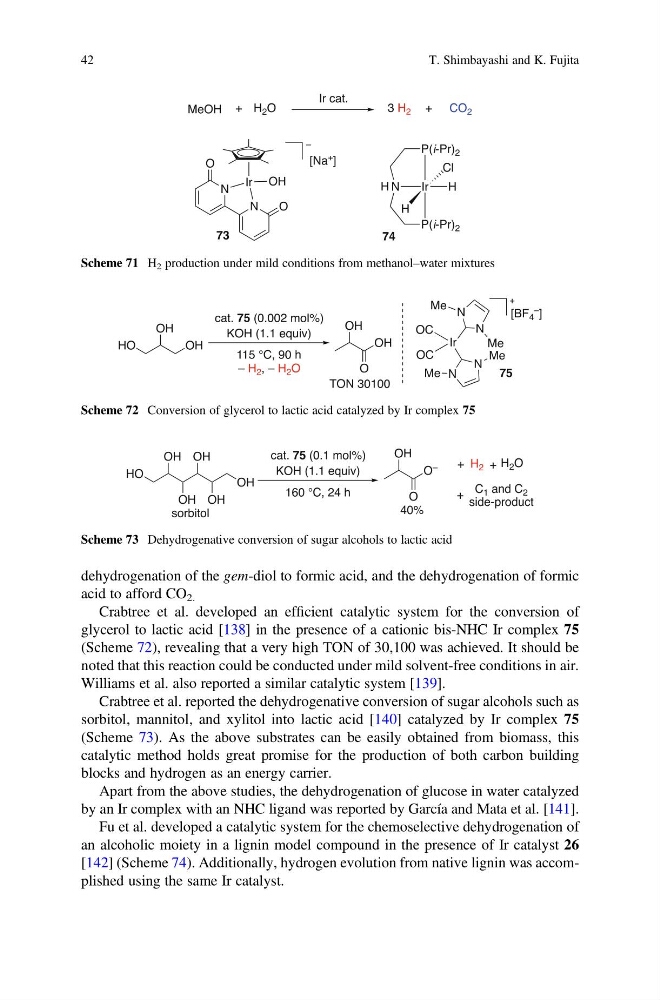
Crabtree et al. developed an efficient catalytic system for the conversion of
glycerol to lactic acid [138] in the presence of a cationic bis-NHC Ir complex 75
(Scheme 72), revealing that a very high TON of 30,100 was achieved. It should be
noted that this reaction could be conducted under mild solvent-free conditions in air.
Williams et al. also reported a similar catalytic system [139].
Crabtree et al. reported the dehydrogenative conversion of sugar alcohols such as
sorbitol, mannitol, and xylitol into lactic acid [140] catalyzed by Ir complex 75
(Scheme 73). As the above substrates can be easily obtained from biomass, this
catalytic method holds great promise for the production of both carbon building
blocks and hydrogen as an energy carrier.
Apart from the above studies, the dehydrogenation of glucose in water catalyzed
by an Ir complex with an NHC ligand was reported by García and Mata et al. [141].
Fu et al. developed a catalytic system for the chemoselective dehydrogenation of
an alcoholic moiety in a lignin model compound in the presence of Ir catalyst 26
[142] (Scheme 74). Additionally, hydrogen evolution from native lignin was accomplished using the same Ir catalyst.
Scheme 71 H 2 production under mild conditions from methanol–water mixtures
Scheme 72 Conversion of glycerol to lactic acid catalyzed by Ir complex 75
Scheme 73 Dehydrogenative conversion of sugar alcohols to lactic acid
42
T. Shimbayashi and K. Fujita
acid to afford CO 2.
Crabtree et al. developed an efficient catalytic system for the conversion of
glycerol to lactic acid [138] in the presence of a cationic bis-NHC Ir complex 75
(Scheme 72), revealing that a very high TON of 30,100 was achieved. It should be
noted that this reaction could be conducted under mild solvent-free conditions in air.
Williams et al. also reported a similar catalytic system [139].
Crabtree et al. reported the dehydrogenative conversion of sugar alcohols such as
sorbitol, mannitol, and xylitol into lactic acid [140] catalyzed by Ir complex 75
(Scheme 73). As the above substrates can be easily obtained from biomass, this
catalytic method holds great promise for the production of both carbon building
blocks and hydrogen as an energy carrier.
Apart from the above studies, the dehydrogenation of glucose in water catalyzed
by an Ir complex with an NHC ligand was reported by García and Mata et al. [141].
Fu et al. developed a catalytic system for the chemoselective dehydrogenation of
an alcoholic moiety in a lignin model compound in the presence of Ir catalyst 26
[142] (Scheme 74). Additionally, hydrogen evolution from native lignin was accomplished using the same Ir catalyst.
Scheme 71 H 2 production under mild conditions from methanol–water mixtures
Scheme 72 Conversion of glycerol to lactic acid catalyzed by Ir complex 75
Scheme 73 Dehydrogenative conversion of sugar alcohols to lactic acid
42
T. Shimbayashi and K. Fujita