

leading to quinoxalines and those of 1,2-phenylenediamine with aromatic primary
alcohols leading to benzimidazoles.
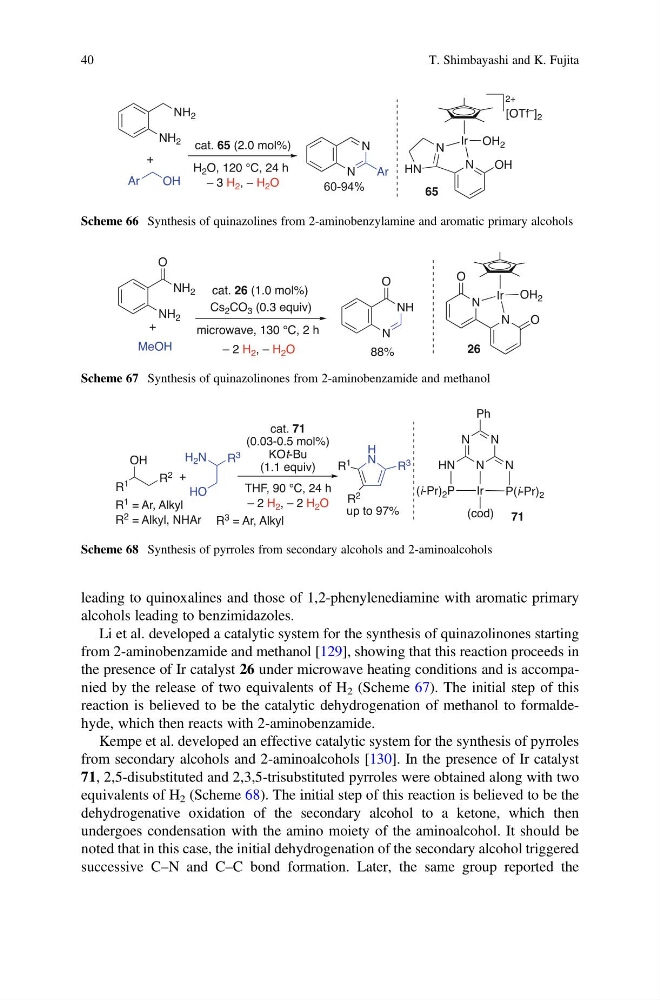
Li et al. developed a catalytic system for the synthesis of quinazolinones starting
from 2-aminobenzamide and methanol [129], showing that this reaction proceeds in
the presence of Ir catalyst 26 under microwave heating conditions and is accompanied by the release of two equivalents of H 2 (Scheme 67). The initial step of this
reaction is believed to be the catalytic dehydrogenation of methanol to formaldehyde, which then reacts with 2-aminobenzamide.
Kempe et al. developed an effective catalytic system for the synthesis of pyrroles
from secondary alcohols and 2-aminoalcohols [130]. In the presence of Ir catalyst
71, 2,5-disubstituted and 2,3,5-trisubstituted pyrroles were obtained along with two
equivalents of H 2 (Scheme 68). The initial step of this reaction is believed to be the
dehydrogenative oxidation of the secondary alcohol to a ketone, which then
undergoes condensation with the amino moiety of the aminoalcohol. It should be
noted that in this case, the initial dehydrogenation of the secondary alcohol triggered
successive C–N and C–C bond formation. Later, the same group reported the
Scheme 66 Synthesis of quinazolines from 2-aminobenzylamine and aromatic primary alcohols
Scheme 67 Synthesis of quinazolinones from 2-aminobenzamide and methanol
Scheme 68 Synthesis of pyrroles from secondary alcohols and 2-aminoalcohols
40
T. Shimbayashi and K. Fujita
alcohols leading to benzimidazoles.
Li et al. developed a catalytic system for the synthesis of quinazolinones starting
from 2-aminobenzamide and methanol [129], showing that this reaction proceeds in
the presence of Ir catalyst 26 under microwave heating conditions and is accompanied by the release of two equivalents of H 2 (Scheme 67). The initial step of this
reaction is believed to be the catalytic dehydrogenation of methanol to formaldehyde, which then reacts with 2-aminobenzamide.
Kempe et al. developed an effective catalytic system for the synthesis of pyrroles
from secondary alcohols and 2-aminoalcohols [130]. In the presence of Ir catalyst
71, 2,5-disubstituted and 2,3,5-trisubstituted pyrroles were obtained along with two
equivalents of H 2 (Scheme 68). The initial step of this reaction is believed to be the
dehydrogenative oxidation of the secondary alcohol to a ketone, which then
undergoes condensation with the amino moiety of the aminoalcohol. It should be
noted that in this case, the initial dehydrogenation of the secondary alcohol triggered
successive C–N and C–C bond formation. Later, the same group reported the
Scheme 66 Synthesis of quinazolines from 2-aminobenzylamine and aromatic primary alcohols
Scheme 67 Synthesis of quinazolinones from 2-aminobenzamide and methanol
Scheme 68 Synthesis of pyrroles from secondary alcohols and 2-aminoalcohols
40
T. Shimbayashi and K. Fujita