

be the dehydrogenative oxidation of the alcoholic moiety of 2-aminobenzyl alcohol.
A similar reaction promoted by an Ir-NHC catalyst in an organic solvent was also
reported by Gülcemal et al. [126].
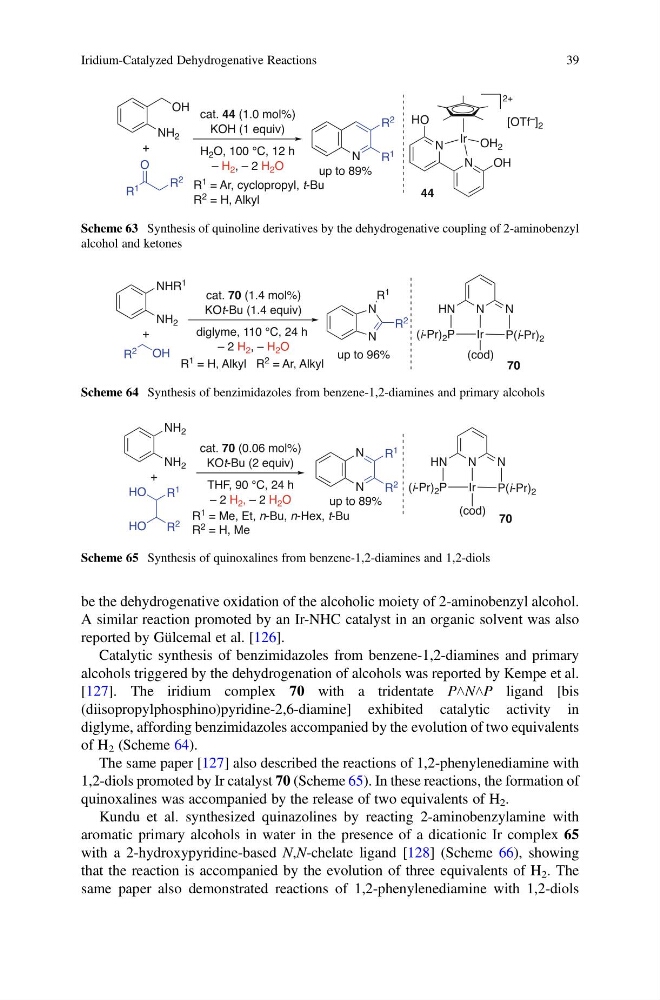
Catalytic synthesis of benzimidazoles from benzene-1,2-diamines and primary
alcohols triggered by the dehydrogenation of alcohols was reported by Kempe et al.
[127]. The iridium complex 70 with a tridentate P˄N˄P ligand [bis
(diisopropylphosphino)pyridine-2,6-diamine] exhibited catalytic activity in
diglyme, affording benzimidazoles accompanied by the evolution of two equivalents
of H 2 (Scheme 64).
The same paper [127] also described the reactions of 1,2-phenylenediamine with
1,2-diols promoted by Ir catalyst 70 (Scheme 65). In these reactions, the formation of
quinoxalines was accompanied by the release of two equivalents of H 2 .
Kundu et al. synthesized quinazolines by reacting 2-aminobenzylamine with
aromatic primary alcohols in water in the presence of a dicationic Ir complex 65
with a 2-hydroxypyridine-based N,N-chelate ligand [128] (Scheme 66), showing
that the reaction is accompanied by the evolution of three equivalents of H 2 . The
same paper also demonstrated reactions of 1,2-phenylenediamine with 1,2-diols
Scheme 63 Synthesis of quinoline derivatives by the dehydrogenative coupling of 2-aminobenzyl
alcohol and ketones
Scheme 64 Synthesis of benzimidazoles from benzene-1,2-diamines and primary alcohols
Scheme 65 Synthesis of quinoxalines from benzene-1,2-diamines and 1,2-diols
Iridium-Catalyzed Dehydrogenative Reactions
39
A similar reaction promoted by an Ir-NHC catalyst in an organic solvent was also
reported by Gülcemal et al. [126].
Catalytic synthesis of benzimidazoles from benzene-1,2-diamines and primary
alcohols triggered by the dehydrogenation of alcohols was reported by Kempe et al.
[127]. The iridium complex 70 with a tridentate P˄N˄P ligand [bis
(diisopropylphosphino)pyridine-2,6-diamine] exhibited catalytic activity in
diglyme, affording benzimidazoles accompanied by the evolution of two equivalents
of H 2 (Scheme 64).
The same paper [127] also described the reactions of 1,2-phenylenediamine with
1,2-diols promoted by Ir catalyst 70 (Scheme 65). In these reactions, the formation of
quinoxalines was accompanied by the release of two equivalents of H 2 .
Kundu et al. synthesized quinazolines by reacting 2-aminobenzylamine with
aromatic primary alcohols in water in the presence of a dicationic Ir complex 65
with a 2-hydroxypyridine-based N,N-chelate ligand [128] (Scheme 66), showing
that the reaction is accompanied by the evolution of three equivalents of H 2 . The
same paper also demonstrated reactions of 1,2-phenylenediamine with 1,2-diols
Scheme 63 Synthesis of quinoline derivatives by the dehydrogenative coupling of 2-aminobenzyl
alcohol and ketones
Scheme 64 Synthesis of benzimidazoles from benzene-1,2-diamines and primary alcohols
Scheme 65 Synthesis of quinoxalines from benzene-1,2-diamines and 1,2-diols
Iridium-Catalyzed Dehydrogenative Reactions
39