

4.5 Synthesis of N-Heterocycles Based on Alcohol
Dehydrogenation
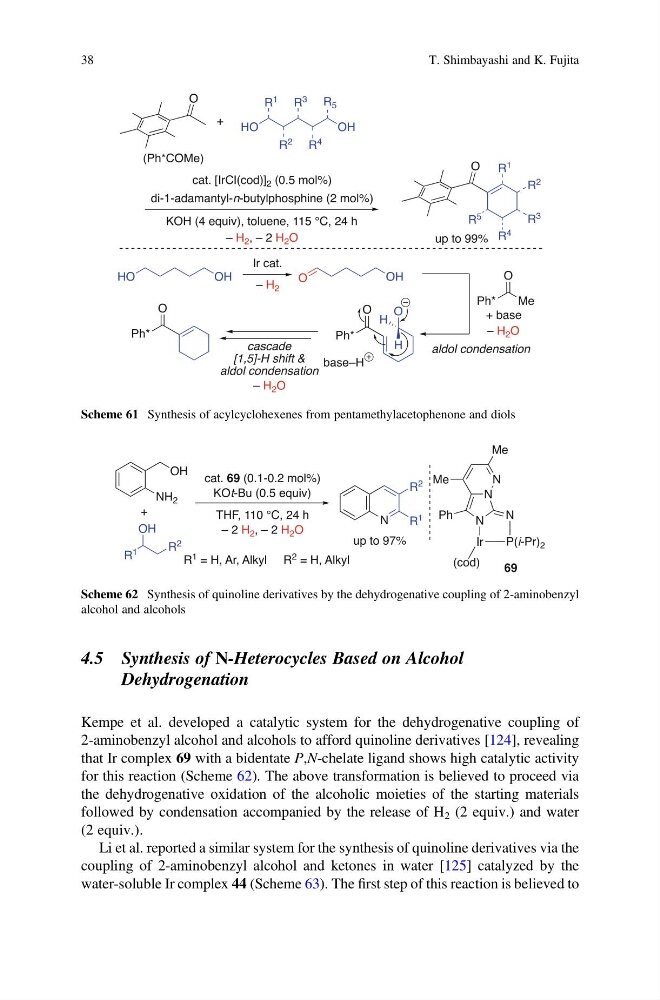
Kempe et al. developed a catalytic system for the dehydrogenative coupling of
2-aminobenzyl alcohol and alcohols to afford quinoline derivatives [124], revealing
that Ir complex 69 with a bidentate P,N-chelate ligand shows high catalytic activity
for this reaction (Scheme 62). The above transformation is believed to proceed via
the dehydrogenative oxidation of the alcoholic moieties of the starting materials
followed by condensation accompanied by the release of H 2 (2 equiv.) and water
(2 equiv.).
Li et al. reported a similar system for the synthesis of quinoline derivatives via the
coupling of 2-aminobenzyl alcohol and ketones in water [125] catalyzed by the
water-soluble Ir complex 44 (Scheme 63). The first step of this reaction is believed to
Scheme 61 Synthesis of acylcyclohexenes from pentamethylacetophenone and diols
Scheme 62 Synthesis of quinoline derivatives by the dehydrogenative coupling of 2-aminobenzyl
alcohol and alcohols
38
T. Shimbayashi and K. Fujita
Dehydrogenation
Kempe et al. developed a catalytic system for the dehydrogenative coupling of
2-aminobenzyl alcohol and alcohols to afford quinoline derivatives [124], revealing
that Ir complex 69 with a bidentate P,N-chelate ligand shows high catalytic activity
for this reaction (Scheme 62). The above transformation is believed to proceed via
the dehydrogenative oxidation of the alcoholic moieties of the starting materials
followed by condensation accompanied by the release of H 2 (2 equiv.) and water
(2 equiv.).
Li et al. reported a similar system for the synthesis of quinoline derivatives via the
coupling of 2-aminobenzyl alcohol and ketones in water [125] catalyzed by the
water-soluble Ir complex 44 (Scheme 63). The first step of this reaction is believed to
Scheme 61 Synthesis of acylcyclohexenes from pentamethylacetophenone and diols
Scheme 62 Synthesis of quinoline derivatives by the dehydrogenative coupling of 2-aminobenzyl
alcohol and alcohols
38
T. Shimbayashi and K. Fujita