

cross aldol condensation, and the transfer hydrogenation of the aldol condensation
product to afford an alkylated ketone.
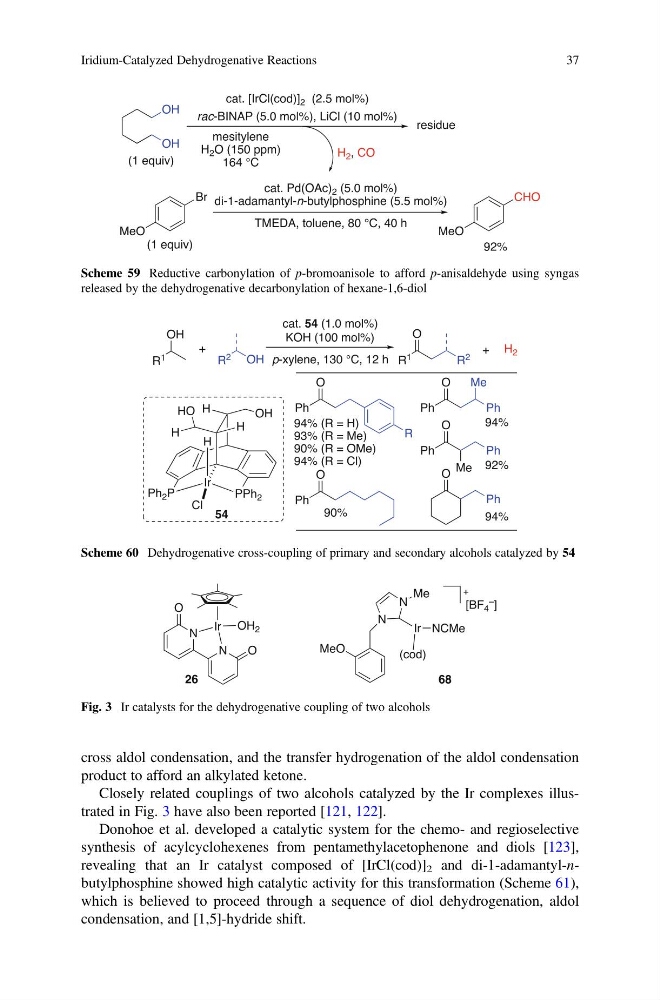
Closely related couplings of two alcohols catalyzed by the Ir complexes illustrated in Fig. 3 have also been reported [121, 122].
Donohoe et al. developed a catalytic system for the chemo- and regioselective
synthesis of acylcyclohexenes from pentamethylacetophenone and diols [123],
revealing that an Ir catalyst composed of [IrCl(cod)] 2 and di-1-adamantyl-nbutylphosphine showed high catalytic activity for this transformation (Scheme 61),
which is believed to proceed through a sequence of diol dehydrogenation, aldol
condensation, and [1,5]-hydride shift.
Scheme 59 Reductive carbonylation of p-bromoanisole to afford p-anisaldehyde using syngas
released by the dehydrogenative decarbonylation of hexane-1,6-diol
Scheme 60 Dehydrogenative cross-coupling of primary and secondary alcohols catalyzed by 54
Fig. 3 Ir catalysts for the dehydrogenative coupling of two alcohols
Iridium-Catalyzed Dehydrogenative Reactions
37
product to afford an alkylated ketone.
Closely related couplings of two alcohols catalyzed by the Ir complexes illustrated in Fig. 3 have also been reported [121, 122].
Donohoe et al. developed a catalytic system for the chemo- and regioselective
synthesis of acylcyclohexenes from pentamethylacetophenone and diols [123],
revealing that an Ir catalyst composed of [IrCl(cod)] 2 and di-1-adamantyl-nbutylphosphine showed high catalytic activity for this transformation (Scheme 61),
which is believed to proceed through a sequence of diol dehydrogenation, aldol
condensation, and [1,5]-hydride shift.
Scheme 59 Reductive carbonylation of p-bromoanisole to afford p-anisaldehyde using syngas
released by the dehydrogenative decarbonylation of hexane-1,6-diol
Scheme 60 Dehydrogenative cross-coupling of primary and secondary alcohols catalyzed by 54
Fig. 3 Ir catalysts for the dehydrogenative coupling of two alcohols
Iridium-Catalyzed Dehydrogenative Reactions
37