

decarbonylation to afford an alkane. Theoretical mechanistic studies on this catalysis
were also performed by Andersson and Madsen et al. [118].
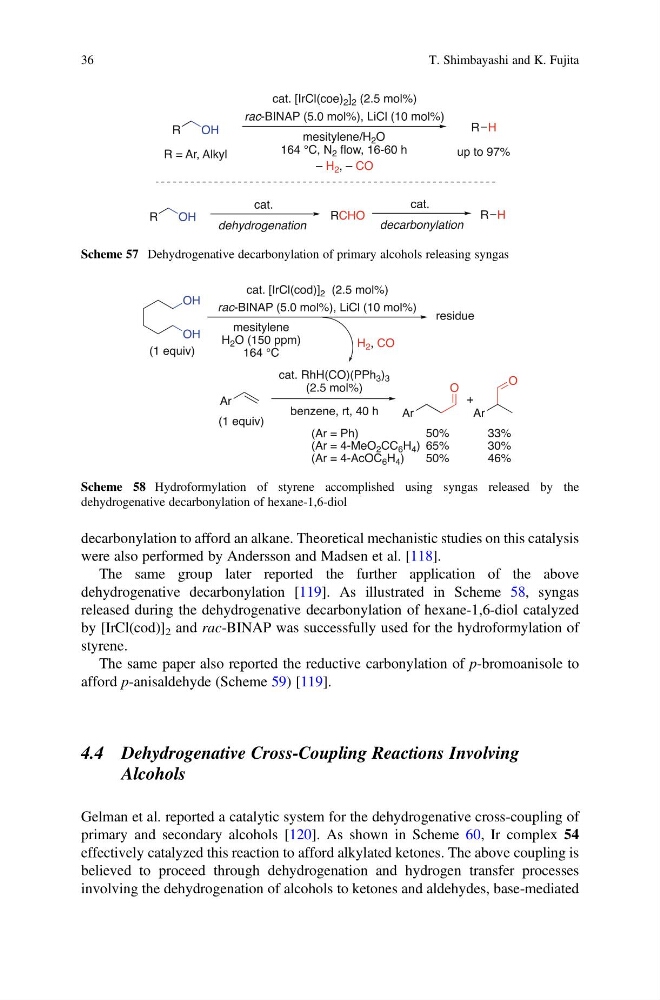
The same group later reported the further application of the above
dehydrogenative decarbonylation [119]. As illustrated in Scheme 58, syngas
released during the dehydrogenative decarbonylation of hexane-1,6-diol catalyzed
by [IrCl(cod)] 2 and rac-BINAP was successfully used for the hydroformylation of
styrene.
The same paper also reported the reductive carbonylation of p-bromoanisole to
afford p-anisaldehyde (Scheme 59) [119].
4.4 Dehydrogenative Cross-Coupling Reactions Involving
Alcohols
Gelman et al. reported a catalytic system for the dehydrogenative cross-coupling of
primary and secondary alcohols [120]. As shown in Scheme 60, Ir complex 54
effectively catalyzed this reaction to afford alkylated ketones. The above coupling is
believed to proceed through dehydrogenation and hydrogen transfer processes
involving the dehydrogenation of alcohols to ketones and aldehydes, base-mediated
Scheme 57 Dehydrogenative decarbonylation of primary alcohols releasing syngas
Scheme 58 Hydroformylation of styrene accomplished using syngas released by the
dehydrogenative decarbonylation of hexane-1,6-diol
36
T. Shimbayashi and K. Fujita
were also performed by Andersson and Madsen et al. [118].
The same group later reported the further application of the above
dehydrogenative decarbonylation [119]. As illustrated in Scheme 58, syngas
released during the dehydrogenative decarbonylation of hexane-1,6-diol catalyzed
by [IrCl(cod)] 2 and rac-BINAP was successfully used for the hydroformylation of
styrene.
The same paper also reported the reductive carbonylation of p-bromoanisole to
afford p-anisaldehyde (Scheme 59) [119].
4.4 Dehydrogenative Cross-Coupling Reactions Involving
Alcohols
Gelman et al. reported a catalytic system for the dehydrogenative cross-coupling of
primary and secondary alcohols [120]. As shown in Scheme 60, Ir complex 54
effectively catalyzed this reaction to afford alkylated ketones. The above coupling is
believed to proceed through dehydrogenation and hydrogen transfer processes
involving the dehydrogenation of alcohols to ketones and aldehydes, base-mediated
Scheme 57 Dehydrogenative decarbonylation of primary alcohols releasing syngas
Scheme 58 Hydroformylation of styrene accomplished using syngas released by the
dehydrogenative decarbonylation of hexane-1,6-diol
36
T. Shimbayashi and K. Fujita