

o-xylene) under mild conditions (room temperature and 3 bar H 2 ). For example,
benzene was completely hydrogenated to cyclohexane with a TOF ¼ 3,215 h
À1 . In
addition, the nanocatalyst showed a high stability versus sintering and leaching,
being reused up to five times preserving more than 50% of its initial activity during
the last run. Most importantly, these zeolite-supported Ir NPs exhibited a catalytic
lifetime without precedents in the neat benzene hydrogenation, with a total turnover
number (TTON) of 197,000 over 92 h. This catalytic process was presented as green
catalysis since it satisfies most of the green chemistry fundamentals, such as 100%
selectivity, the transformation of all substrates into products, solvent-free, etc. A year
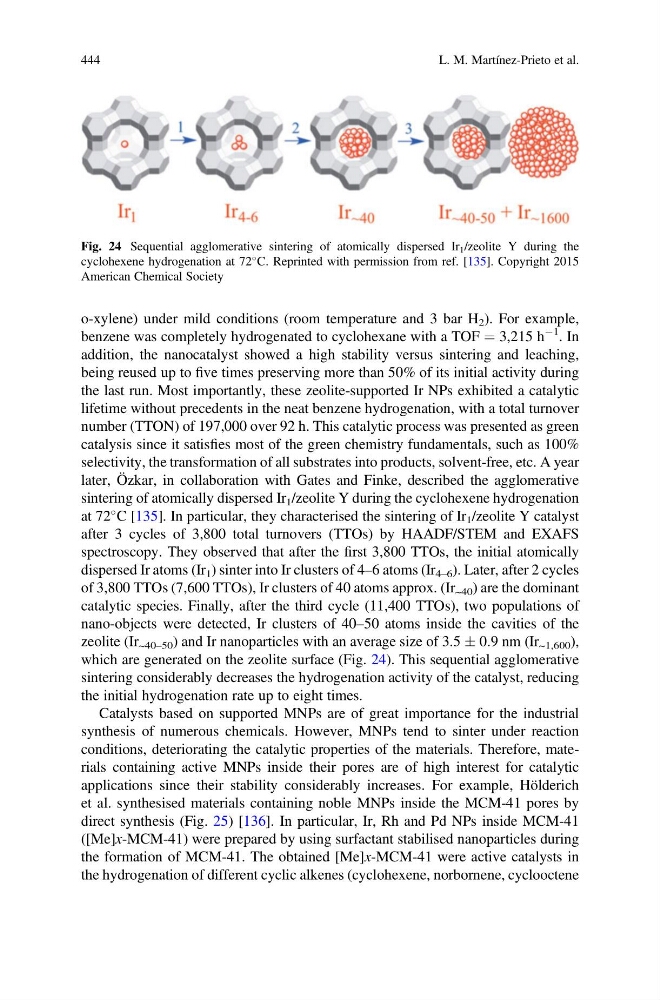
later, Özkar, in collaboration with Gates and Finke, described the agglomerative
sintering of atomically dispersed Ir 1 /zeolite Y during the cyclohexene hydrogenation
at 72
C [135]. In particular, they characterised the sintering of Ir 1 /zeolite Y catalyst
after 3 cycles of 3,800 total turnovers (TTOs) by HAADF/STEM and EXAFS
spectroscopy. They observed that after the first 3,800 TTOs, the initial atomically
dispersed Ir atoms (Ir 1 ) sinter into Ir clusters of 4–6 atoms (Ir 4–6 ). Later, after 2 cycles
of 3,800 TTOs (7,600 TTOs), Ir clusters of 40 atoms approx. (Ir ~40 ) are the dominant
catalytic species. Finally, after the third cycle (11,400 TTOs), two populations of
nano-objects were detected, Ir clusters of 40–50 atoms inside the cavities of the
zeolite (Ir ~40–50 ) and Ir nanoparticles with an average size of 3.5 Æ 0.9 nm (Ir ~1,600 ),
which are generated on the zeolite surface (Fig. 24). This sequential agglomerative
sintering considerably decreases the hydrogenation activity of the catalyst, reducing
the initial hydrogenation rate up to eight times.
Catalysts based on supported MNPs are of great importance for the industrial
synthesis of numerous chemicals. However, MNPs tend to sinter under reaction
conditions, deteriorating the catalytic properties of the materials. Therefore, materials containing active MNPs inside their pores are of high interest for catalytic
applications since their stability considerably increases. For example, Hölderich
et al. synthesised materials containing noble MNPs inside the MCM-41 pores by
direct synthesis (Fig. 25) [136]. In particular, Ir, Rh and Pd NPs inside MCM-41
([Me]x-MCM-41) were prepared by using surfactant stabilised nanoparticles during
the formation of MCM-41. The obtained [Me]x-MCM-41 were active catalysts in
the hydrogenation of different cyclic alkenes (cyclohexene, norbornene, cyclooctene
Fig. 24 Sequential agglomerative sintering of atomically dispersed Ir 1 /zeolite Y during the
cyclohexene hydrogenation at 72
C. Reprinted with permission from ref. [135]. Copyright 2015
American Chemical Society
444
L. M. Martínez-Prieto et al.
benzene was completely hydrogenated to cyclohexane with a TOF ¼ 3,215 h
À1 . In
addition, the nanocatalyst showed a high stability versus sintering and leaching,
being reused up to five times preserving more than 50% of its initial activity during
the last run. Most importantly, these zeolite-supported Ir NPs exhibited a catalytic
lifetime without precedents in the neat benzene hydrogenation, with a total turnover
number (TTON) of 197,000 over 92 h. This catalytic process was presented as green
catalysis since it satisfies most of the green chemistry fundamentals, such as 100%
selectivity, the transformation of all substrates into products, solvent-free, etc. A year
later, Özkar, in collaboration with Gates and Finke, described the agglomerative
sintering of atomically dispersed Ir 1 /zeolite Y during the cyclohexene hydrogenation
at 72
C [135]. In particular, they characterised the sintering of Ir 1 /zeolite Y catalyst
after 3 cycles of 3,800 total turnovers (TTOs) by HAADF/STEM and EXAFS
spectroscopy. They observed that after the first 3,800 TTOs, the initial atomically
dispersed Ir atoms (Ir 1 ) sinter into Ir clusters of 4–6 atoms (Ir 4–6 ). Later, after 2 cycles
of 3,800 TTOs (7,600 TTOs), Ir clusters of 40 atoms approx. (Ir ~40 ) are the dominant
catalytic species. Finally, after the third cycle (11,400 TTOs), two populations of
nano-objects were detected, Ir clusters of 40–50 atoms inside the cavities of the
zeolite (Ir ~40–50 ) and Ir nanoparticles with an average size of 3.5 Æ 0.9 nm (Ir ~1,600 ),
which are generated on the zeolite surface (Fig. 24). This sequential agglomerative
sintering considerably decreases the hydrogenation activity of the catalyst, reducing
the initial hydrogenation rate up to eight times.
Catalysts based on supported MNPs are of great importance for the industrial
synthesis of numerous chemicals. However, MNPs tend to sinter under reaction
conditions, deteriorating the catalytic properties of the materials. Therefore, materials containing active MNPs inside their pores are of high interest for catalytic
applications since their stability considerably increases. For example, Hölderich
et al. synthesised materials containing noble MNPs inside the MCM-41 pores by
direct synthesis (Fig. 25) [136]. In particular, Ir, Rh and Pd NPs inside MCM-41
([Me]x-MCM-41) were prepared by using surfactant stabilised nanoparticles during
the formation of MCM-41. The obtained [Me]x-MCM-41 were active catalysts in
the hydrogenation of different cyclic alkenes (cyclohexene, norbornene, cyclooctene
Fig. 24 Sequential agglomerative sintering of atomically dispersed Ir 1 /zeolite Y during the
cyclohexene hydrogenation at 72
C. Reprinted with permission from ref. [135]. Copyright 2015
American Chemical Society
444
L. M. Martínez-Prieto et al.