

separation of molecules (adsorbents, gas purification, etc.). In addition, zeolites have
been widely used as catalyst by the petrochemical industry and lately as MNP
support because of its higher surface-volume ratio and the possibility to modify
the MNP catalytic activity. In 2014, Özkar et al. reported Ir NPs supported on a
zeolite with faujasite (FAU) framework as a green nanocatalyst for the hydrogenation of aromatics [134]. The nanocatalyst, IrNPs@FAU, was obtained following a
two-step procedure: (1) first, Ir
3+ cations were inserted in FAU via an ion-exchange
process; (2) then, the Ir
3+ -exchanged FAU was chemically reduced by NaBH 4 ,
generating Ir NPs (5.8 Æ 2.1 nm) on the FAU surface and Ir nanoclusters inside
the zeolite cavities. The resulting catalyst showed a high activity and stability in the
hydrogenation of several neat aromatic substrates (benzene, toluene, mesitylene and
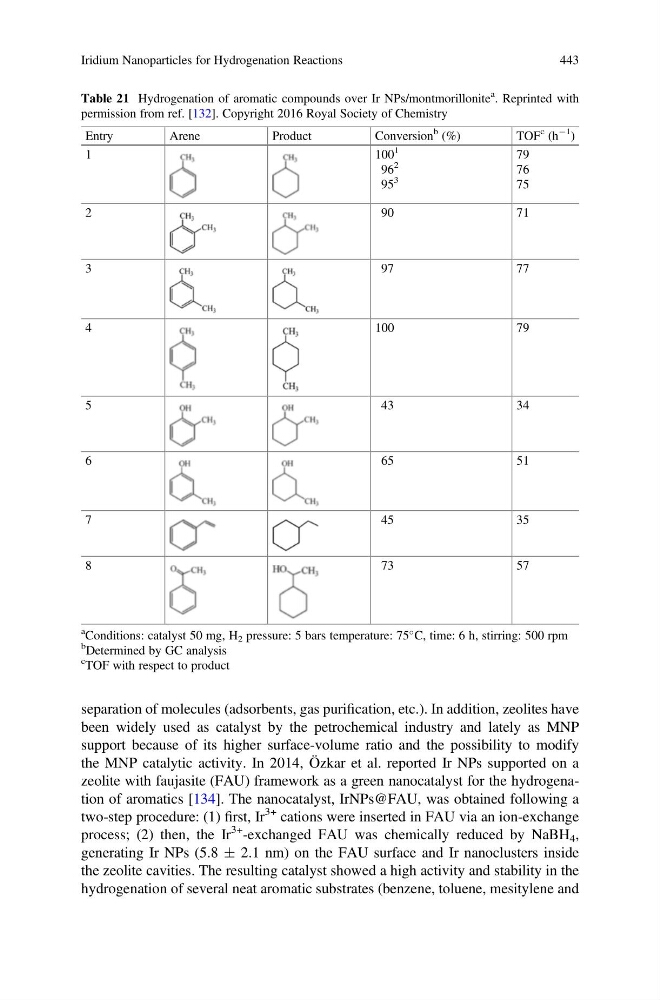
Table 21 Hydrogenation of aromatic compounds over Ir NPs/montmorillonite
a . Reprinted with
permission from ref. [132]. Copyright 2016 Royal Society of Chemistry
Entry
Arene
Product
Conversion
b (%)
TOF
c (h
À1
)
1
100
1
96
2
95
3
79
76
75
2
90
71
3
97
77
4
100
79
5
43
34
6
65
51
7
45
35
8
73
57
a Conditions: catalyst 50 mg, H 2 pressure: 5 bars temperature: 75
C, time: 6 h, stirring: 500 rpm
b
Determined by GC analysis
c TOF with respect to product
Iridium Nanoparticles for Hydrogenation Reactions
443
been widely used as catalyst by the petrochemical industry and lately as MNP
support because of its higher surface-volume ratio and the possibility to modify
the MNP catalytic activity. In 2014, Özkar et al. reported Ir NPs supported on a
zeolite with faujasite (FAU) framework as a green nanocatalyst for the hydrogenation of aromatics [134]. The nanocatalyst, IrNPs@FAU, was obtained following a
two-step procedure: (1) first, Ir
3+ cations were inserted in FAU via an ion-exchange
process; (2) then, the Ir
3+ -exchanged FAU was chemically reduced by NaBH 4 ,
generating Ir NPs (5.8 Æ 2.1 nm) on the FAU surface and Ir nanoclusters inside
the zeolite cavities. The resulting catalyst showed a high activity and stability in the
hydrogenation of several neat aromatic substrates (benzene, toluene, mesitylene and
Table 21 Hydrogenation of aromatic compounds over Ir NPs/montmorillonite
a . Reprinted with
permission from ref. [132]. Copyright 2016 Royal Society of Chemistry
Entry
Arene
Product
Conversion
b (%)
TOF
c (h
À1
)
1
100
1
96
2
95
3
79
76
75
2
90
71
3
97
77
4
100
79
5
43
34
6
65
51
7
45
35
8
73
57
a Conditions: catalyst 50 mg, H 2 pressure: 5 bars temperature: 75
C, time: 6 h, stirring: 500 rpm
b
Determined by GC analysis
c TOF with respect to product
Iridium Nanoparticles for Hydrogenation Reactions
443