

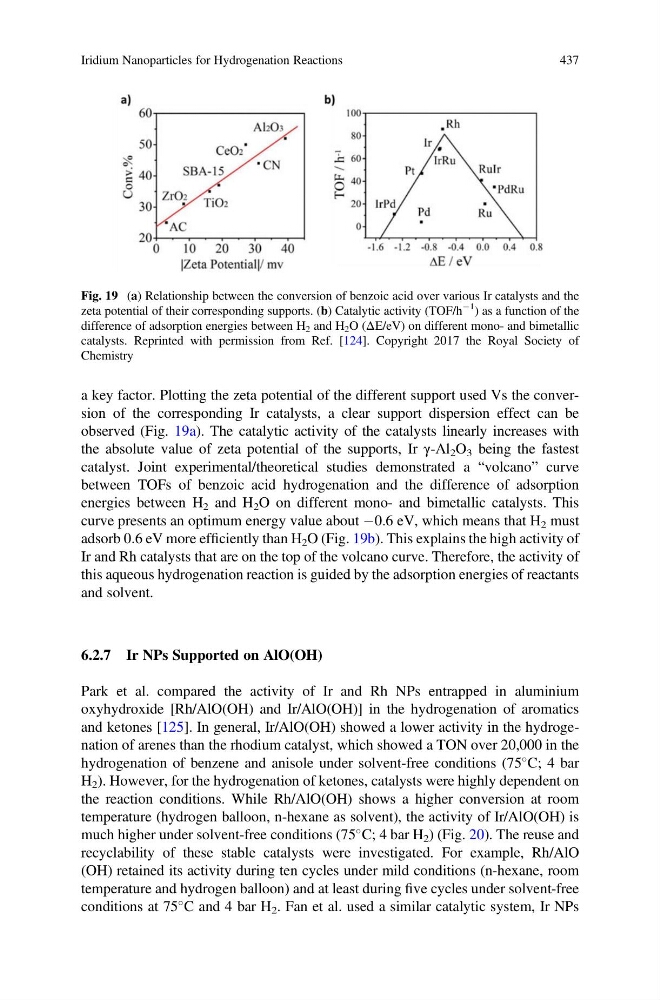
a key factor. Plotting the zeta potential of the different support used Vs the conversion of the corresponding Ir catalysts, a clear support dispersion effect can be
observed (Fig. 19a). The catalytic activity of the catalysts linearly increases with
the absolute value of zeta potential of the supports, Ir γ-Al 2 O 3 being the fastest
catalyst. Joint experimental/theoretical studies demonstrated a “volcano” curve
between TOFs of benzoic acid hydrogenation and the difference of adsorption
energies between H 2 and H 2 O on different mono- and bimetallic catalysts. This
curve presents an optimum energy value about À0.6 eV, which means that H 2 must
adsorb 0.6 eV more efficiently than H 2 O (Fig. 19b). This explains the high activity of
Ir and Rh catalysts that are on the top of the volcano curve. Therefore, the activity of
this aqueous hydrogenation reaction is guided by the adsorption energies of reactants
and solvent.
6.2.7 Ir NPs Supported on AlO(OH)
Park et al. compared the activity of Ir and Rh NPs entrapped in aluminium
oxyhydroxide [Rh/AlO(OH) and Ir/AlO(OH)] in the hydrogenation of aromatics
and ketones [125]. In general, Ir/AlO(OH) showed a lower activity in the hydrogenation of arenes than the rhodium catalyst, which showed a TON over 20,000 in the
hydrogenation of benzene and anisole under solvent-free conditions (75
C; 4 bar
H 2 ). However, for the hydrogenation of ketones, catalysts were highly dependent on
the reaction conditions. While Rh/AlO(OH) shows a higher conversion at room
temperature (hydrogen balloon, n-hexane as solvent), the activity of Ir/AlO(OH) is
much higher under solvent-free conditions (75
C; 4 bar H 2 ) (Fig. 20). The reuse and
recyclability of these stable catalysts were investigated. For example, Rh/AlO
(OH) retained its activity during ten cycles under mild conditions (n-hexane, room
temperature and hydrogen balloon) and at least during five cycles under solvent-free
conditions at 75
C and 4 bar H 2 . Fan et al. used a similar catalytic system, Ir NPs
Fig. 19 (a) Relationship between the conversion of benzoic acid over various Ir catalysts and the
zeta potential of their corresponding supports. (b) Catalytic activity (TOF/h
À1
) as a function of the
difference of adsorption energies between H 2 and H 2 O (ΔE/eV) on different mono- and bimetallic
catalysts. Reprinted with permission from Ref. [124]. Copyright 2017 the Royal Society of
Chemistry
Iridium Nanoparticles for Hydrogenation Reactions
437
observed (Fig. 19a). The catalytic activity of the catalysts linearly increases with
the absolute value of zeta potential of the supports, Ir γ-Al 2 O 3 being the fastest
catalyst. Joint experimental/theoretical studies demonstrated a “volcano” curve
between TOFs of benzoic acid hydrogenation and the difference of adsorption
energies between H 2 and H 2 O on different mono- and bimetallic catalysts. This
curve presents an optimum energy value about À0.6 eV, which means that H 2 must
adsorb 0.6 eV more efficiently than H 2 O (Fig. 19b). This explains the high activity of
Ir and Rh catalysts that are on the top of the volcano curve. Therefore, the activity of
this aqueous hydrogenation reaction is guided by the adsorption energies of reactants
and solvent.
6.2.7 Ir NPs Supported on AlO(OH)
Park et al. compared the activity of Ir and Rh NPs entrapped in aluminium
oxyhydroxide [Rh/AlO(OH) and Ir/AlO(OH)] in the hydrogenation of aromatics
and ketones [125]. In general, Ir/AlO(OH) showed a lower activity in the hydrogenation of arenes than the rhodium catalyst, which showed a TON over 20,000 in the
hydrogenation of benzene and anisole under solvent-free conditions (75
C; 4 bar
H 2 ). However, for the hydrogenation of ketones, catalysts were highly dependent on
the reaction conditions. While Rh/AlO(OH) shows a higher conversion at room
temperature (hydrogen balloon, n-hexane as solvent), the activity of Ir/AlO(OH) is
much higher under solvent-free conditions (75
C; 4 bar H 2 ) (Fig. 20). The reuse and
recyclability of these stable catalysts were investigated. For example, Rh/AlO
(OH) retained its activity during ten cycles under mild conditions (n-hexane, room
temperature and hydrogen balloon) and at least during five cycles under solvent-free
conditions at 75
C and 4 bar H 2 . Fan et al. used a similar catalytic system, Ir NPs
Fig. 19 (a) Relationship between the conversion of benzoic acid over various Ir catalysts and the
zeta potential of their corresponding supports. (b) Catalytic activity (TOF/h
À1
) as a function of the
difference of adsorption energies between H 2 and H 2 O (ΔE/eV) on different mono- and bimetallic
catalysts. Reprinted with permission from Ref. [124]. Copyright 2017 the Royal Society of
Chemistry
Iridium Nanoparticles for Hydrogenation Reactions
437