

entrapped in AlO(OH), for the selective hydrogenation of p-chloronitrobenzene to pchloroaniline under mild conditions (35
C, 1 bar H 2 , 1 mmol substrate, solvent:
5 mL ethanol +2.0 mL H 2 O, 2 h) [126]. The excellent activity and selectivity of this
catalyst are attributed to the formation of hydrogen bonds between the nitro group of
the substrate and the surface hydroxyl groups of the catalyst, which promotes the
hydrogenation of –NO 2 groups. Moreover, the hydrogen bonds formed between the
aniline and water facilitate the desorption of the products from the catalyst surface.
6.3 SiO 2 -Supported Ir NPs
SiO 2 , also called silica, has been widely used to stabilise MNPs. Unlike reducible
metal oxides like TiO 2 , which present strong metal-support interactions and influence in a higher degree the MNP properties, the irreducible oxides like silica are
normally more inert supports. In a collaborative effort, Reyes and Claver generated
Ir, Pt and Rh NPs on SiO 2 by reduction of the corresponding metallic salts in the
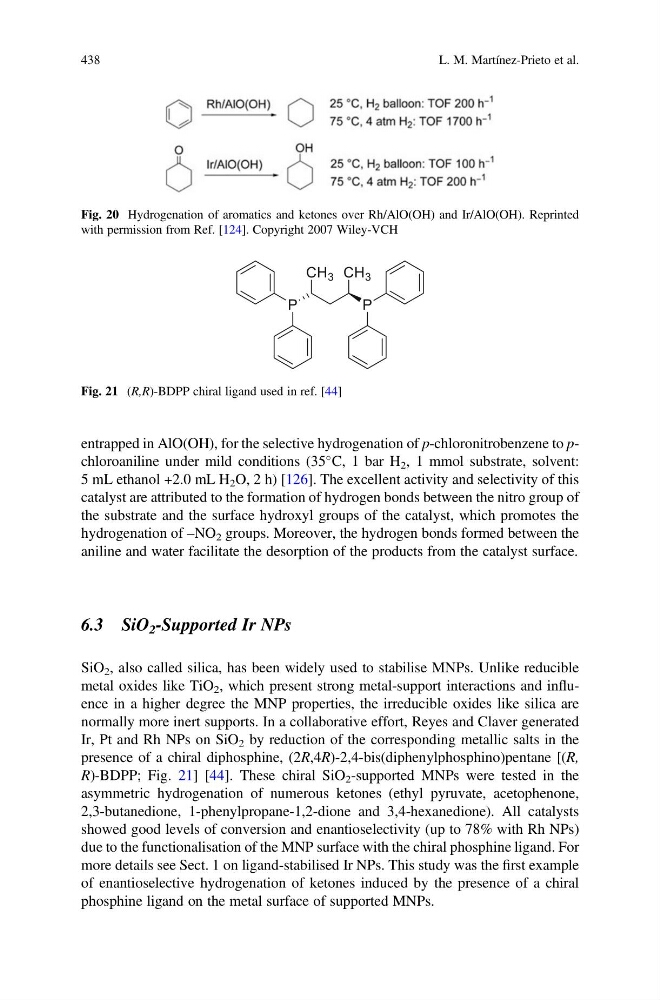
presence of a chiral diphosphine, (2R,4R)-2,4-bis(diphenylphosphino)pentane [(R,
R)-BDPP; Fig. 21] [44]. These chiral SiO 2 -supported MNPs were tested in the
asymmetric hydrogenation of numerous ketones (ethyl pyruvate, acetophenone,
2,3-butanedione, 1-phenylpropane-1,2-dione and 3,4-hexanedione). All catalysts
showed good levels of conversion and enantioselectivity (up to 78% with Rh NPs)
due to the functionalisation of the MNP surface with the chiral phosphine ligand. For
more details see Sect. 1 on ligand-stabilised Ir NPs. This study was the first example
of enantioselective hydrogenation of ketones induced by the presence of a chiral
phosphine ligand on the metal surface of supported MNPs.
Fig. 20 Hydrogenation of aromatics and ketones over Rh/AlO(OH) and Ir/AlO(OH). Reprinted
with permission from Ref. [124]. Copyright 2007 Wiley-VCH
Fig. 21 (R,R)-BDPP chiral ligand used in ref. [44]
438
L. M. Martínez-Prieto et al.
C, 1 bar H 2 , 1 mmol substrate, solvent:
5 mL ethanol +2.0 mL H 2 O, 2 h) [126]. The excellent activity and selectivity of this
catalyst are attributed to the formation of hydrogen bonds between the nitro group of
the substrate and the surface hydroxyl groups of the catalyst, which promotes the
hydrogenation of –NO 2 groups. Moreover, the hydrogen bonds formed between the
aniline and water facilitate the desorption of the products from the catalyst surface.
6.3 SiO 2 -Supported Ir NPs
SiO 2 , also called silica, has been widely used to stabilise MNPs. Unlike reducible
metal oxides like TiO 2 , which present strong metal-support interactions and influence in a higher degree the MNP properties, the irreducible oxides like silica are
normally more inert supports. In a collaborative effort, Reyes and Claver generated
Ir, Pt and Rh NPs on SiO 2 by reduction of the corresponding metallic salts in the
presence of a chiral diphosphine, (2R,4R)-2,4-bis(diphenylphosphino)pentane [(R,
R)-BDPP; Fig. 21] [44]. These chiral SiO 2 -supported MNPs were tested in the
asymmetric hydrogenation of numerous ketones (ethyl pyruvate, acetophenone,
2,3-butanedione, 1-phenylpropane-1,2-dione and 3,4-hexanedione). All catalysts
showed good levels of conversion and enantioselectivity (up to 78% with Rh NPs)
due to the functionalisation of the MNP surface with the chiral phosphine ligand. For
more details see Sect. 1 on ligand-stabilised Ir NPs. This study was the first example
of enantioselective hydrogenation of ketones induced by the presence of a chiral
phosphine ligand on the metal surface of supported MNPs.
Fig. 20 Hydrogenation of aromatics and ketones over Rh/AlO(OH) and Ir/AlO(OH). Reprinted
with permission from Ref. [124]. Copyright 2007 Wiley-VCH
Fig. 21 (R,R)-BDPP chiral ligand used in ref. [44]
438
L. M. Martínez-Prieto et al.