

the hydrogenation reactions. The inactive catalysts were those based on MNPs
supported on SiO 2 , SiO 2 (25%)-TiO 2 (75%) and SiO 2 (50%)-TiO 2 (50%). Among the
substrates, only five [toluene, naphthalene, indole, quinoline and benzothiophene (<
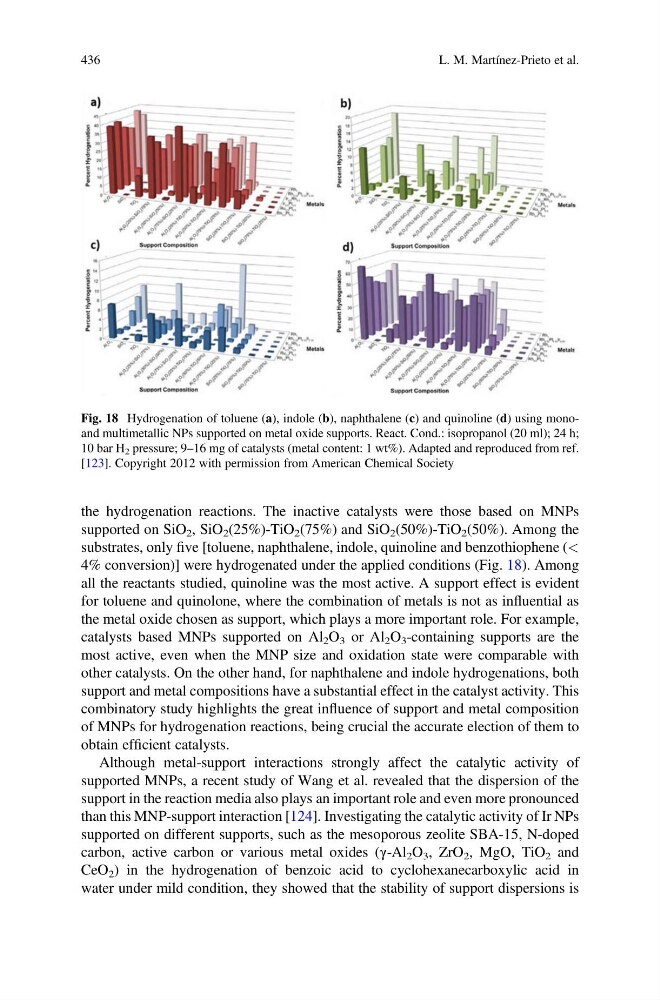
4% conversion)] were hydrogenated under the applied conditions (Fig. 18). Among
all the reactants studied, quinoline was the most active. A support effect is evident
for toluene and quinolone, where the combination of metals is not as influential as
the metal oxide chosen as support, which plays a more important role. For example,
catalysts based MNPs supported on Al 2 O 3 or Al 2 O 3 -containing supports are the
most active, even when the MNP size and oxidation state were comparable with
other catalysts. On the other hand, for naphthalene and indole hydrogenations, both
support and metal compositions have a substantial effect in the catalyst activity. This
combinatory study highlights the great influence of support and metal composition
of MNPs for hydrogenation reactions, being crucial the accurate election of them to
obtain efficient catalysts.
Although metal-support interactions strongly affect the catalytic activity of
supported MNPs, a recent study of Wang et al. revealed that the dispersion of the
support in the reaction media also plays an important role and even more pronounced
than this MNP-support interaction [124]. Investigating the catalytic activity of Ir NPs
supported on different supports, such as the mesoporous zeolite SBA-15, N-doped
carbon, active carbon or various metal oxides (γ-Al 2 O 3 , ZrO 2 , MgO, TiO 2 and
CeO 2 ) in the hydrogenation of benzoic acid to cyclohexanecarboxylic acid in
water under mild condition, they showed that the stability of support dispersions is
Fig. 18 Hydrogenation of toluene (a), indole (b), naphthalene (c) and quinoline (d) using monoand multimetallic NPs supported on metal oxide supports. React. Cond.: isopropanol (20 ml); 24 h;
10 bar H 2 pressure; 9–16 mg of catalysts (metal content: 1 wt%). Adapted and reproduced from ref.
[123]. Copyright 2012 with permission from American Chemical Society
436
L. M. Martínez-Prieto et al.
supported on SiO 2 , SiO 2 (25%)-TiO 2 (75%) and SiO 2 (50%)-TiO 2 (50%). Among the
substrates, only five [toluene, naphthalene, indole, quinoline and benzothiophene (<
4% conversion)] were hydrogenated under the applied conditions (Fig. 18). Among
all the reactants studied, quinoline was the most active. A support effect is evident
for toluene and quinolone, where the combination of metals is not as influential as
the metal oxide chosen as support, which plays a more important role. For example,
catalysts based MNPs supported on Al 2 O 3 or Al 2 O 3 -containing supports are the
most active, even when the MNP size and oxidation state were comparable with
other catalysts. On the other hand, for naphthalene and indole hydrogenations, both
support and metal compositions have a substantial effect in the catalyst activity. This
combinatory study highlights the great influence of support and metal composition
of MNPs for hydrogenation reactions, being crucial the accurate election of them to
obtain efficient catalysts.
Although metal-support interactions strongly affect the catalytic activity of
supported MNPs, a recent study of Wang et al. revealed that the dispersion of the
support in the reaction media also plays an important role and even more pronounced
than this MNP-support interaction [124]. Investigating the catalytic activity of Ir NPs
supported on different supports, such as the mesoporous zeolite SBA-15, N-doped
carbon, active carbon or various metal oxides (γ-Al 2 O 3 , ZrO 2 , MgO, TiO 2 and
CeO 2 ) in the hydrogenation of benzoic acid to cyclohexanecarboxylic acid in
water under mild condition, they showed that the stability of support dispersions is
Fig. 18 Hydrogenation of toluene (a), indole (b), naphthalene (c) and quinoline (d) using monoand multimetallic NPs supported on metal oxide supports. React. Cond.: isopropanol (20 ml); 24 h;
10 bar H 2 pressure; 9–16 mg of catalysts (metal content: 1 wt%). Adapted and reproduced from ref.
[123]. Copyright 2012 with permission from American Chemical Society
436
L. M. Martínez-Prieto et al.