

Structural symmetric dendrimers have also been used to generate and stabilise Ir
NPs. The strong dendrimer-metal precursor interactions facilitate and control the
formation of the nanoparticles. For example, in 2008, Williams et al. obtained Ir NPs
supported on γ-Al 2 O 3 (Ir/γ-Al 2 O 3 ) following a dendrimer metal nanocomposite
approach (DMN) [122]. In particular, IrCl 3 Á3H 2 O was first complexed with a four
generation hydroxyl-terminated polyamidoamine [(G4OH) PAMAM] dendrimer,
thanks to the large amount of amines sites available for Ir
3+ coordination. Then,
Ir/γ-Al 2 O 3 was prepared through a wet impregnation of the DMN precursor on the
alumina followed by an oxidation/reduction treatment. The resultant catalyst (1 wt
%) was tested in the hydrogenation of benzonitrile and compared with Ir/γ-Al 2 O
prepared by a conventional method (wet impregnation of IrCl 3 Á3H 2 O instead of the
DMN precursor). Although the DMN approach produces more well-dispersed NPs
overall with large Ir loadings, dendrimer-derived catalysts show similar activity and
selectivity for benzonitrile hydrogenation compared to conventionally prepared
catalyst.
Mixed oxides are also attracting attention as MNP support since they present a
wide range of acidities. In 2012, Buriak et al. reported an interesting comparative
study about mono- and multimetallic nanoparticles supported on different metal
oxide supports for the hydrogenation of a series of aromatic compounds [123]. In
particular, the catalytic activity of 72 different catalysts (with different MNP and
support compositions) were compared in the hydrogenation of arenes (toluene,
naphthalene) and heteroarenes (pyridine, quinoline, indole, thiophene and
benzothiophene). Combination of 4 metals (Rh, RhPt, RhIr, RuPt, IrPt and RhPtIr)
over 12 different supports (pure Al 2 O 3 , SiO 2 and TiO 2 and 9 combinations between
them) were used to create the catalyst library and perform the screening study. The
catalyst synthesis followed a one-pot process in which the metallic salts
(NP precursors) were mixed with metal alkoxides (oxide support precursors) in a
solution of EtOH/H 2 O/HCl. 56 catalysts of the initial 72 demonstrated to be active in
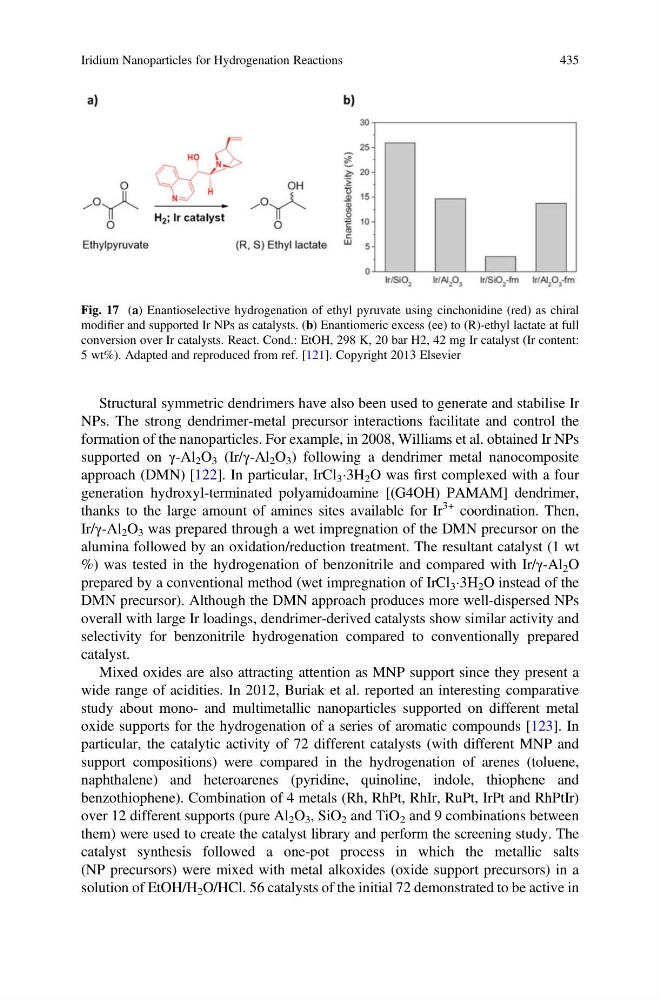
Fig. 17 (a) Enantioselective hydrogenation of ethyl pyruvate using cinchonidine (red) as chiral
modifier and supported Ir NPs as catalysts. (b) Enantiomeric excess (ee) to (R)-ethyl lactate at full
conversion over Ir catalysts. React. Cond.: EtOH, 298 K, 20 bar H2, 42 mg Ir catalyst (Ir content:
5 wt%). Adapted and reproduced from ref. [121]. Copyright 2013 Elsevier
Iridium Nanoparticles for Hydrogenation Reactions
435
NPs. The strong dendrimer-metal precursor interactions facilitate and control the
formation of the nanoparticles. For example, in 2008, Williams et al. obtained Ir NPs
supported on γ-Al 2 O 3 (Ir/γ-Al 2 O 3 ) following a dendrimer metal nanocomposite
approach (DMN) [122]. In particular, IrCl 3 Á3H 2 O was first complexed with a four
generation hydroxyl-terminated polyamidoamine [(G4OH) PAMAM] dendrimer,
thanks to the large amount of amines sites available for Ir
3+ coordination. Then,
Ir/γ-Al 2 O 3 was prepared through a wet impregnation of the DMN precursor on the
alumina followed by an oxidation/reduction treatment. The resultant catalyst (1 wt
%) was tested in the hydrogenation of benzonitrile and compared with Ir/γ-Al 2 O
prepared by a conventional method (wet impregnation of IrCl 3 Á3H 2 O instead of the
DMN precursor). Although the DMN approach produces more well-dispersed NPs
overall with large Ir loadings, dendrimer-derived catalysts show similar activity and
selectivity for benzonitrile hydrogenation compared to conventionally prepared
catalyst.
Mixed oxides are also attracting attention as MNP support since they present a
wide range of acidities. In 2012, Buriak et al. reported an interesting comparative
study about mono- and multimetallic nanoparticles supported on different metal
oxide supports for the hydrogenation of a series of aromatic compounds [123]. In
particular, the catalytic activity of 72 different catalysts (with different MNP and
support compositions) were compared in the hydrogenation of arenes (toluene,
naphthalene) and heteroarenes (pyridine, quinoline, indole, thiophene and
benzothiophene). Combination of 4 metals (Rh, RhPt, RhIr, RuPt, IrPt and RhPtIr)
over 12 different supports (pure Al 2 O 3 , SiO 2 and TiO 2 and 9 combinations between
them) were used to create the catalyst library and perform the screening study. The
catalyst synthesis followed a one-pot process in which the metallic salts
(NP precursors) were mixed with metal alkoxides (oxide support precursors) in a
solution of EtOH/H 2 O/HCl. 56 catalysts of the initial 72 demonstrated to be active in
Fig. 17 (a) Enantioselective hydrogenation of ethyl pyruvate using cinchonidine (red) as chiral
modifier and supported Ir NPs as catalysts. (b) Enantiomeric excess (ee) to (R)-ethyl lactate at full
conversion over Ir catalysts. React. Cond.: EtOH, 298 K, 20 bar H2, 42 mg Ir catalyst (Ir content:
5 wt%). Adapted and reproduced from ref. [121]. Copyright 2013 Elsevier
Iridium Nanoparticles for Hydrogenation Reactions
435