

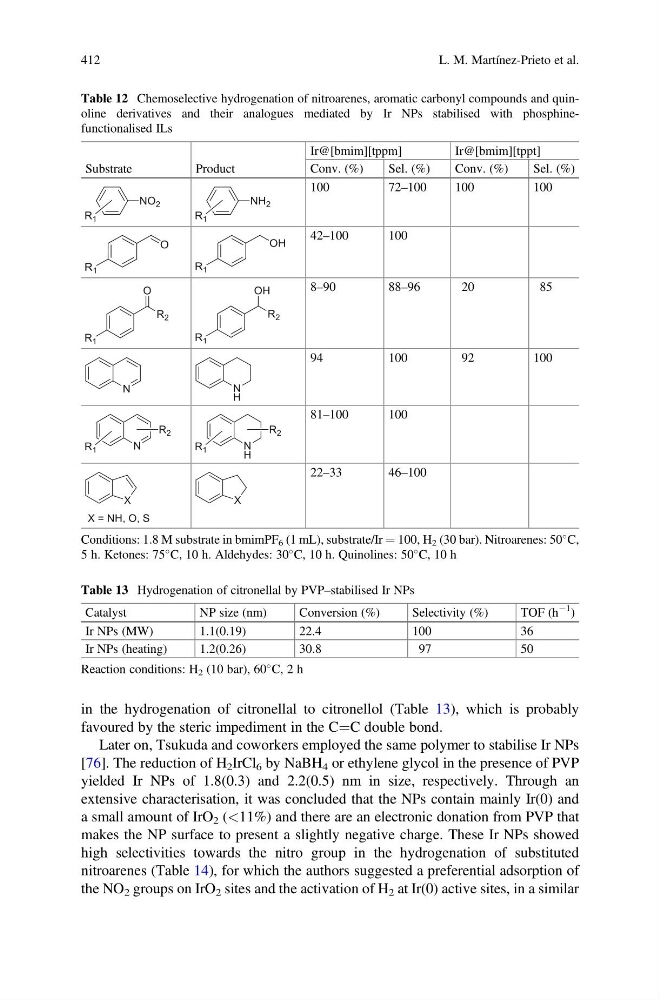
in the hydrogenation of citronellal to citronellol (Table 13), which is probably
favoured by the steric impediment in the C¼C double bond.
Later on, Tsukuda and coworkers employed the same polymer to stabilise Ir NPs
[76]. The reduction of H 2 IrCl 6 by NaBH 4 or ethylene glycol in the presence of PVP
yielded Ir NPs of 1.8(0.3) and 2.2(0.5) nm in size, respectively. Through an
extensive characterisation, it was concluded that the NPs contain mainly Ir(0) and
a small amount of IrO 2 (<11%) and there are an electronic donation from PVP that
makes the NP surface to present a slightly negative charge. These Ir NPs showed
high selectivities towards the nitro group in the hydrogenation of substituted
nitroarenes (Table 14), for which the authors suggested a preferential adsorption of
the NO 2 groups on IrO 2 sites and the activation of H 2 at Ir(0) active sites, in a similar
Table 12 Chemoselective hydrogenation of nitroarenes, aromatic carbonyl compounds and quinoline derivatives and their analogues mediated by Ir NPs stabilised with phosphinefunctionalised ILs
Substrate
Product
Ir@[bmim][tppm]
Ir@[bmim][tppt]
Conv. (%)
Sel. (%)
Conv. (%)
Sel. (%)
100
72–100
100
100
42–100
100
8–90
88–96
20
85
94
100
92
100
81–100
100
22–33
46–100
Conditions: 1.8 M substrate in bmimPF 6 (1 mL), substrate/Ir ¼ 100, H 2 (30 bar). Nitroarenes: 50
C,
5 h. Ketones: 75
C, 10 h. Aldehydes: 30
C, 10 h. Quinolines: 50
C, 10 h
Table 13 Hydrogenation of citronellal by PVP–stabilised Ir NPs
Catalyst
NP size (nm)
Conversion (%)
Selectivity (%)
TOF (h
À1
)
Ir NPs (MW)
1.1(0.19)
22.4
100
36
Ir NPs (heating)
1.2(0.26)
30.8
97
50
Reaction conditions: H 2 (10 bar), 60
C, 2 h
412
L. M. Martínez-Prieto et al.
favoured by the steric impediment in the C¼C double bond.
Later on, Tsukuda and coworkers employed the same polymer to stabilise Ir NPs
[76]. The reduction of H 2 IrCl 6 by NaBH 4 or ethylene glycol in the presence of PVP
yielded Ir NPs of 1.8(0.3) and 2.2(0.5) nm in size, respectively. Through an
extensive characterisation, it was concluded that the NPs contain mainly Ir(0) and
a small amount of IrO 2 (<11%) and there are an electronic donation from PVP that
makes the NP surface to present a slightly negative charge. These Ir NPs showed
high selectivities towards the nitro group in the hydrogenation of substituted
nitroarenes (Table 14), for which the authors suggested a preferential adsorption of
the NO 2 groups on IrO 2 sites and the activation of H 2 at Ir(0) active sites, in a similar
Table 12 Chemoselective hydrogenation of nitroarenes, aromatic carbonyl compounds and quinoline derivatives and their analogues mediated by Ir NPs stabilised with phosphinefunctionalised ILs
Substrate
Product
Ir@[bmim][tppm]
Ir@[bmim][tppt]
Conv. (%)
Sel. (%)
Conv. (%)
Sel. (%)
100
72–100
100
100
42–100
100
8–90
88–96
20
85
94
100
92
100
81–100
100
22–33
46–100
Conditions: 1.8 M substrate in bmimPF 6 (1 mL), substrate/Ir ¼ 100, H 2 (30 bar). Nitroarenes: 50
C,
5 h. Ketones: 75
C, 10 h. Aldehydes: 30
C, 10 h. Quinolines: 50
C, 10 h
Table 13 Hydrogenation of citronellal by PVP–stabilised Ir NPs
Catalyst
NP size (nm)
Conversion (%)
Selectivity (%)
TOF (h
À1
)
Ir NPs (MW)
1.1(0.19)
22.4
100
36
Ir NPs (heating)
1.2(0.26)
30.8
97
50
Reaction conditions: H 2 (10 bar), 60
C, 2 h
412
L. M. Martínez-Prieto et al.