

or surface which does not necessarily correspond to the smallest NPs. However, no
insights about this proposal were given.
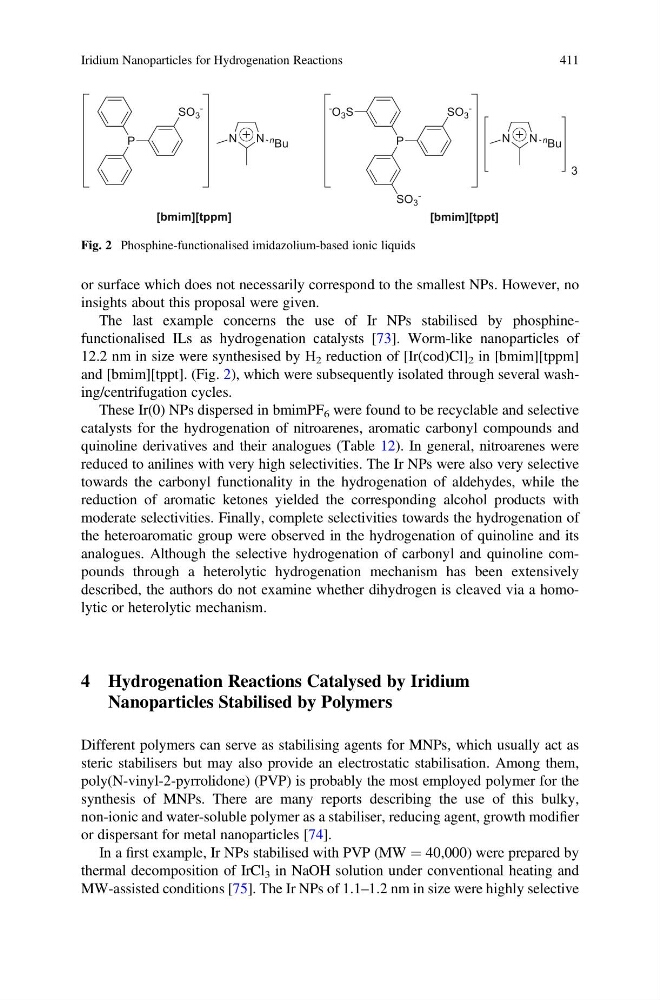
The last example concerns the use of Ir NPs stabilised by phosphinefunctionalised ILs as hydrogenation catalysts [73]. Worm-like nanoparticles of
12.2 nm in size were synthesised by H 2 reduction of [Ir(cod)Cl] 2 in [bmim][tppm]
and [bmim][tppt]. (Fig. 2), which were subsequently isolated through several washing/centrifugation cycles.
These Ir(0) NPs dispersed in bmimPF 6 were found to be recyclable and selective
catalysts for the hydrogenation of nitroarenes, aromatic carbonyl compounds and
quinoline derivatives and their analogues (Table 12). In general, nitroarenes were
reduced to anilines with very high selectivities. The Ir NPs were also very selective
towards the carbonyl functionality in the hydrogenation of aldehydes, while the
reduction of aromatic ketones yielded the corresponding alcohol products with
moderate selectivities. Finally, complete selectivities towards the hydrogenation of
the heteroaromatic group were observed in the hydrogenation of quinoline and its
analogues. Although the selective hydrogenation of carbonyl and quinoline compounds through a heterolytic hydrogenation mechanism has been extensively
described, the authors do not examine whether dihydrogen is cleaved via a homolytic or heterolytic mechanism.
4 Hydrogenation Reactions Catalysed by Iridium
Nanoparticles Stabilised by Polymers
Different polymers can serve as stabilising agents for MNPs, which usually act as
steric stabilisers but may also provide an electrostatic stabilisation. Among them,
poly(N-vinyl-2-pyrrolidone) (PVP) is probably the most employed polymer for the
synthesis of MNPs. There are many reports describing the use of this bulky,
non-ionic and water-soluble polymer as a stabiliser, reducing agent, growth modifier
or dispersant for metal nanoparticles [74].
In a first example, Ir NPs stabilised with PVP (MW ¼ 40,000) were prepared by
thermal decomposition of IrCl 3 in NaOH solution under conventional heating and
MW-assisted conditions [75]. The Ir NPs of 1.1–1.2 nm in size were highly selective
Fig. 2 Phosphine-functionalised imidazolium-based ionic liquids
Iridium Nanoparticles for Hydrogenation Reactions
411
insights about this proposal were given.
The last example concerns the use of Ir NPs stabilised by phosphinefunctionalised ILs as hydrogenation catalysts [73]. Worm-like nanoparticles of
12.2 nm in size were synthesised by H 2 reduction of [Ir(cod)Cl] 2 in [bmim][tppm]
and [bmim][tppt]. (Fig. 2), which were subsequently isolated through several washing/centrifugation cycles.
These Ir(0) NPs dispersed in bmimPF 6 were found to be recyclable and selective
catalysts for the hydrogenation of nitroarenes, aromatic carbonyl compounds and
quinoline derivatives and their analogues (Table 12). In general, nitroarenes were
reduced to anilines with very high selectivities. The Ir NPs were also very selective
towards the carbonyl functionality in the hydrogenation of aldehydes, while the
reduction of aromatic ketones yielded the corresponding alcohol products with
moderate selectivities. Finally, complete selectivities towards the hydrogenation of
the heteroaromatic group were observed in the hydrogenation of quinoline and its
analogues. Although the selective hydrogenation of carbonyl and quinoline compounds through a heterolytic hydrogenation mechanism has been extensively
described, the authors do not examine whether dihydrogen is cleaved via a homolytic or heterolytic mechanism.
4 Hydrogenation Reactions Catalysed by Iridium
Nanoparticles Stabilised by Polymers
Different polymers can serve as stabilising agents for MNPs, which usually act as
steric stabilisers but may also provide an electrostatic stabilisation. Among them,
poly(N-vinyl-2-pyrrolidone) (PVP) is probably the most employed polymer for the
synthesis of MNPs. There are many reports describing the use of this bulky,
non-ionic and water-soluble polymer as a stabiliser, reducing agent, growth modifier
or dispersant for metal nanoparticles [74].
In a first example, Ir NPs stabilised with PVP (MW ¼ 40,000) were prepared by
thermal decomposition of IrCl 3 in NaOH solution under conventional heating and
MW-assisted conditions [75]. The Ir NPs of 1.1–1.2 nm in size were highly selective
Fig. 2 Phosphine-functionalised imidazolium-based ionic liquids
Iridium Nanoparticles for Hydrogenation Reactions
411