

The iridium catalysts were successfully recycled up to seven times, but an improved
recyclability was observed for the polymeric catalytic systems.
In addition, it is worth noting the work of Janiak and coworkers, in which Ir NPs
stabilised in bmimX (X ¼ BF 4 , OTf) and BtMANTf 2 (BtMA ¼ n-butyl-tri-methylammonium) were synthesised by thermal decomposition of Ir 4 (CO) 12 [70]. Welldispersed Ir NPs of 1.1–3.6 nm in size were obtained in bmimX, while the use of
BtMANTf 2 as stabilising media led to highly agglomerated Ir NPs. The resulting
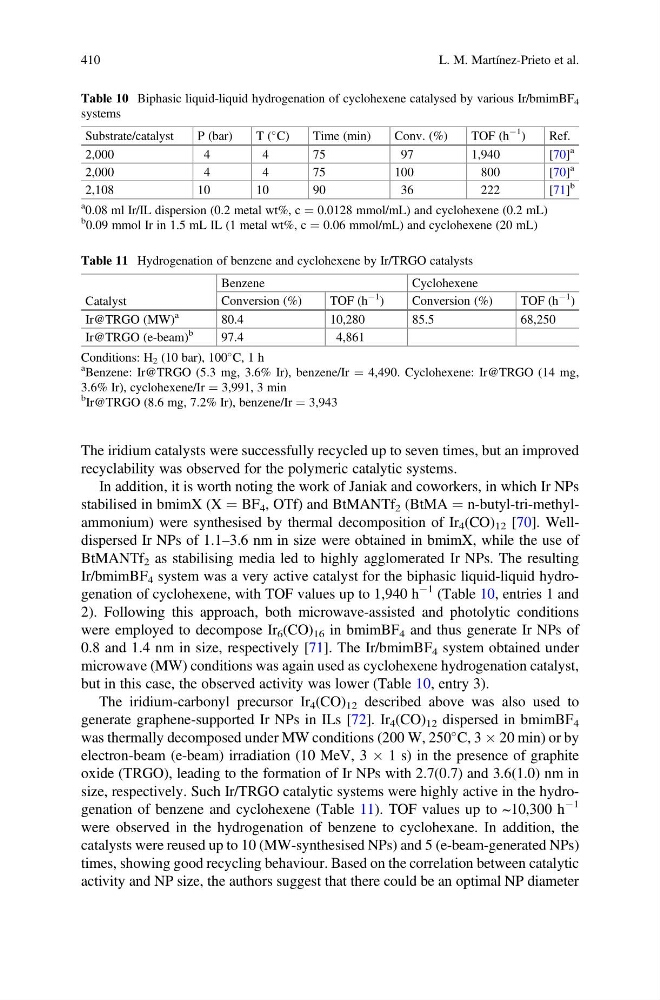
Ir/bmimBF 4 system was a very active catalyst for the biphasic liquid-liquid hydrogenation of cyclohexene, with TOF values up to 1,940 h
À1 (Table 10, entries 1 and
2). Following this approach, both microwave-assisted and photolytic conditions
were employed to decompose Ir 6 (CO) 16 in bmimBF 4 and thus generate Ir NPs of
0.8 and 1.4 nm in size, respectively [71]. The Ir/bmimBF 4 system obtained under
microwave (MW) conditions was again used as cyclohexene hydrogenation catalyst,
but in this case, the observed activity was lower (Table 10, entry 3).
The iridium-carbonyl precursor Ir 4 (CO) 12 described above was also used to
generate graphene-supported Ir NPs in ILs [72]. Ir 4 (CO) 12 dispersed in bmimBF 4
was thermally decomposed under MW conditions (200 W, 250
C, 3 Â 20 min) or by
electron-beam (e-beam) irradiation (10 MeV, 3 Â 1 s) in the presence of graphite
oxide (TRGO), leading to the formation of Ir NPs with 2.7(0.7) and 3.6(1.0) nm in
size, respectively. Such Ir/TRGO catalytic systems were highly active in the hydrogenation of benzene and cyclohexene (Table 11). TOF values up to ~10,300 h
À1
were observed in the hydrogenation of benzene to cyclohexane. In addition, the
catalysts were reused up to 10 (MW-synthesised NPs) and 5 (e-beam-generated NPs)
times, showing good recycling behaviour. Based on the correlation between catalytic
activity and NP size, the authors suggest that there could be an optimal NP diameter
Table 10 Biphasic liquid-liquid hydrogenation of cyclohexene catalysed by various Ir/bmimBF 4
systems
Substrate/catalyst
P (bar)
T (
C)
Time (min)
Conv. (%)
TOF (h
À1
)
Ref.
2,000
4
4
75
97
1,940
[70]
a
2,000
4
4
75
100
800
[70]
a
2,108
10
10
90
36
222
[71]
b
a 0.08 ml Ir/IL dispersion (0.2 metal wt%, c ¼ 0.0128 mmol/mL) and cyclohexene (0.2 mL)
b
0.09 mmol Ir in 1.5 mL IL (1 metal wt%, c ¼ 0.06 mmol/mL) and cyclohexene (20 mL)
Table 11 Hydrogenation of benzene and cyclohexene by Ir/TRGO catalysts
Catalyst
Benzene
Cyclohexene
Conversion (%)
TOF (h
À1
)
Conversion (%)
TOF (h
À1
)
Ir@TRGO (MW)
a
80.4
10,280
85.5
68,250
Ir@TRGO (e-beam)
b
97.4
4,861
Conditions: H 2 (10 bar), 100
C, 1 h
a Benzene: Ir@TRGO (5.3 mg, 3.6% Ir), benzene/Ir ¼ 4,490. Cyclohexene: Ir@TRGO (14 mg,
3.6% Ir), cyclohexene/Ir ¼ 3,991, 3 min
b
Ir@TRGO (8.6 mg, 7.2% Ir), benzene/Ir ¼ 3,943
410
L. M. Martínez-Prieto et al.
recyclability was observed for the polymeric catalytic systems.
In addition, it is worth noting the work of Janiak and coworkers, in which Ir NPs
stabilised in bmimX (X ¼ BF 4 , OTf) and BtMANTf 2 (BtMA ¼ n-butyl-tri-methylammonium) were synthesised by thermal decomposition of Ir 4 (CO) 12 [70]. Welldispersed Ir NPs of 1.1–3.6 nm in size were obtained in bmimX, while the use of
BtMANTf 2 as stabilising media led to highly agglomerated Ir NPs. The resulting
Ir/bmimBF 4 system was a very active catalyst for the biphasic liquid-liquid hydrogenation of cyclohexene, with TOF values up to 1,940 h
À1 (Table 10, entries 1 and
2). Following this approach, both microwave-assisted and photolytic conditions
were employed to decompose Ir 6 (CO) 16 in bmimBF 4 and thus generate Ir NPs of
0.8 and 1.4 nm in size, respectively [71]. The Ir/bmimBF 4 system obtained under
microwave (MW) conditions was again used as cyclohexene hydrogenation catalyst,
but in this case, the observed activity was lower (Table 10, entry 3).
The iridium-carbonyl precursor Ir 4 (CO) 12 described above was also used to
generate graphene-supported Ir NPs in ILs [72]. Ir 4 (CO) 12 dispersed in bmimBF 4
was thermally decomposed under MW conditions (200 W, 250
C, 3 Â 20 min) or by
electron-beam (e-beam) irradiation (10 MeV, 3 Â 1 s) in the presence of graphite
oxide (TRGO), leading to the formation of Ir NPs with 2.7(0.7) and 3.6(1.0) nm in
size, respectively. Such Ir/TRGO catalytic systems were highly active in the hydrogenation of benzene and cyclohexene (Table 11). TOF values up to ~10,300 h
À1
were observed in the hydrogenation of benzene to cyclohexane. In addition, the
catalysts were reused up to 10 (MW-synthesised NPs) and 5 (e-beam-generated NPs)
times, showing good recycling behaviour. Based on the correlation between catalytic
activity and NP size, the authors suggest that there could be an optimal NP diameter
Table 10 Biphasic liquid-liquid hydrogenation of cyclohexene catalysed by various Ir/bmimBF 4
systems
Substrate/catalyst
P (bar)
T (
C)
Time (min)
Conv. (%)
TOF (h
À1
)
Ref.
2,000
4
4
75
97
1,940
[70]
a
2,000
4
4
75
100
800
[70]
a
2,108
10
10
90
36
222
[71]
b
a 0.08 ml Ir/IL dispersion (0.2 metal wt%, c ¼ 0.0128 mmol/mL) and cyclohexene (0.2 mL)
b
0.09 mmol Ir in 1.5 mL IL (1 metal wt%, c ¼ 0.06 mmol/mL) and cyclohexene (20 mL)
Table 11 Hydrogenation of benzene and cyclohexene by Ir/TRGO catalysts
Catalyst
Benzene
Cyclohexene
Conversion (%)
TOF (h
À1
)
Conversion (%)
TOF (h
À1
)
Ir@TRGO (MW)
a
80.4
10,280
85.5
68,250
Ir@TRGO (e-beam)
b
97.4
4,861
Conditions: H 2 (10 bar), 100
C, 1 h
a Benzene: Ir@TRGO (5.3 mg, 3.6% Ir), benzene/Ir ¼ 4,490. Cyclohexene: Ir@TRGO (14 mg,
3.6% Ir), cyclohexene/Ir ¼ 3,991, 3 min
b
Ir@TRGO (8.6 mg, 7.2% Ir), benzene/Ir ¼ 3,943
410
L. M. Martínez-Prieto et al.