

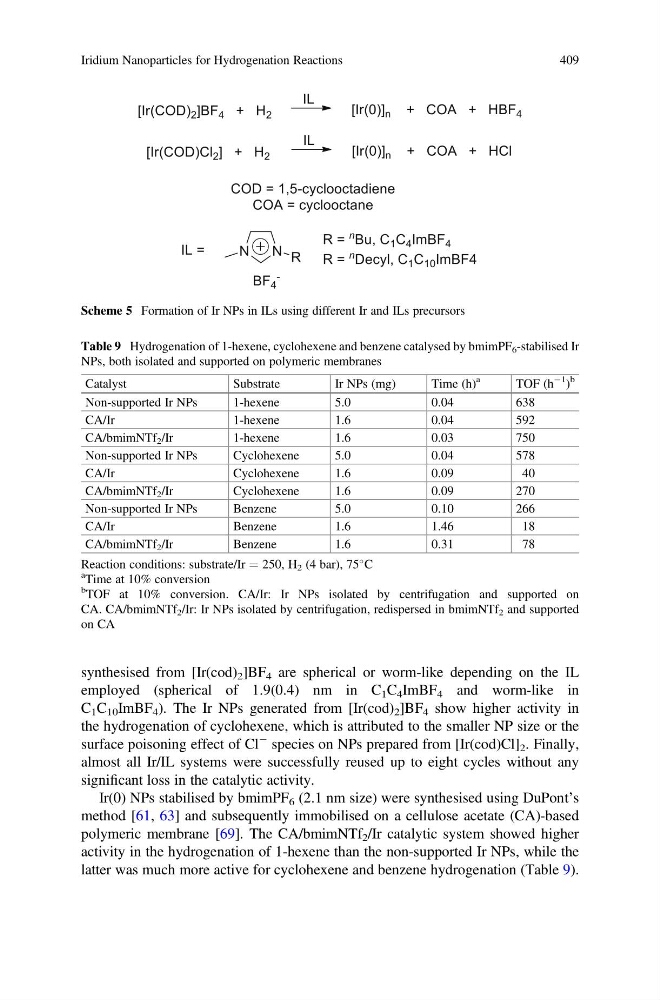
synthesised from [Ir(cod) 2 ]BF 4 are spherical or worm-like depending on the IL
employed (spherical of 1.9(0.4) nm in C 1 C 4 ImBF 4 and worm-like in
C 1 C 10 ImBF 4 ). The Ir NPs generated from [Ir(cod) 2 ]BF 4 show higher activity in
the hydrogenation of cyclohexene, which is attributed to the smaller NP size or the
surface poisoning effect of Cl
À species on NPs prepared from [Ir(cod)Cl] 2 . Finally,
almost all Ir/IL systems were successfully reused up to eight cycles without any
significant loss in the catalytic activity.
Ir(0) NPs stabilised by bmimPF 6 (2.1 nm size) were synthesised using DuPont’s
method [61, 63] and subsequently immobilised on a cellulose acetate (CA)-based
polymeric membrane [69]. The CA/bmimNTf 2 /Ir catalytic system showed higher
activity in the hydrogenation of 1-hexene than the non-supported Ir NPs, while the
latter was much more active for cyclohexene and benzene hydrogenation (Table 9).
Scheme 5 Formation of Ir NPs in ILs using different Ir and ILs precursors
Table 9 Hydrogenation of 1-hexene, cyclohexene and benzene catalysed by bmimPF 6 -stabilised Ir
NPs, both isolated and supported on polymeric membranes
Catalyst
Substrate
Ir NPs (mg)
Time (h)
a
TOF (h
À1
)
b
Non-supported Ir NPs
1-hexene
5.0
0.04
638
CA/Ir
1-hexene
1.6
0.04
592
CA/bmimNTf 2 /Ir
1-hexene
1.6
0.03
750
Non-supported Ir NPs
Cyclohexene
5.0
0.04
578
CA/Ir
Cyclohexene
1.6
0.09
40
CA/bmimNTf 2 /Ir
Cyclohexene
1.6
0.09
270
Non-supported Ir NPs
Benzene
5.0
0.10
266
CA/Ir
Benzene
1.6
1.46
18
CA/bmimNTf 2 /Ir
Benzene
1.6
0.31
78
Reaction conditions: substrate/Ir ¼ 250, H 2 (4 bar), 75
C
a Time at 10% conversion
b
TOF at 10% conversion. CA/Ir: Ir NPs isolated by centrifugation and supported on
CA. CA/bmimNTf 2 /Ir: Ir NPs isolated by centrifugation, redispersed in bmimNTf 2 and supported
on CA
Iridium Nanoparticles for Hydrogenation Reactions
409
employed (spherical of 1.9(0.4) nm in C 1 C 4 ImBF 4 and worm-like in
C 1 C 10 ImBF 4 ). The Ir NPs generated from [Ir(cod) 2 ]BF 4 show higher activity in
the hydrogenation of cyclohexene, which is attributed to the smaller NP size or the
surface poisoning effect of Cl
À species on NPs prepared from [Ir(cod)Cl] 2 . Finally,
almost all Ir/IL systems were successfully reused up to eight cycles without any
significant loss in the catalytic activity.
Ir(0) NPs stabilised by bmimPF 6 (2.1 nm size) were synthesised using DuPont’s
method [61, 63] and subsequently immobilised on a cellulose acetate (CA)-based
polymeric membrane [69]. The CA/bmimNTf 2 /Ir catalytic system showed higher
activity in the hydrogenation of 1-hexene than the non-supported Ir NPs, while the
latter was much more active for cyclohexene and benzene hydrogenation (Table 9).
Scheme 5 Formation of Ir NPs in ILs using different Ir and ILs precursors
Table 9 Hydrogenation of 1-hexene, cyclohexene and benzene catalysed by bmimPF 6 -stabilised Ir
NPs, both isolated and supported on polymeric membranes
Catalyst
Substrate
Ir NPs (mg)
Time (h)
a
TOF (h
À1
)
b
Non-supported Ir NPs
1-hexene
5.0
0.04
638
CA/Ir
1-hexene
1.6
0.04
592
CA/bmimNTf 2 /Ir
1-hexene
1.6
0.03
750
Non-supported Ir NPs
Cyclohexene
5.0
0.04
578
CA/Ir
Cyclohexene
1.6
0.09
40
CA/bmimNTf 2 /Ir
Cyclohexene
1.6
0.09
270
Non-supported Ir NPs
Benzene
5.0
0.10
266
CA/Ir
Benzene
1.6
1.46
18
CA/bmimNTf 2 /Ir
Benzene
1.6
0.31
78
Reaction conditions: substrate/Ir ¼ 250, H 2 (4 bar), 75
C
a Time at 10% conversion
b
TOF at 10% conversion. CA/Ir: Ir NPs isolated by centrifugation and supported on
CA. CA/bmimNTf 2 /Ir: Ir NPs isolated by centrifugation, redispersed in bmimNTf 2 and supported
on CA
Iridium Nanoparticles for Hydrogenation Reactions
409