

v ¼
k c K S
½
1 þ K S
½
The kinetic studies also showed that the hydrogenation reaction is a mass transfercontrolled process at [H 2 ] < 4 bar. The catalytic kinetic constant (kc) at [H 2 ] ! 4 bar
and the adsorption constant (K ) are independent of H 2 pressure. This reveals that the
hydrogenation process shows no dependence on [H 2 ] and thus is only determined by
[1-decene] in IL.
Later on, the same group demonstrated the participation of N-heterocyclic
carbenes (NHCs) in hydrogenation reactions catalysed by Ir NPs dissolved in
imidazolium-based ionic liquids [67]. bmimNTf 2 -stabilised Ir(0) NPs of 4.2(0.8)
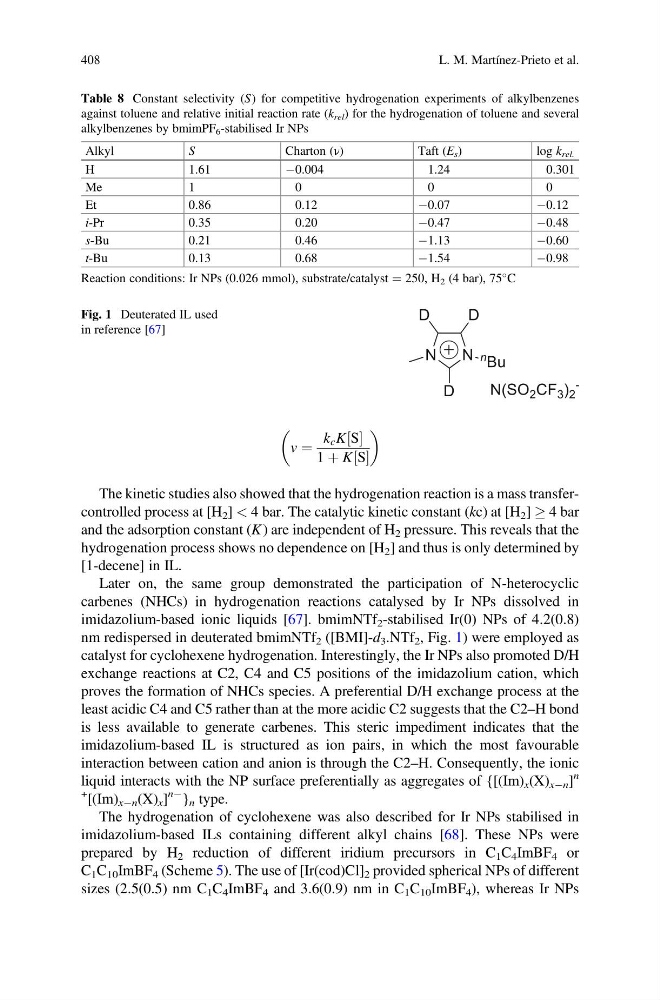
nm redispersed in deuterated bmimNTf 2 ([BMI]-d 3 .NTf 2 , Fig. 1) were employed as
catalyst for cyclohexene hydrogenation. Interestingly, the Ir NPs also promoted D/H
exchange reactions at C2, C4 and C5 positions of the imidazolium cation, which
proves the formation of NHCs species. A preferential D/H exchange process at the
least acidic C4 and C5 rather than at the more acidic C2 suggests that the C2–H bond
is less available to generate carbenes. This steric impediment indicates that the
imidazolium-based IL is structured as ion pairs, in which the most favourable
interaction between cation and anion is through the C2–H. Consequently, the ionic
liquid interacts with the NP surface preferentially as aggregates of {[(Im) x (X) xÀn ]
n
+
[(Im) xÀn (X) x ]
nÀ
} n type.
The hydrogenation of cyclohexene was also described for Ir NPs stabilised in
imidazolium-based ILs containing different alkyl chains [68]. These NPs were
prepared by H 2 reduction of different iridium precursors in C 1 C 4 ImBF 4 or
C 1 C 10 ImBF 4 (Scheme 5). The use of [Ir(cod)Cl] 2 provided spherical NPs of different
sizes (2.5(0.5) nm C 1 C 4 ImBF 4 and 3.6(0.9) nm in C 1 C 10 ImBF 4 ), whereas Ir NPs
Table 8 Constant selectivity (S) for competitive hydrogenation experiments of alkylbenzenes
against toluene and relative initial reaction rate (k rel ) for the hydrogenation of toluene and several
alkylbenzenes by bmimPF 6 -stabilised Ir NPs
Alkyl
S
Charton (ν)
Taft (E s )
log k rel.
H
1.61
À0.004
1.24
0.301
Me
1
0
0
0
Et
0.86
0.12
À0.07
À0.12
i-Pr
0.35
0.20
À0.47
À0.48
s-Bu
0.21
0.46
À1.13
À0.60
t-Bu
0.13
0.68
À1.54
À0.98
Reaction conditions: Ir NPs (0.026 mmol), substrate/catalyst ¼ 250, H 2 (4 bar), 75
C
Fig. 1 Deuterated IL used
in reference [67]
408
L. M. Martínez-Prieto et al.
k c K S
½
1 þ K S
½
The kinetic studies also showed that the hydrogenation reaction is a mass transfercontrolled process at [H 2 ] < 4 bar. The catalytic kinetic constant (kc) at [H 2 ] ! 4 bar
and the adsorption constant (K ) are independent of H 2 pressure. This reveals that the
hydrogenation process shows no dependence on [H 2 ] and thus is only determined by
[1-decene] in IL.
Later on, the same group demonstrated the participation of N-heterocyclic
carbenes (NHCs) in hydrogenation reactions catalysed by Ir NPs dissolved in
imidazolium-based ionic liquids [67]. bmimNTf 2 -stabilised Ir(0) NPs of 4.2(0.8)
nm redispersed in deuterated bmimNTf 2 ([BMI]-d 3 .NTf 2 , Fig. 1) were employed as
catalyst for cyclohexene hydrogenation. Interestingly, the Ir NPs also promoted D/H
exchange reactions at C2, C4 and C5 positions of the imidazolium cation, which
proves the formation of NHCs species. A preferential D/H exchange process at the
least acidic C4 and C5 rather than at the more acidic C2 suggests that the C2–H bond
is less available to generate carbenes. This steric impediment indicates that the
imidazolium-based IL is structured as ion pairs, in which the most favourable
interaction between cation and anion is through the C2–H. Consequently, the ionic
liquid interacts with the NP surface preferentially as aggregates of {[(Im) x (X) xÀn ]
n
+
[(Im) xÀn (X) x ]
nÀ
} n type.
The hydrogenation of cyclohexene was also described for Ir NPs stabilised in
imidazolium-based ILs containing different alkyl chains [68]. These NPs were
prepared by H 2 reduction of different iridium precursors in C 1 C 4 ImBF 4 or
C 1 C 10 ImBF 4 (Scheme 5). The use of [Ir(cod)Cl] 2 provided spherical NPs of different
sizes (2.5(0.5) nm C 1 C 4 ImBF 4 and 3.6(0.9) nm in C 1 C 10 ImBF 4 ), whereas Ir NPs
Table 8 Constant selectivity (S) for competitive hydrogenation experiments of alkylbenzenes
against toluene and relative initial reaction rate (k rel ) for the hydrogenation of toluene and several
alkylbenzenes by bmimPF 6 -stabilised Ir NPs
Alkyl
S
Charton (ν)
Taft (E s )
log k rel.
H
1.61
À0.004
1.24
0.301
Me
1
0
0
0
Et
0.86
0.12
À0.07
À0.12
i-Pr
0.35
0.20
À0.47
À0.48
s-Bu
0.21
0.46
À1.13
À0.60
t-Bu
0.13
0.68
À1.54
À0.98
Reaction conditions: Ir NPs (0.026 mmol), substrate/catalyst ¼ 250, H 2 (4 bar), 75
C
Fig. 1 Deuterated IL used
in reference [67]
408
L. M. Martínez-Prieto et al.