

way to previous reports on nitroarene reduction mediated by MNPs supported on
metal oxides [77, 78].
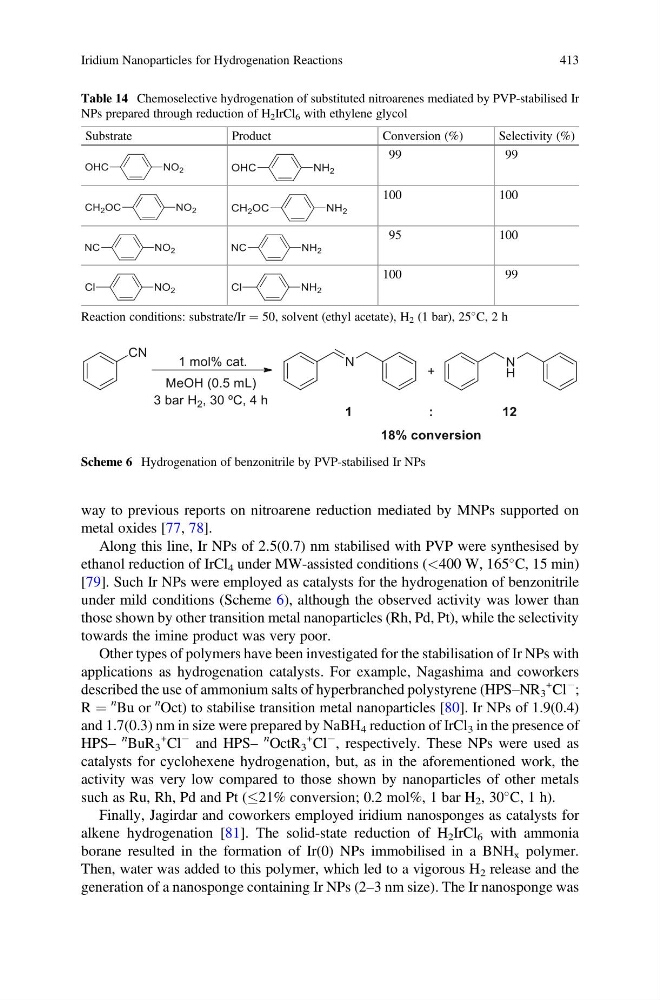
Along this line, Ir NPs of 2.5(0.7) nm stabilised with PVP were synthesised by
ethanol reduction of IrCl 4 under MW-assisted conditions (<400 W, 165
C, 15 min)
[79]. Such Ir NPs were employed as catalysts for the hydrogenation of benzonitrile
under mild conditions (Scheme 6), although the observed activity was lower than
those shown by other transition metal nanoparticles (Rh, Pd, Pt), while the selectivity
towards the imine product was very poor.
Other types of polymers have been investigated for the stabilisation of Ir NPs with
applications as hydrogenation catalysts. For example, Nagashima and coworkers
described the use of ammonium salts of hyperbranched polystyrene (HPS–NR 3
+ Cl
À
;
R ¼
n Bu or
n Oct) to stabilise transition metal nanoparticles [80]. Ir NPs of 1.9(0.4)
and 1.7(0.3) nm in size were prepared by NaBH 4 reduction of IrCl 3 in the presence of
HPS–
n BuR 3
+
Cl
À and HPS–
n OctR 3
+ Cl
À
, respectively. These NPs were used as
catalysts for cyclohexene hydrogenation, but, as in the aforementioned work, the
activity was very low compared to those shown by nanoparticles of other metals
such as Ru, Rh, Pd and Pt ( 21% conversion; 0.2 mol%, 1 bar H 2 , 30
C, 1 h).
Finally, Jagirdar and coworkers employed iridium nanosponges as catalysts for
alkene hydrogenation [81]. The solid-state reduction of H 2 IrCl 6 with ammonia
borane resulted in the formation of Ir(0) NPs immobilised in a BNH x polymer.
Then, water was added to this polymer, which led to a vigorous H 2 release and the
generation of a nanosponge containing Ir NPs (2–3 nm size). The Ir nanosponge was
Table 14 Chemoselective hydrogenation of substituted nitroarenes mediated by PVP-stabilised Ir
NPs prepared through reduction of H 2 IrCl 6 with ethylene glycol
Substrate
Product
Conversion (%)
Selectivity (%)
99
99
100
100
95
100
100
99
Reaction conditions: substrate/Ir ¼ 50, solvent (ethyl acetate), H 2 (1 bar), 25
C, 2 h
Scheme 6 Hydrogenation of benzonitrile by PVP-stabilised Ir NPs
Iridium Nanoparticles for Hydrogenation Reactions
413
metal oxides [77, 78].
Along this line, Ir NPs of 2.5(0.7) nm stabilised with PVP were synthesised by
ethanol reduction of IrCl 4 under MW-assisted conditions (<400 W, 165
C, 15 min)
[79]. Such Ir NPs were employed as catalysts for the hydrogenation of benzonitrile
under mild conditions (Scheme 6), although the observed activity was lower than
those shown by other transition metal nanoparticles (Rh, Pd, Pt), while the selectivity
towards the imine product was very poor.
Other types of polymers have been investigated for the stabilisation of Ir NPs with
applications as hydrogenation catalysts. For example, Nagashima and coworkers
described the use of ammonium salts of hyperbranched polystyrene (HPS–NR 3
+ Cl
À
;
R ¼
n Bu or
n Oct) to stabilise transition metal nanoparticles [80]. Ir NPs of 1.9(0.4)
and 1.7(0.3) nm in size were prepared by NaBH 4 reduction of IrCl 3 in the presence of
HPS–
n BuR 3
+
Cl
À and HPS–
n OctR 3
+ Cl
À
, respectively. These NPs were used as
catalysts for cyclohexene hydrogenation, but, as in the aforementioned work, the
activity was very low compared to those shown by nanoparticles of other metals
such as Ru, Rh, Pd and Pt ( 21% conversion; 0.2 mol%, 1 bar H 2 , 30
C, 1 h).
Finally, Jagirdar and coworkers employed iridium nanosponges as catalysts for
alkene hydrogenation [81]. The solid-state reduction of H 2 IrCl 6 with ammonia
borane resulted in the formation of Ir(0) NPs immobilised in a BNH x polymer.
Then, water was added to this polymer, which led to a vigorous H 2 release and the
generation of a nanosponge containing Ir NPs (2–3 nm size). The Ir nanosponge was
Table 14 Chemoselective hydrogenation of substituted nitroarenes mediated by PVP-stabilised Ir
NPs prepared through reduction of H 2 IrCl 6 with ethylene glycol
Substrate
Product
Conversion (%)
Selectivity (%)
99
99
100
100
95
100
100
99
Reaction conditions: substrate/Ir ¼ 50, solvent (ethyl acetate), H 2 (1 bar), 25
C, 2 h
Scheme 6 Hydrogenation of benzonitrile by PVP-stabilised Ir NPs
Iridium Nanoparticles for Hydrogenation Reactions
413