

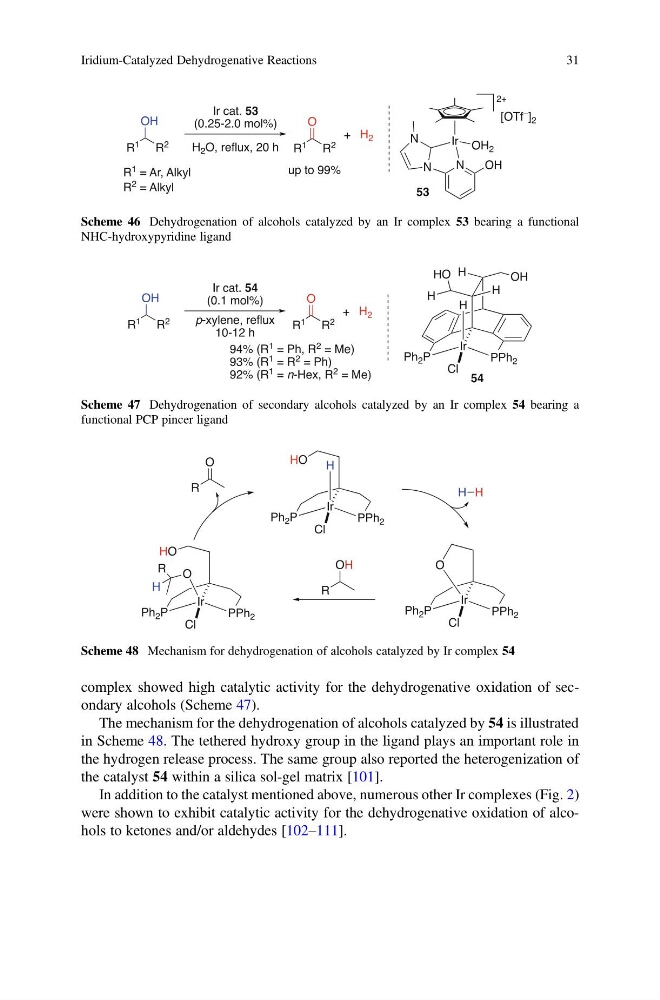
complex showed high catalytic activity for the dehydrogenative oxidation of secondary alcohols (Scheme 47).
The mechanism for the dehydrogenation of alcohols catalyzed by 54 is illustrated
in Scheme 48. The tethered hydroxy group in the ligand plays an important role in
the hydrogen release process. The same group also reported the heterogenization of
the catalyst 54 within a silica sol-gel matrix [101].
In addition to the catalyst mentioned above, numerous other Ir complexes (Fig. 2)
were shown to exhibit catalytic activity for the dehydrogenative oxidation of alcohols to ketones and/or aldehydes [102–111].
Scheme 46 Dehydrogenation of alcohols catalyzed by an Ir complex 53 bearing a functional
NHC-hydroxypyridine ligand
Scheme 47 Dehydrogenation of secondary alcohols catalyzed by an Ir complex 54 bearing a
functional PCP pincer ligand
Scheme 48 Mechanism for dehydrogenation of alcohols catalyzed by Ir complex 54
Iridium-Catalyzed Dehydrogenative Reactions
31
The mechanism for the dehydrogenation of alcohols catalyzed by 54 is illustrated
in Scheme 48. The tethered hydroxy group in the ligand plays an important role in
the hydrogen release process. The same group also reported the heterogenization of
the catalyst 54 within a silica sol-gel matrix [101].
In addition to the catalyst mentioned above, numerous other Ir complexes (Fig. 2)
were shown to exhibit catalytic activity for the dehydrogenative oxidation of alcohols to ketones and/or aldehydes [102–111].
Scheme 46 Dehydrogenation of alcohols catalyzed by an Ir complex 53 bearing a functional
NHC-hydroxypyridine ligand
Scheme 47 Dehydrogenation of secondary alcohols catalyzed by an Ir complex 54 bearing a
functional PCP pincer ligand
Scheme 48 Mechanism for dehydrogenation of alcohols catalyzed by Ir complex 54
Iridium-Catalyzed Dehydrogenative Reactions
31