

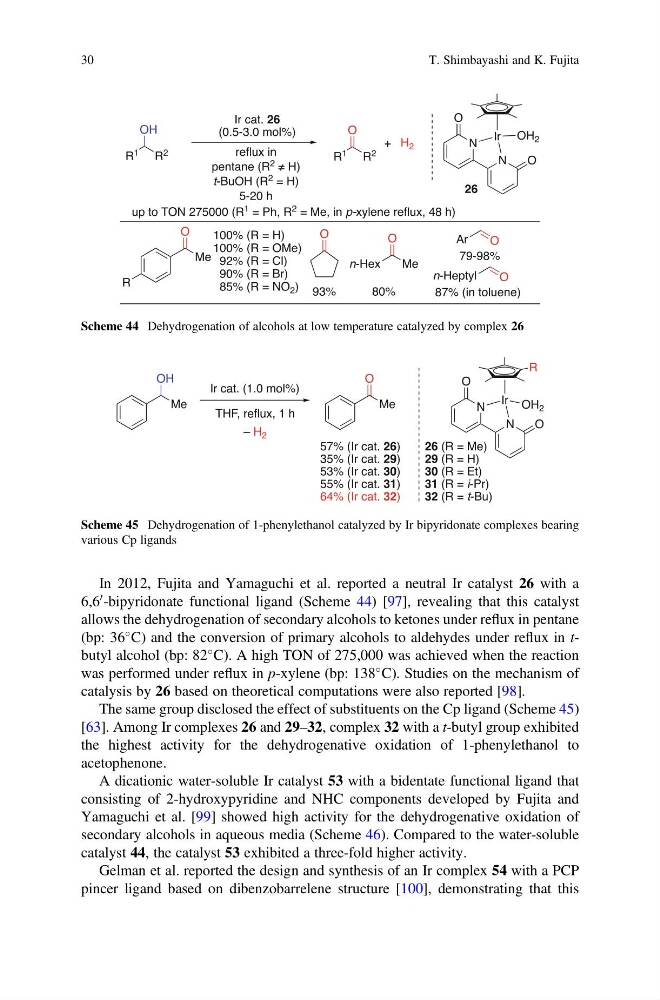
In 2012, Fujita and Yamaguchi et al. reported a neutral Ir catalyst 26 with a
6,6
0 -bipyridonate functional ligand (Scheme 44) [97], revealing that this catalyst
allows the dehydrogenation of secondary alcohols to ketones under reflux in pentane
(bp: 36
C) and the conversion of primary alcohols to aldehydes under reflux in tbutyl alcohol (bp: 82
C). A high TON of 275,000 was achieved when the reaction
was performed under reflux in p-xylene (bp: 138
C). Studies on the mechanism of
catalysis by 26 based on theoretical computations were also reported [98].
The same group disclosed the effect of substituents on the Cp ligand (Scheme 45)
[63]. Among Ir complexes 26 and 29–32, complex 32 with a t-butyl group exhibited
the highest activity for the dehydrogenative oxidation of 1-phenylethanol to
acetophenone.
A dicationic water-soluble Ir catalyst 53 with a bidentate functional ligand that
consisting of 2-hydroxypyridine and NHC components developed by Fujita and
Yamaguchi et al. [99] showed high activity for the dehydrogenative oxidation of
secondary alcohols in aqueous media (Scheme 46). Compared to the water-soluble
catalyst 44, the catalyst 53 exhibited a three-fold higher activity.
Gelman et al. reported the design and synthesis of an Ir complex 54 with a PCP
pincer ligand based on dibenzobarrelene structure [100], demonstrating that this
Scheme 44 Dehydrogenation of alcohols at low temperature catalyzed by complex 26
Scheme 45 Dehydrogenation of 1-phenylethanol catalyzed by Ir bipyridonate complexes bearing
various Cp ligands
30
T. Shimbayashi and K. Fujita
6,6
0 -bipyridonate functional ligand (Scheme 44) [97], revealing that this catalyst
allows the dehydrogenation of secondary alcohols to ketones under reflux in pentane
(bp: 36
C) and the conversion of primary alcohols to aldehydes under reflux in tbutyl alcohol (bp: 82
C). A high TON of 275,000 was achieved when the reaction
was performed under reflux in p-xylene (bp: 138
C). Studies on the mechanism of
catalysis by 26 based on theoretical computations were also reported [98].
The same group disclosed the effect of substituents on the Cp ligand (Scheme 45)
[63]. Among Ir complexes 26 and 29–32, complex 32 with a t-butyl group exhibited
the highest activity for the dehydrogenative oxidation of 1-phenylethanol to
acetophenone.
A dicationic water-soluble Ir catalyst 53 with a bidentate functional ligand that
consisting of 2-hydroxypyridine and NHC components developed by Fujita and
Yamaguchi et al. [99] showed high activity for the dehydrogenative oxidation of
secondary alcohols in aqueous media (Scheme 46). Compared to the water-soluble
catalyst 44, the catalyst 53 exhibited a three-fold higher activity.
Gelman et al. reported the design and synthesis of an Ir complex 54 with a PCP
pincer ligand based on dibenzobarrelene structure [100], demonstrating that this
Scheme 44 Dehydrogenation of alcohols at low temperature catalyzed by complex 26
Scheme 45 Dehydrogenation of 1-phenylethanol catalyzed by Ir bipyridonate complexes bearing
various Cp ligands
30
T. Shimbayashi and K. Fujita