

of secondary alcohols proceeded well under base-free conditions at a lower loading
of 52.
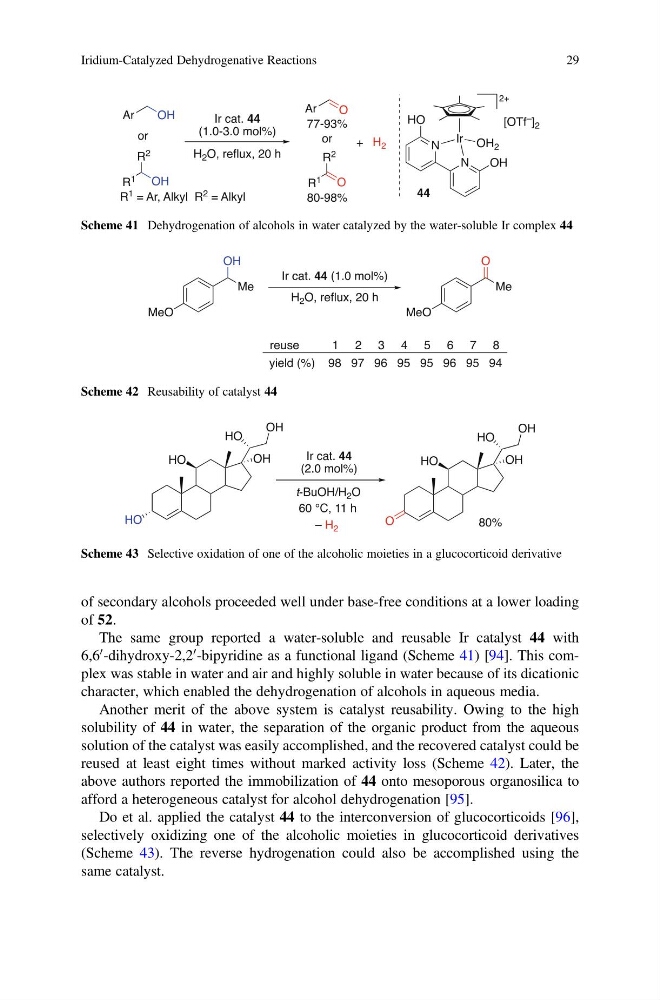
The same group reported a water-soluble and reusable Ir catalyst 44 with
6,6
0 -dihydroxy-2,2
0 -bipyridine as a functional ligand (Scheme 41) [94]. This complex was stable in water and air and highly soluble in water because of its dicationic
character, which enabled the dehydrogenation of alcohols in aqueous media.
Another merit of the above system is catalyst reusability. Owing to the high
solubility of 44 in water, the separation of the organic product from the aqueous
solution of the catalyst was easily accomplished, and the recovered catalyst could be
reused at least eight times without marked activity loss (Scheme 42). Later, the
above authors reported the immobilization of 44 onto mesoporous organosilica to
afford a heterogeneous catalyst for alcohol dehydrogenation [95].
Do et al. applied the catalyst 44 to the interconversion of glucocorticoids [96],
selectively oxidizing one of the alcoholic moieties in glucocorticoid derivatives
(Scheme 43). The reverse hydrogenation could also be accomplished using the
same catalyst.
Scheme 41 Dehydrogenation of alcohols in water catalyzed by the water-soluble Ir complex 44
Scheme 42 Reusability of catalyst 44
Scheme 43 Selective oxidation of one of the alcoholic moieties in a glucocorticoid derivative
Iridium-Catalyzed Dehydrogenative Reactions
29
of 52.
The same group reported a water-soluble and reusable Ir catalyst 44 with
6,6
0 -dihydroxy-2,2
0 -bipyridine as a functional ligand (Scheme 41) [94]. This complex was stable in water and air and highly soluble in water because of its dicationic
character, which enabled the dehydrogenation of alcohols in aqueous media.
Another merit of the above system is catalyst reusability. Owing to the high
solubility of 44 in water, the separation of the organic product from the aqueous
solution of the catalyst was easily accomplished, and the recovered catalyst could be
reused at least eight times without marked activity loss (Scheme 42). Later, the
above authors reported the immobilization of 44 onto mesoporous organosilica to
afford a heterogeneous catalyst for alcohol dehydrogenation [95].
Do et al. applied the catalyst 44 to the interconversion of glucocorticoids [96],
selectively oxidizing one of the alcoholic moieties in glucocorticoid derivatives
(Scheme 43). The reverse hydrogenation could also be accomplished using the
same catalyst.
Scheme 41 Dehydrogenation of alcohols in water catalyzed by the water-soluble Ir complex 44
Scheme 42 Reusability of catalyst 44
Scheme 43 Selective oxidation of one of the alcoholic moieties in a glucocorticoid derivative
Iridium-Catalyzed Dehydrogenative Reactions
29