

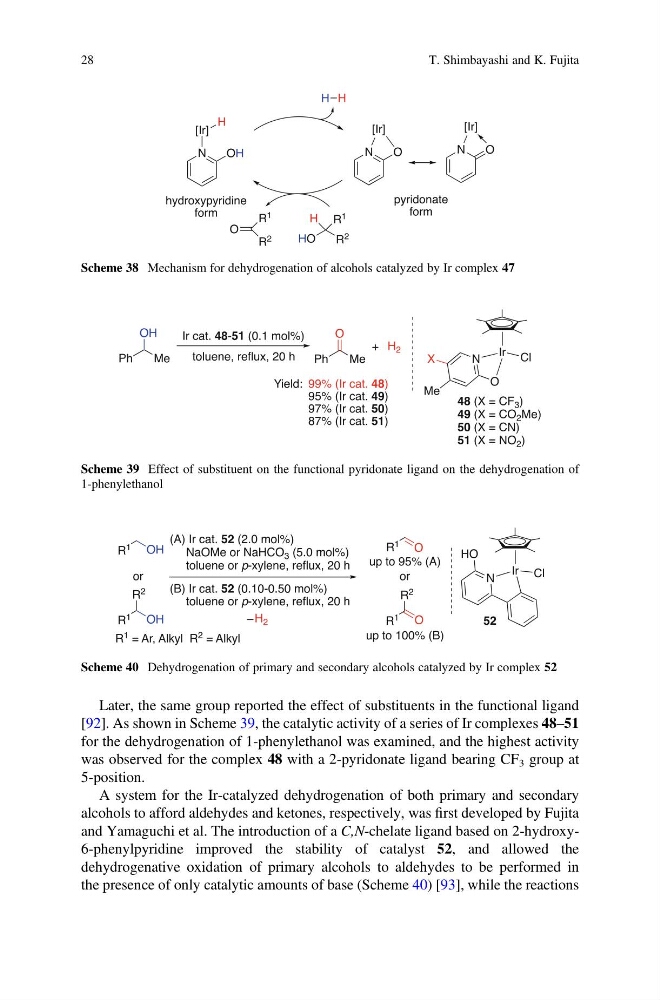
Later, the same group reported the effect of substituents in the functional ligand
[92]. As shown in Scheme 39, the catalytic activity of a series of Ir complexes 48–51
for the dehydrogenation of 1-phenylethanol was examined, and the highest activity
was observed for the complex 48 with a 2-pyridonate ligand bearing CF 3 group at
5-position.
A system for the Ir-catalyzed dehydrogenation of both primary and secondary
alcohols to afford aldehydes and ketones, respectively, was first developed by Fujita
and Yamaguchi et al. The introduction of a C,N-chelate ligand based on 2-hydroxy6-phenylpyridine improved the stability of catalyst 52, and allowed the
dehydrogenative oxidation of primary alcohols to aldehydes to be performed in
the presence of only catalytic amounts of base (Scheme 40) [93], while the reactions
Scheme 38 Mechanism for dehydrogenation of alcohols catalyzed by Ir complex 47
Scheme 39 Effect of substituent on the functional pyridonate ligand on the dehydrogenation of
1-phenylethanol
Scheme 40 Dehydrogenation of primary and secondary alcohols catalyzed by Ir complex 52
28
T. Shimbayashi and K. Fujita
[92]. As shown in Scheme 39, the catalytic activity of a series of Ir complexes 48–51
for the dehydrogenation of 1-phenylethanol was examined, and the highest activity
was observed for the complex 48 with a 2-pyridonate ligand bearing CF 3 group at
5-position.
A system for the Ir-catalyzed dehydrogenation of both primary and secondary
alcohols to afford aldehydes and ketones, respectively, was first developed by Fujita
and Yamaguchi et al. The introduction of a C,N-chelate ligand based on 2-hydroxy6-phenylpyridine improved the stability of catalyst 52, and allowed the
dehydrogenative oxidation of primary alcohols to aldehydes to be performed in
the presence of only catalytic amounts of base (Scheme 40) [93], while the reactions
Scheme 38 Mechanism for dehydrogenation of alcohols catalyzed by Ir complex 47
Scheme 39 Effect of substituent on the functional pyridonate ligand on the dehydrogenation of
1-phenylethanol
Scheme 40 Dehydrogenation of primary and secondary alcohols catalyzed by Ir complex 52
28
T. Shimbayashi and K. Fujita