

absence of oxidants is a better alternative from the viewpoint of environmental
friendliness. In this section, catalytic systems for the dehydrogenative oxidation of
alcohols and related applications in organic synthesis are surveyed.
4.1 Dehydrogenative Oxidation of Alcohols to Aldehydes
and Ketones
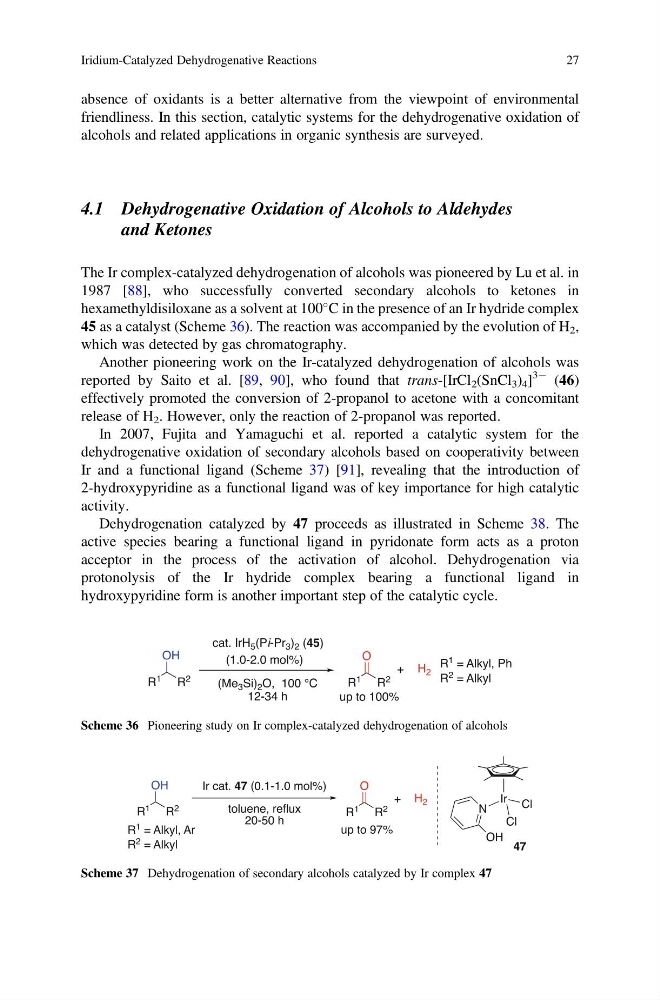
The Ir complex-catalyzed dehydrogenation of alcohols was pioneered by Lu et al. in
1987 [88], who successfully converted secondary alcohols to ketones in
hexamethyldisiloxane as a solvent at 100
C in the presence of an Ir hydride complex
45 as a catalyst (Scheme 36). The reaction was accompanied by the evolution of H 2 ,
which was detected by gas chromatography.
Another pioneering work on the Ir-catalyzed dehydrogenation of alcohols was
reported by Saito et al. [89, 90], who found that trans-[IrCl 2 (SnCl 3 ) 4 ]
3À (46)
effectively promoted the conversion of 2-propanol to acetone with a concomitant
release of H 2 . However, only the reaction of 2-propanol was reported.
In 2007, Fujita and Yamaguchi et al. reported a catalytic system for the
dehydrogenative oxidation of secondary alcohols based on cooperativity between
Ir and a functional ligand (Scheme 37) [91], revealing that the introduction of
2-hydroxypyridine as a functional ligand was of key importance for high catalytic
activity.
Dehydrogenation catalyzed by 47 proceeds as illustrated in Scheme 38. The
active species bearing a functional ligand in pyridonate form acts as a proton
acceptor in the process of the activation of alcohol. Dehydrogenation via
protonolysis of the Ir hydride complex bearing a functional ligand in
hydroxypyridine form is another important step of the catalytic cycle.
Scheme 36 Pioneering study on Ir complex-catalyzed dehydrogenation of alcohols
Scheme 37 Dehydrogenation of secondary alcohols catalyzed by Ir complex 47
Iridium-Catalyzed Dehydrogenative Reactions
27
friendliness. In this section, catalytic systems for the dehydrogenative oxidation of
alcohols and related applications in organic synthesis are surveyed.
4.1 Dehydrogenative Oxidation of Alcohols to Aldehydes
and Ketones
The Ir complex-catalyzed dehydrogenation of alcohols was pioneered by Lu et al. in
1987 [88], who successfully converted secondary alcohols to ketones in
hexamethyldisiloxane as a solvent at 100
C in the presence of an Ir hydride complex
45 as a catalyst (Scheme 36). The reaction was accompanied by the evolution of H 2 ,
which was detected by gas chromatography.
Another pioneering work on the Ir-catalyzed dehydrogenation of alcohols was
reported by Saito et al. [89, 90], who found that trans-[IrCl 2 (SnCl 3 ) 4 ]
3À (46)
effectively promoted the conversion of 2-propanol to acetone with a concomitant
release of H 2 . However, only the reaction of 2-propanol was reported.
In 2007, Fujita and Yamaguchi et al. reported a catalytic system for the
dehydrogenative oxidation of secondary alcohols based on cooperativity between
Ir and a functional ligand (Scheme 37) [91], revealing that the introduction of
2-hydroxypyridine as a functional ligand was of key importance for high catalytic
activity.
Dehydrogenation catalyzed by 47 proceeds as illustrated in Scheme 38. The
active species bearing a functional ligand in pyridonate form acts as a proton
acceptor in the process of the activation of alcohol. Dehydrogenation via
protonolysis of the Ir hydride complex bearing a functional ligand in
hydroxypyridine form is another important step of the catalytic cycle.
Scheme 36 Pioneering study on Ir complex-catalyzed dehydrogenation of alcohols
Scheme 37 Dehydrogenation of secondary alcohols catalyzed by Ir complex 47
Iridium-Catalyzed Dehydrogenative Reactions
27