

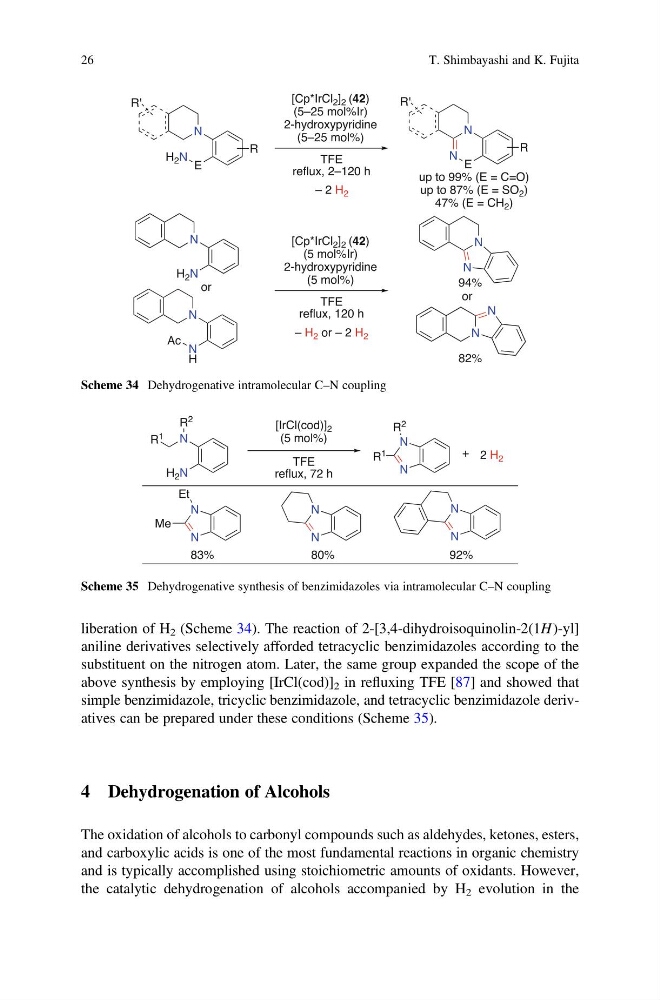
liberation of H 2 (Scheme 34). The reaction of 2-[3,4-dihydroisoquinolin-2(1H )-yl]
aniline derivatives selectively afforded tetracyclic benzimidazoles according to the
substituent on the nitrogen atom. Later, the same group expanded the scope of the
above synthesis by employing [IrCl(cod)] 2 in refluxing TFE [87] and showed that
simple benzimidazole, tricyclic benzimidazole, and tetracyclic benzimidazole derivatives can be prepared under these conditions (Scheme 35).
4 Dehydrogenation of Alcohols
The oxidation of alcohols to carbonyl compounds such as aldehydes, ketones, esters,
and carboxylic acids is one of the most fundamental reactions in organic chemistry
and is typically accomplished using stoichiometric amounts of oxidants. However,
the catalytic dehydrogenation of alcohols accompanied by H 2 evolution in the
Scheme 34 Dehydrogenative intramolecular C–N coupling
Scheme 35 Dehydrogenative synthesis of benzimidazoles via intramolecular C–N coupling
26
T. Shimbayashi and K. Fujita
aniline derivatives selectively afforded tetracyclic benzimidazoles according to the
substituent on the nitrogen atom. Later, the same group expanded the scope of the
above synthesis by employing [IrCl(cod)] 2 in refluxing TFE [87] and showed that
simple benzimidazole, tricyclic benzimidazole, and tetracyclic benzimidazole derivatives can be prepared under these conditions (Scheme 35).
4 Dehydrogenation of Alcohols
The oxidation of alcohols to carbonyl compounds such as aldehydes, ketones, esters,
and carboxylic acids is one of the most fundamental reactions in organic chemistry
and is typically accomplished using stoichiometric amounts of oxidants. However,
the catalytic dehydrogenation of alcohols accompanied by H 2 evolution in the
Scheme 34 Dehydrogenative intramolecular C–N coupling
Scheme 35 Dehydrogenative synthesis of benzimidazoles via intramolecular C–N coupling
26
T. Shimbayashi and K. Fujita