

(dppe, 5 mol%) promoted the intramolecular two-fold dehydrogenative coupling of
two C(sp
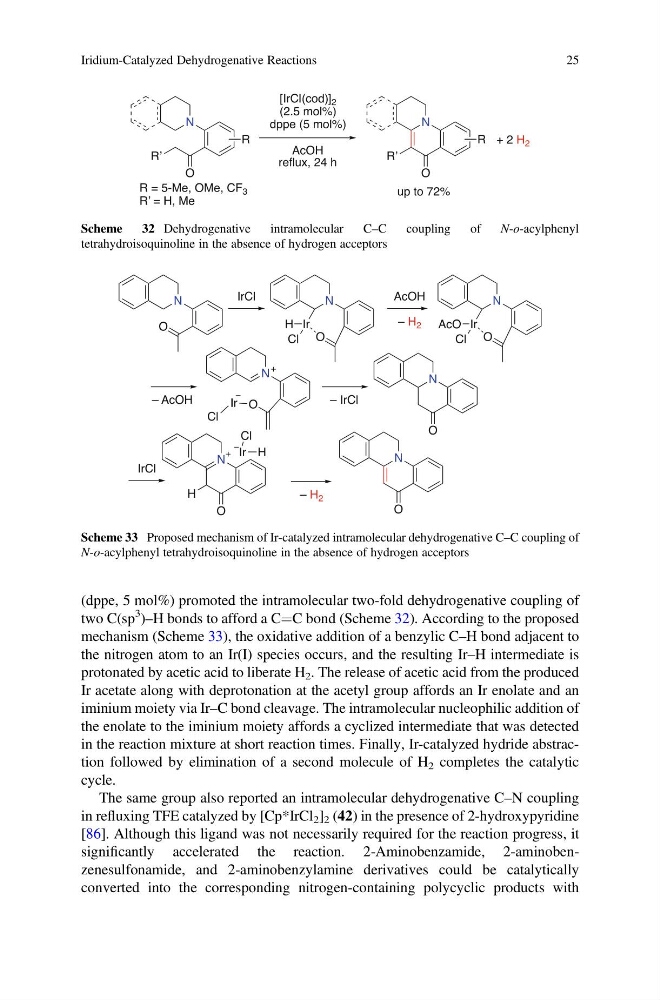
3 )–H bonds to afford a C¼C bond (Scheme 32). According to the proposed
mechanism (Scheme 33), the oxidative addition of a benzylic C–H bond adjacent to
the nitrogen atom to an Ir(I) species occurs, and the resulting Ir–H intermediate is
protonated by acetic acid to liberate H 2 . The release of acetic acid from the produced
Ir acetate along with deprotonation at the acetyl group affords an Ir enolate and an
iminium moiety via Ir–C bond cleavage. The intramolecular nucleophilic addition of
the enolate to the iminium moiety affords a cyclized intermediate that was detected
in the reaction mixture at short reaction times. Finally, Ir-catalyzed hydride abstraction followed by elimination of a second molecule of H 2 completes the catalytic
cycle.
The same group also reported an intramolecular dehydrogenative C–N coupling
in refluxing TFE catalyzed by [Cp*IrCl 2 ] 2 (42) in the presence of 2-hydroxypyridine
[86]. Although this ligand was not necessarily required for the reaction progress, it
significantly accelerated the reaction. 2-Aminobenzamide, 2-aminobenzenesulfonamide, and 2-aminobenzylamine derivatives could be catalytically
converted into the corresponding nitrogen-containing polycyclic products with
Scheme
32 Dehydrogenative
intramolecular
C–C
coupling
of
N-o-acylphenyl
tetrahydroisoquinoline in the absence of hydrogen acceptors
Scheme 33 Proposed mechanism of Ir-catalyzed intramolecular dehydrogenative C–C coupling of
N-o-acylphenyl tetrahydroisoquinoline in the absence of hydrogen acceptors
Iridium-Catalyzed Dehydrogenative Reactions
25
two C(sp
3 )–H bonds to afford a C¼C bond (Scheme 32). According to the proposed
mechanism (Scheme 33), the oxidative addition of a benzylic C–H bond adjacent to
the nitrogen atom to an Ir(I) species occurs, and the resulting Ir–H intermediate is
protonated by acetic acid to liberate H 2 . The release of acetic acid from the produced
Ir acetate along with deprotonation at the acetyl group affords an Ir enolate and an
iminium moiety via Ir–C bond cleavage. The intramolecular nucleophilic addition of
the enolate to the iminium moiety affords a cyclized intermediate that was detected
in the reaction mixture at short reaction times. Finally, Ir-catalyzed hydride abstraction followed by elimination of a second molecule of H 2 completes the catalytic
cycle.
The same group also reported an intramolecular dehydrogenative C–N coupling
in refluxing TFE catalyzed by [Cp*IrCl 2 ] 2 (42) in the presence of 2-hydroxypyridine
[86]. Although this ligand was not necessarily required for the reaction progress, it
significantly accelerated the reaction. 2-Aminobenzamide, 2-aminobenzenesulfonamide, and 2-aminobenzylamine derivatives could be catalytically
converted into the corresponding nitrogen-containing polycyclic products with
Scheme
32 Dehydrogenative
intramolecular
C–C
coupling
of
N-o-acylphenyl
tetrahydroisoquinoline in the absence of hydrogen acceptors
Scheme 33 Proposed mechanism of Ir-catalyzed intramolecular dehydrogenative C–C coupling of
N-o-acylphenyl tetrahydroisoquinoline in the absence of hydrogen acceptors
Iridium-Catalyzed Dehydrogenative Reactions
25