

The same group also reported a [Cp*IrCl 2 ] 2 (42)-catalyzed dehydrogenative
one-pot synthesis of quinazolinones from o-aminobenzonitrile, n-butylaldoxime,
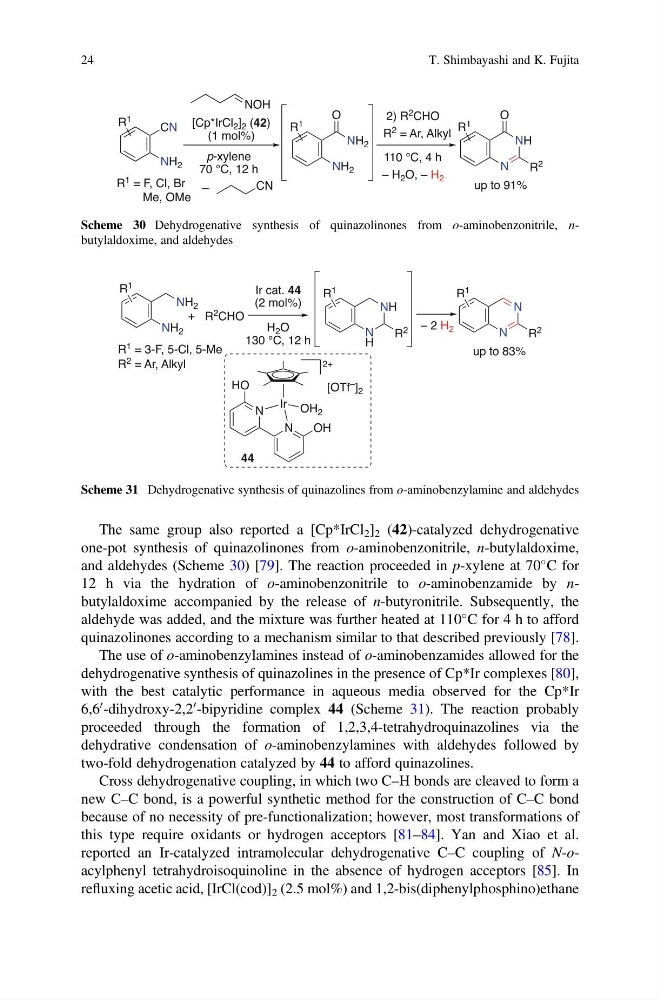
and aldehydes (Scheme 30) [79]. The reaction proceeded in p-xylene at 70
C for
12 h via the hydration of o-aminobenzonitrile to o-aminobenzamide by nbutylaldoxime accompanied by the release of n-butyronitrile. Subsequently, the
aldehyde was added, and the mixture was further heated at 110
C for 4 h to afford
quinazolinones according to a mechanism similar to that described previously [78].
The use of o-aminobenzylamines instead of o-aminobenzamides allowed for the
dehydrogenative synthesis of quinazolines in the presence of Cp*Ir complexes [80],
with the best catalytic performance in aqueous media observed for the Cp*Ir
6,6
0 -dihydroxy-2,2
0 -bipyridine complex 44 (Scheme 31). The reaction probably
proceeded through the formation of 1,2,3,4-tetrahydroquinazolines via the
dehydrative condensation of o-aminobenzylamines with aldehydes followed by
two-fold dehydrogenation catalyzed by 44 to afford quinazolines.
Cross dehydrogenative coupling, in which two C–H bonds are cleaved to form a
new C–C bond, is a powerful synthetic method for the construction of C–C bond
because of no necessity of pre-functionalization; however, most transformations of
this type require oxidants or hydrogen acceptors [81–84]. Yan and Xiao et al.
reported an Ir-catalyzed intramolecular dehydrogenative C–C coupling of N-oacylphenyl tetrahydroisoquinoline in the absence of hydrogen acceptors [85]. In
refluxing acetic acid, [IrCl(cod)] 2 (2.5 mol%) and 1,2-bis(diphenylphosphino)ethane
Scheme 30 Dehydrogenative synthesis of quinazolinones from o-aminobenzonitrile, nbutylaldoxime, and aldehydes
Scheme 31 Dehydrogenative synthesis of quinazolines from o-aminobenzylamine and aldehydes
24
T. Shimbayashi and K. Fujita
one-pot synthesis of quinazolinones from o-aminobenzonitrile, n-butylaldoxime,
and aldehydes (Scheme 30) [79]. The reaction proceeded in p-xylene at 70
C for
12 h via the hydration of o-aminobenzonitrile to o-aminobenzamide by nbutylaldoxime accompanied by the release of n-butyronitrile. Subsequently, the
aldehyde was added, and the mixture was further heated at 110
C for 4 h to afford
quinazolinones according to a mechanism similar to that described previously [78].
The use of o-aminobenzylamines instead of o-aminobenzamides allowed for the
dehydrogenative synthesis of quinazolines in the presence of Cp*Ir complexes [80],
with the best catalytic performance in aqueous media observed for the Cp*Ir
6,6
0 -dihydroxy-2,2
0 -bipyridine complex 44 (Scheme 31). The reaction probably
proceeded through the formation of 1,2,3,4-tetrahydroquinazolines via the
dehydrative condensation of o-aminobenzylamines with aldehydes followed by
two-fold dehydrogenation catalyzed by 44 to afford quinazolines.
Cross dehydrogenative coupling, in which two C–H bonds are cleaved to form a
new C–C bond, is a powerful synthetic method for the construction of C–C bond
because of no necessity of pre-functionalization; however, most transformations of
this type require oxidants or hydrogen acceptors [81–84]. Yan and Xiao et al.
reported an Ir-catalyzed intramolecular dehydrogenative C–C coupling of N-oacylphenyl tetrahydroisoquinoline in the absence of hydrogen acceptors [85]. In
refluxing acetic acid, [IrCl(cod)] 2 (2.5 mol%) and 1,2-bis(diphenylphosphino)ethane
Scheme 30 Dehydrogenative synthesis of quinazolinones from o-aminobenzonitrile, nbutylaldoxime, and aldehydes
Scheme 31 Dehydrogenative synthesis of quinazolines from o-aminobenzylamine and aldehydes
24
T. Shimbayashi and K. Fujita