

4.2 Dehydrogenative Oxidation of Primary Alcohols
to Esters, Carboxylic Acids, and Acetals
Catalyst 54, mentioned in the preceding section, effectively promoted the
dehydrogenative esterification of two molecules of primary benzylic alcohols in
the presence of catalytic amounts of Cs 2 CO 3 (Scheme 49) [100]. This esterification
is believed to proceed through several steps involving dehydrogenation,
hemiacetalyzation, and dehydrogenation. Moreover, the above catalyst also promoted the lactonization of diols.
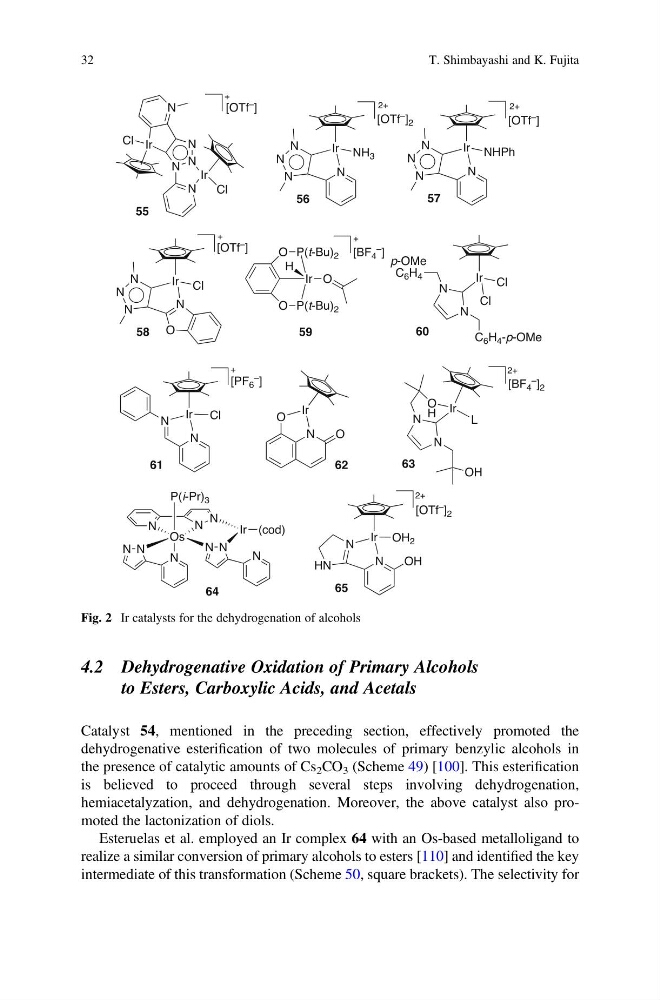
Esteruelas et al. employed an Ir complex 64 with an Os-based metalloligand to
realize a similar conversion of primary alcohols to esters [110] and identified the key
intermediate of this transformation (Scheme 50, square brackets). The selectivity for
Fig. 2 Ir catalysts for the dehydrogenation of alcohols
32
T. Shimbayashi and K. Fujita
to Esters, Carboxylic Acids, and Acetals
Catalyst 54, mentioned in the preceding section, effectively promoted the
dehydrogenative esterification of two molecules of primary benzylic alcohols in
the presence of catalytic amounts of Cs 2 CO 3 (Scheme 49) [100]. This esterification
is believed to proceed through several steps involving dehydrogenation,
hemiacetalyzation, and dehydrogenation. Moreover, the above catalyst also promoted the lactonization of diols.
Esteruelas et al. employed an Ir complex 64 with an Os-based metalloligand to
realize a similar conversion of primary alcohols to esters [110] and identified the key
intermediate of this transformation (Scheme 50, square brackets). The selectivity for
Fig. 2 Ir catalysts for the dehydrogenation of alcohols
32
T. Shimbayashi and K. Fujita