

stability issues [106]. A range of different amine ligands chosen for their air stability
were screened with [Ir(cod)Cl] 2 under the same reaction conditions as before.
Aliphatic tertiary amines gave good conversions, while for aromatic amines and
those with delocalized electrons the conversions were much lower, reflecting their
weaker binding to the iridium. The best ligand in the screening was the
triphenylphosphine analogue NPh 3, forming the amine analogue catalyst [Ir-58].
However, it could not reach the activity of the PPh 3 catalyst from the previous
publication. While the selectivity for LAOs was much higher with the phosphane
ligand, it was found that it was possible to tune the reaction conditions to reach very
high selectivity for LIOs with the amine ligands.
7.2.3 Hydroformylation
Carpentier and coworkers investigated the use of iridium among other metals for the
hydroformylation-isomerization reaction of fatty acid derivatives [107]. The study
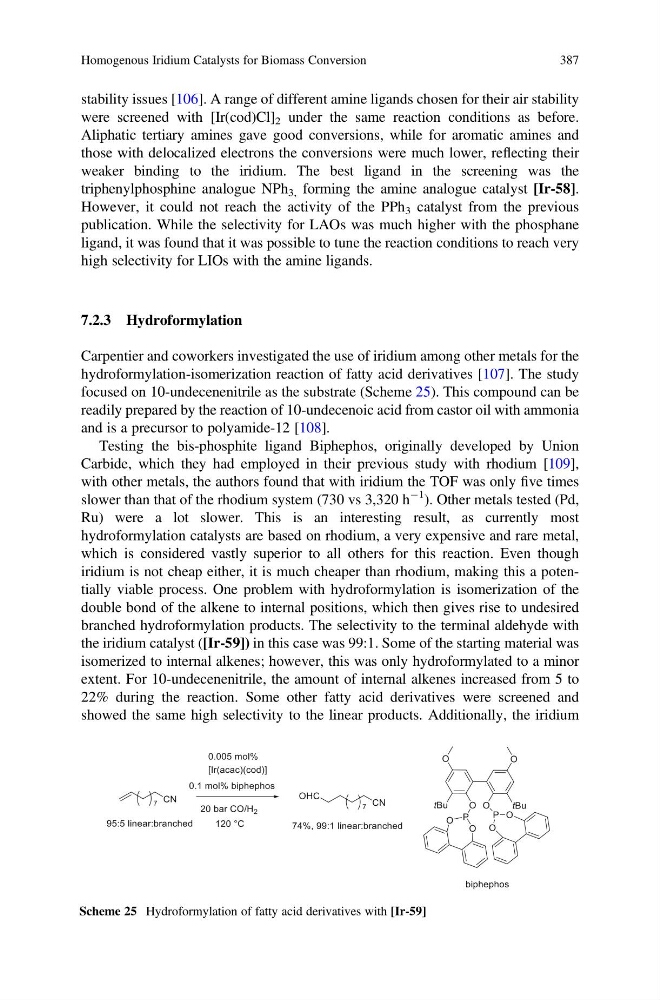
focused on 10-undecenenitrile as the substrate (Scheme 25). This compound can be
readily prepared by the reaction of 10-undecenoic acid from castor oil with ammonia
and is a precursor to polyamide-12 [108].
Testing the bis-phosphite ligand Biphephos, originally developed by Union
Carbide, which they had employed in their previous study with rhodium [109],
with other metals, the authors found that with iridium the TOF was only five times
slower than that of the rhodium system (730 vs 3,320 h
À1 ). Other metals tested (Pd,
Ru) were a lot slower. This is an interesting result, as currently most
hydroformylation catalysts are based on rhodium, a very expensive and rare metal,
which is considered vastly superior to all others for this reaction. Even though
iridium is not cheap either, it is much cheaper than rhodium, making this a potentially viable process. One problem with hydroformylation is isomerization of the
double bond of the alkene to internal positions, which then gives rise to undesired
branched hydroformylation products. The selectivity to the terminal aldehyde with
the iridium catalyst ([Ir-59]) in this case was 99:1. Some of the starting material was
isomerized to internal alkenes; however, this was only hydroformylated to a minor
extent. For 10-undecenenitrile, the amount of internal alkenes increased from 5 to
22% during the reaction. Some other fatty acid derivatives were screened and
showed the same high selectivity to the linear products. Additionally, the iridium
Scheme 25 Hydroformylation of fatty acid derivatives with [Ir-59]
Homogenous Iridium Catalysts for Biomass Conversion
387
were screened with [Ir(cod)Cl] 2 under the same reaction conditions as before.
Aliphatic tertiary amines gave good conversions, while for aromatic amines and
those with delocalized electrons the conversions were much lower, reflecting their
weaker binding to the iridium. The best ligand in the screening was the
triphenylphosphine analogue NPh 3, forming the amine analogue catalyst [Ir-58].
However, it could not reach the activity of the PPh 3 catalyst from the previous
publication. While the selectivity for LAOs was much higher with the phosphane
ligand, it was found that it was possible to tune the reaction conditions to reach very
high selectivity for LIOs with the amine ligands.
7.2.3 Hydroformylation
Carpentier and coworkers investigated the use of iridium among other metals for the
hydroformylation-isomerization reaction of fatty acid derivatives [107]. The study
focused on 10-undecenenitrile as the substrate (Scheme 25). This compound can be
readily prepared by the reaction of 10-undecenoic acid from castor oil with ammonia
and is a precursor to polyamide-12 [108].
Testing the bis-phosphite ligand Biphephos, originally developed by Union
Carbide, which they had employed in their previous study with rhodium [109],
with other metals, the authors found that with iridium the TOF was only five times
slower than that of the rhodium system (730 vs 3,320 h
À1 ). Other metals tested (Pd,
Ru) were a lot slower. This is an interesting result, as currently most
hydroformylation catalysts are based on rhodium, a very expensive and rare metal,
which is considered vastly superior to all others for this reaction. Even though
iridium is not cheap either, it is much cheaper than rhodium, making this a potentially viable process. One problem with hydroformylation is isomerization of the
double bond of the alkene to internal positions, which then gives rise to undesired
branched hydroformylation products. The selectivity to the terminal aldehyde with
the iridium catalyst ([Ir-59]) in this case was 99:1. Some of the starting material was
isomerized to internal alkenes; however, this was only hydroformylated to a minor
extent. For 10-undecenenitrile, the amount of internal alkenes increased from 5 to
22% during the reaction. Some other fatty acid derivatives were screened and
showed the same high selectivity to the linear products. Additionally, the iridium
Scheme 25 Hydroformylation of fatty acid derivatives with [Ir-59]
Homogenous Iridium Catalysts for Biomass Conversion
387