

could be reused three times by distilling off the reaction mixture and product and
adding more ligand.
7.2.4 Trialkylsilylation
As we have already seen, terminal olefins are often more desired for further
functionalization, giving rise to linear, end-functionalized compounds. Riepl and
coworkers investigated the iridium-catalyzed isomerizing dehydrogenative
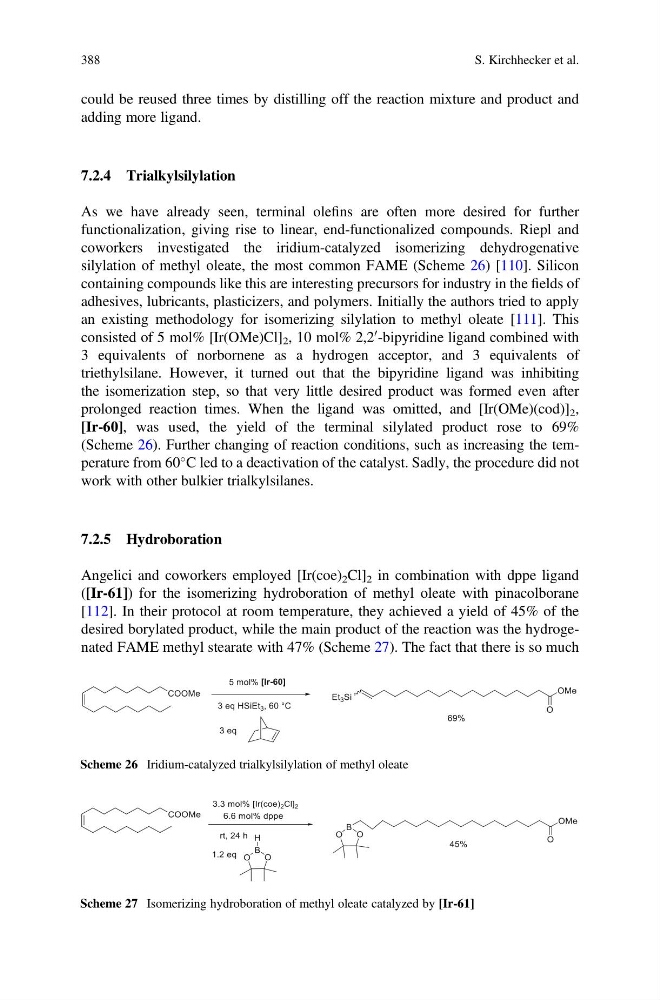
silylation of methyl oleate, the most common FAME (Scheme 26) [110]. Silicon
containing compounds like this are interesting precursors for industry in the fields of
adhesives, lubricants, plasticizers, and polymers. Initially the authors tried to apply
an existing methodology for isomerizing silylation to methyl oleate [111]. This
consisted of 5 mol% [Ir(OMe)Cl] 2 , 10 mol% 2,2
0 -bipyridine ligand combined with
3 equivalents of norbornene as a hydrogen acceptor, and 3 equivalents of
triethylsilane. However, it turned out that the bipyridine ligand was inhibiting
the isomerization step, so that very little desired product was formed even after
prolonged reaction times. When the ligand was omitted, and [Ir(OMe)(cod)] 2 ,
[Ir-60], was used, the yield of the terminal silylated product rose to 69%
(Scheme 26). Further changing of reaction conditions, such as increasing the temperature from 60
C led to a deactivation of the catalyst. Sadly, the procedure did not
work with other bulkier trialkylsilanes.
7.2.5 Hydroboration
Angelici and coworkers employed [Ir(coe) 2 Cl] 2 in combination with dppe ligand
([Ir-61]) for the isomerizing hydroboration of methyl oleate with pinacolborane
[112]. In their protocol at room temperature, they achieved a yield of 45% of the
desired borylated product, while the main product of the reaction was the hydrogenated FAME methyl stearate with 47% (Scheme 27). The fact that there is so much
Scheme 26 Iridium-catalyzed trialkylsilylation of methyl oleate
Scheme 27 Isomerizing hydroboration of methyl oleate catalyzed by [Ir-61]
388
S. Kirchhecker et al.
adding more ligand.
7.2.4 Trialkylsilylation
As we have already seen, terminal olefins are often more desired for further
functionalization, giving rise to linear, end-functionalized compounds. Riepl and
coworkers investigated the iridium-catalyzed isomerizing dehydrogenative
silylation of methyl oleate, the most common FAME (Scheme 26) [110]. Silicon
containing compounds like this are interesting precursors for industry in the fields of
adhesives, lubricants, plasticizers, and polymers. Initially the authors tried to apply
an existing methodology for isomerizing silylation to methyl oleate [111]. This
consisted of 5 mol% [Ir(OMe)Cl] 2 , 10 mol% 2,2
0 -bipyridine ligand combined with
3 equivalents of norbornene as a hydrogen acceptor, and 3 equivalents of
triethylsilane. However, it turned out that the bipyridine ligand was inhibiting
the isomerization step, so that very little desired product was formed even after
prolonged reaction times. When the ligand was omitted, and [Ir(OMe)(cod)] 2 ,
[Ir-60], was used, the yield of the terminal silylated product rose to 69%
(Scheme 26). Further changing of reaction conditions, such as increasing the temperature from 60
C led to a deactivation of the catalyst. Sadly, the procedure did not
work with other bulkier trialkylsilanes.
7.2.5 Hydroboration
Angelici and coworkers employed [Ir(coe) 2 Cl] 2 in combination with dppe ligand
([Ir-61]) for the isomerizing hydroboration of methyl oleate with pinacolborane
[112]. In their protocol at room temperature, they achieved a yield of 45% of the
desired borylated product, while the main product of the reaction was the hydrogenated FAME methyl stearate with 47% (Scheme 27). The fact that there is so much
Scheme 26 Iridium-catalyzed trialkylsilylation of methyl oleate
Scheme 27 Isomerizing hydroboration of methyl oleate catalyzed by [Ir-61]
388
S. Kirchhecker et al.