

additives. When using 20 mol% KI as an additive at a reaction temperature of 250
C,
internal alkenes were formed with selectivities >98%. A test with the iodine
analogue of the iridium catalysts worked equally well, indicating that the KI might
activate the catalyst via chloride–iodide exchange. By lowering the temperature to
160
C and adding 2 equivalents of acetic anhydride (Ac 2 O) together with 0.5 eq of
KI, it was possible to invert the selectivity to produce the terminal alkenes with 98%
selectivity. The methodology was applied to a range of saturated fatty acids, all
giving the desired product in >80% yield with 99% selectivity for LIOs and >76%
yield and >96% selectivity for LAOs. The proposed mechanism starts by the
oxidative addition of an acid anhydride to the iridium. This acid anhydride is either
generated from two molecules or carboxylic acid, or by reaction with Ac 2 O,
indicating this additive’s role in the reaction. The formed acyl complex is then
decarbonylated releasing CO. The alkene is released by β-hydride elimination,
leaving an iridium hydride complex, which can either release a carboxylic acid
and return to the initial state or catalyze the isomerization of the double bond.
Hapiot and coworkers later applied this catalytic system to the decarbonylation of
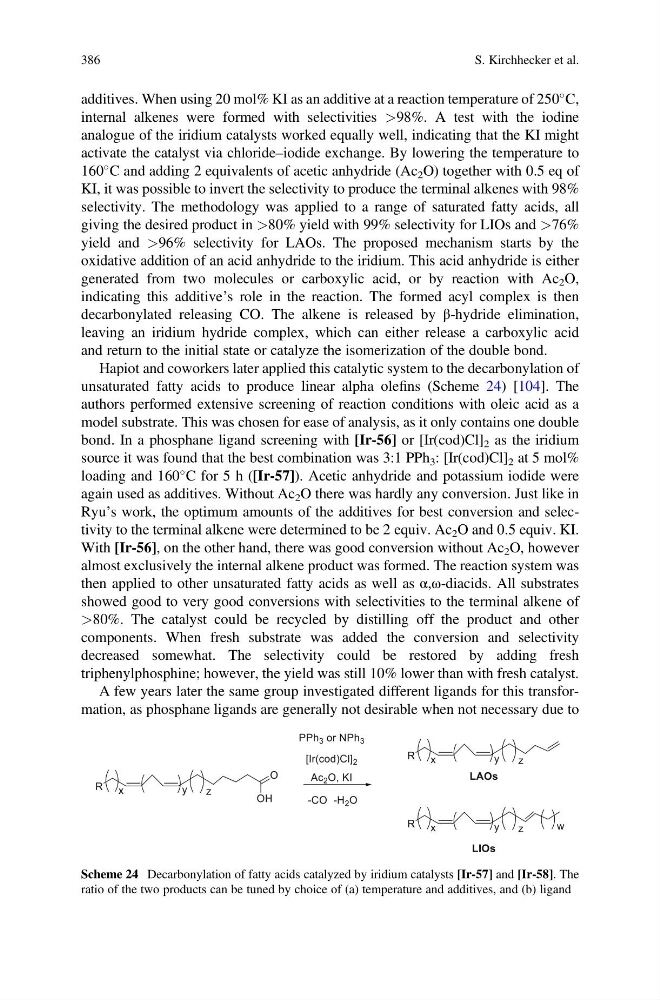
unsaturated fatty acids to produce linear alpha olefins (Scheme 24) [104]. The
authors performed extensive screening of reaction conditions with oleic acid as a
model substrate. This was chosen for ease of analysis, as it only contains one double
bond. In a phosphane ligand screening with [Ir-56] or [Ir(cod)Cl] 2 as the iridium
source it was found that the best combination was 3:1 PPh 3 : [Ir(cod)Cl] 2 at 5 mol%
loading and 160
C for 5 h ([Ir-57]). Acetic anhydride and potassium iodide were
again used as additives. Without Ac 2 O there was hardly any conversion. Just like in
Ryu’s work, the optimum amounts of the additives for best conversion and selectivity to the terminal alkene were determined to be 2 equiv. Ac 2 O and 0.5 equiv. KI.
With [Ir-56], on the other hand, there was good conversion without Ac 2 O, however
almost exclusively the internal alkene product was formed. The reaction system was
then applied to other unsaturated fatty acids as well as α,ω-diacids. All substrates
showed good to very good conversions with selectivities to the terminal alkene of
>80%. The catalyst could be recycled by distilling off the product and other
components. When fresh substrate was added the conversion and selectivity
decreased somewhat. The selectivity could be restored by adding fresh
triphenylphosphine; however, the yield was still 10% lower than with fresh catalyst.
A few years later the same group investigated different ligands for this transformation, as phosphane ligands are generally not desirable when not necessary due to
Scheme 24 Decarbonylation of fatty acids catalyzed by iridium catalysts [Ir-57] and [Ir-58]. The
ratio of the two products can be tuned by choice of (a) temperature and additives, and (b) ligand
386
S. Kirchhecker et al.
C,
internal alkenes were formed with selectivities >98%. A test with the iodine
analogue of the iridium catalysts worked equally well, indicating that the KI might
activate the catalyst via chloride–iodide exchange. By lowering the temperature to
160
C and adding 2 equivalents of acetic anhydride (Ac 2 O) together with 0.5 eq of
KI, it was possible to invert the selectivity to produce the terminal alkenes with 98%
selectivity. The methodology was applied to a range of saturated fatty acids, all
giving the desired product in >80% yield with 99% selectivity for LIOs and >76%
yield and >96% selectivity for LAOs. The proposed mechanism starts by the
oxidative addition of an acid anhydride to the iridium. This acid anhydride is either
generated from two molecules or carboxylic acid, or by reaction with Ac 2 O,
indicating this additive’s role in the reaction. The formed acyl complex is then
decarbonylated releasing CO. The alkene is released by β-hydride elimination,
leaving an iridium hydride complex, which can either release a carboxylic acid
and return to the initial state or catalyze the isomerization of the double bond.
Hapiot and coworkers later applied this catalytic system to the decarbonylation of
unsaturated fatty acids to produce linear alpha olefins (Scheme 24) [104]. The
authors performed extensive screening of reaction conditions with oleic acid as a
model substrate. This was chosen for ease of analysis, as it only contains one double
bond. In a phosphane ligand screening with [Ir-56] or [Ir(cod)Cl] 2 as the iridium
source it was found that the best combination was 3:1 PPh 3 : [Ir(cod)Cl] 2 at 5 mol%
loading and 160
C for 5 h ([Ir-57]). Acetic anhydride and potassium iodide were
again used as additives. Without Ac 2 O there was hardly any conversion. Just like in
Ryu’s work, the optimum amounts of the additives for best conversion and selectivity to the terminal alkene were determined to be 2 equiv. Ac 2 O and 0.5 equiv. KI.
With [Ir-56], on the other hand, there was good conversion without Ac 2 O, however
almost exclusively the internal alkene product was formed. The reaction system was
then applied to other unsaturated fatty acids as well as α,ω-diacids. All substrates
showed good to very good conversions with selectivities to the terminal alkene of
>80%. The catalyst could be recycled by distilling off the product and other
components. When fresh substrate was added the conversion and selectivity
decreased somewhat. The selectivity could be restored by adding fresh
triphenylphosphine; however, the yield was still 10% lower than with fresh catalyst.
A few years later the same group investigated different ligands for this transformation, as phosphane ligands are generally not desirable when not necessary due to
Scheme 24 Decarbonylation of fatty acids catalyzed by iridium catalysts [Ir-57] and [Ir-58]. The
ratio of the two products can be tuned by choice of (a) temperature and additives, and (b) ligand
386
S. Kirchhecker et al.