

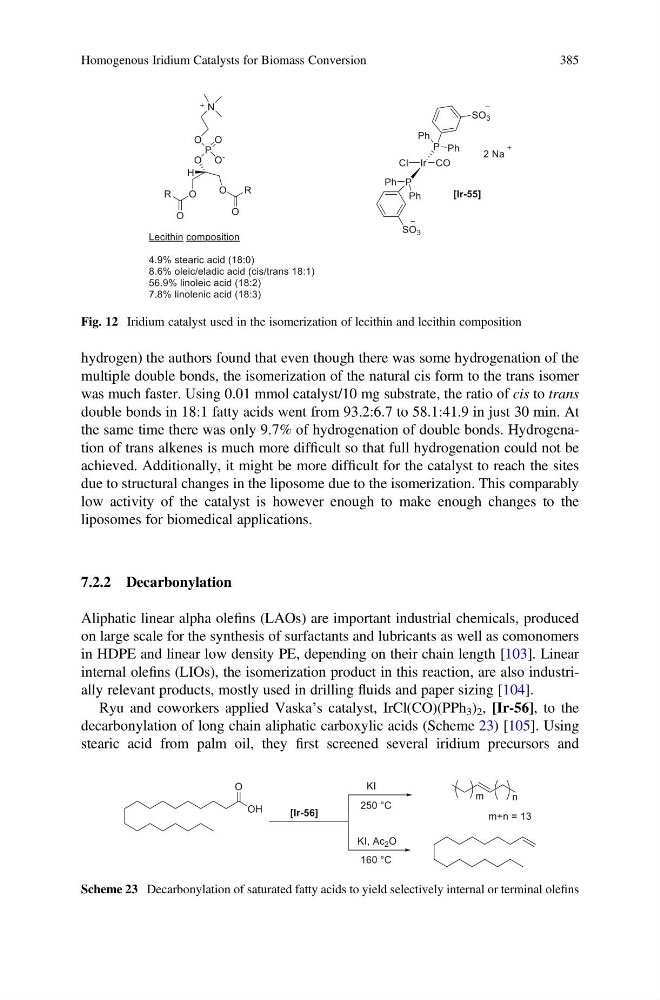
hydrogen) the authors found that even though there was some hydrogenation of the
multiple double bonds, the isomerization of the natural cis form to the trans isomer
was much faster. Using 0.01 mmol catalyst/10 mg substrate, the ratio of cis to trans
double bonds in 18:1 fatty acids went from 93.2:6.7 to 58.1:41.9 in just 30 min. At
the same time there was only 9.7% of hydrogenation of double bonds. Hydrogenation of trans alkenes is much more difficult so that full hydrogenation could not be
achieved. Additionally, it might be more difficult for the catalyst to reach the sites
due to structural changes in the liposome due to the isomerization. This comparably
low activity of the catalyst is however enough to make enough changes to the
liposomes for biomedical applications.
7.2.2 Decarbonylation
Aliphatic linear alpha olefins (LAOs) are important industrial chemicals, produced
on large scale for the synthesis of surfactants and lubricants as well as comonomers
in HDPE and linear low density PE, depending on their chain length [103]. Linear
internal olefins (LIOs), the isomerization product in this reaction, are also industrially relevant products, mostly used in drilling fluids and paper sizing [104].
Ryu and coworkers applied Vaska’s catalyst, IrCl(CO)(PPh 3 ) 2 , [Ir-56], to the
decarbonylation of long chain aliphatic carboxylic acids (Scheme 23) [105]. Using
stearic acid from palm oil, they first screened several iridium precursors and
Fig. 12 Iridium catalyst used in the isomerization of lecithin and lecithin composition
Scheme 23 Decarbonylation of saturated fatty acids to yield selectively internal or terminal olefins
Homogenous Iridium Catalysts for Biomass Conversion
385
multiple double bonds, the isomerization of the natural cis form to the trans isomer
was much faster. Using 0.01 mmol catalyst/10 mg substrate, the ratio of cis to trans
double bonds in 18:1 fatty acids went from 93.2:6.7 to 58.1:41.9 in just 30 min. At
the same time there was only 9.7% of hydrogenation of double bonds. Hydrogenation of trans alkenes is much more difficult so that full hydrogenation could not be
achieved. Additionally, it might be more difficult for the catalyst to reach the sites
due to structural changes in the liposome due to the isomerization. This comparably
low activity of the catalyst is however enough to make enough changes to the
liposomes for biomedical applications.
7.2.2 Decarbonylation
Aliphatic linear alpha olefins (LAOs) are important industrial chemicals, produced
on large scale for the synthesis of surfactants and lubricants as well as comonomers
in HDPE and linear low density PE, depending on their chain length [103]. Linear
internal olefins (LIOs), the isomerization product in this reaction, are also industrially relevant products, mostly used in drilling fluids and paper sizing [104].
Ryu and coworkers applied Vaska’s catalyst, IrCl(CO)(PPh 3 ) 2 , [Ir-56], to the
decarbonylation of long chain aliphatic carboxylic acids (Scheme 23) [105]. Using
stearic acid from palm oil, they first screened several iridium precursors and
Fig. 12 Iridium catalyst used in the isomerization of lecithin and lecithin composition
Scheme 23 Decarbonylation of saturated fatty acids to yield selectively internal or terminal olefins
Homogenous Iridium Catalysts for Biomass Conversion
385