

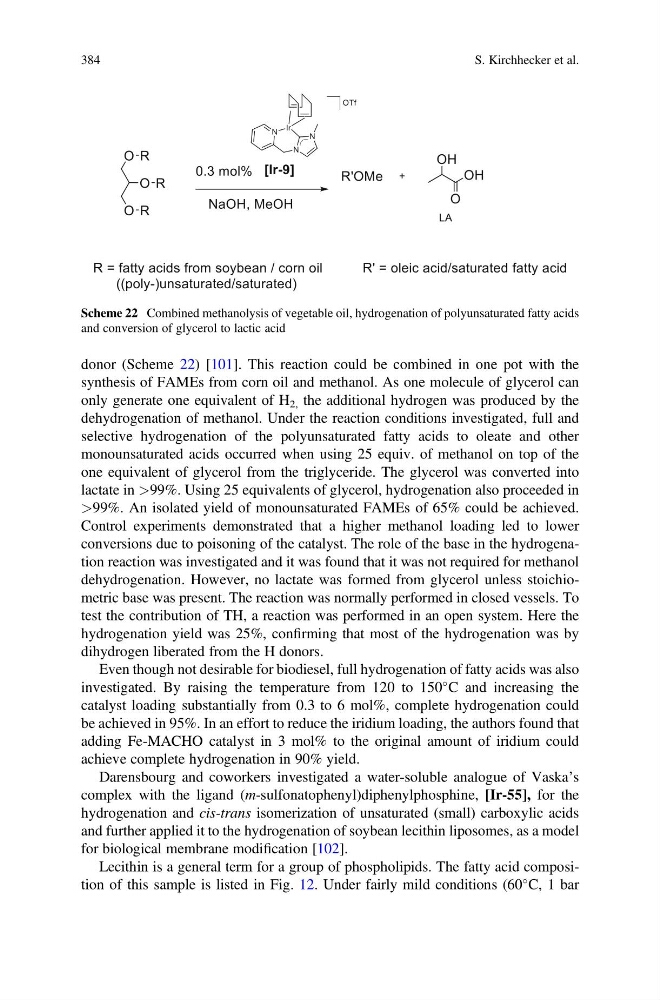
donor (Scheme 22) [101]. This reaction could be combined in one pot with the
synthesis of FAMEs from corn oil and methanol. As one molecule of glycerol can
only generate one equivalent of H 2, the additional hydrogen was produced by the
dehydrogenation of methanol. Under the reaction conditions investigated, full and
selective hydrogenation of the polyunsaturated fatty acids to oleate and other
monounsaturated acids occurred when using 25 equiv. of methanol on top of the
one equivalent of glycerol from the triglyceride. The glycerol was converted into
lactate in >99%. Using 25 equivalents of glycerol, hydrogenation also proceeded in
>99%. An isolated yield of monounsaturated FAMEs of 65% could be achieved.
Control experiments demonstrated that a higher methanol loading led to lower
conversions due to poisoning of the catalyst. The role of the base in the hydrogenation reaction was investigated and it was found that it was not required for methanol
dehydrogenation. However, no lactate was formed from glycerol unless stoichiometric base was present. The reaction was normally performed in closed vessels. To
test the contribution of TH, a reaction was performed in an open system. Here the
hydrogenation yield was 25%, confirming that most of the hydrogenation was by
dihydrogen liberated from the H donors.
Even though not desirable for biodiesel, full hydrogenation of fatty acids was also
investigated. By raising the temperature from 120 to 150
C and increasing the
catalyst loading substantially from 0.3 to 6 mol%, complete hydrogenation could
be achieved in 95%. In an effort to reduce the iridium loading, the authors found that
adding Fe-MACHO catalyst in 3 mol% to the original amount of iridium could
achieve complete hydrogenation in 90% yield.
Darensbourg and coworkers investigated a water-soluble analogue of Vaska’s
complex with the ligand (m-sulfonatophenyl)diphenylphosphine, [Ir-55], for the
hydrogenation and cis-trans isomerization of unsaturated (small) carboxylic acids
and further applied it to the hydrogenation of soybean lecithin liposomes, as a model
for biological membrane modification [102].
Lecithin is a general term for a group of phospholipids. The fatty acid composition of this sample is listed in Fig. 12. Under fairly mild conditions (60
C, 1 bar
Scheme 22 Combined methanolysis of vegetable oil, hydrogenation of polyunsaturated fatty acids
and conversion of glycerol to lactic acid
384
S. Kirchhecker et al.
synthesis of FAMEs from corn oil and methanol. As one molecule of glycerol can
only generate one equivalent of H 2, the additional hydrogen was produced by the
dehydrogenation of methanol. Under the reaction conditions investigated, full and
selective hydrogenation of the polyunsaturated fatty acids to oleate and other
monounsaturated acids occurred when using 25 equiv. of methanol on top of the
one equivalent of glycerol from the triglyceride. The glycerol was converted into
lactate in >99%. Using 25 equivalents of glycerol, hydrogenation also proceeded in
>99%. An isolated yield of monounsaturated FAMEs of 65% could be achieved.
Control experiments demonstrated that a higher methanol loading led to lower
conversions due to poisoning of the catalyst. The role of the base in the hydrogenation reaction was investigated and it was found that it was not required for methanol
dehydrogenation. However, no lactate was formed from glycerol unless stoichiometric base was present. The reaction was normally performed in closed vessels. To
test the contribution of TH, a reaction was performed in an open system. Here the
hydrogenation yield was 25%, confirming that most of the hydrogenation was by
dihydrogen liberated from the H donors.
Even though not desirable for biodiesel, full hydrogenation of fatty acids was also
investigated. By raising the temperature from 120 to 150
C and increasing the
catalyst loading substantially from 0.3 to 6 mol%, complete hydrogenation could
be achieved in 95%. In an effort to reduce the iridium loading, the authors found that
adding Fe-MACHO catalyst in 3 mol% to the original amount of iridium could
achieve complete hydrogenation in 90% yield.
Darensbourg and coworkers investigated a water-soluble analogue of Vaska’s
complex with the ligand (m-sulfonatophenyl)diphenylphosphine, [Ir-55], for the
hydrogenation and cis-trans isomerization of unsaturated (small) carboxylic acids
and further applied it to the hydrogenation of soybean lecithin liposomes, as a model
for biological membrane modification [102].
Lecithin is a general term for a group of phospholipids. The fatty acid composition of this sample is listed in Fig. 12. Under fairly mild conditions (60
C, 1 bar
Scheme 22 Combined methanolysis of vegetable oil, hydrogenation of polyunsaturated fatty acids
and conversion of glycerol to lactic acid
384
S. Kirchhecker et al.