

(ligno)cellulose. Therefore, a three-step protocol was adopted: First, the biomass was
depolymerized in NMP by acid hydrolysis using HCl for 2.5 h at 120
C after which
time the reaction mixture was cooled to 95
C, neutralized, and 1.5 eq NaOH were
added and in the second step reacted for another hour at 120
C. In the third step,
[Ir-38] was added for hydrogen generation at the same temperature. With cellulose
the catalyst reached at TON of 6,285 after 2 h at 20.3 ppm loading, and with bamboo
lignocellulose a TON of 2,844 after 8 h at a loading of 20.9 ppm. Unfortunately, only
a small percentage of the sugars was dehydrogenated. When calculated on the total
theoretically available hydrogen from the sugar molecule (6), the yield of this
process is only around 3.3%. This is much lower than other proposed methods for
the generation of renewable hydrogen from biomass, such as aqueous phase
reforming. Here a hydrogen yield from glucose of 51% can be achieved, albeit at
much higher temperatures [86].
5.2 Biomass Molecules as Hydrogen Donors for Transfer
Hydrogenation
Another area where dehydrogenation of biomass compounds might be valorized is
their use as sacrificial hydrogen donors in transfer hydrogenation. The most commonly used hydrogen donor in TH reactions is isopropanol, which is currently not
produced renewably; however, FA is also often employed, as discussed in the
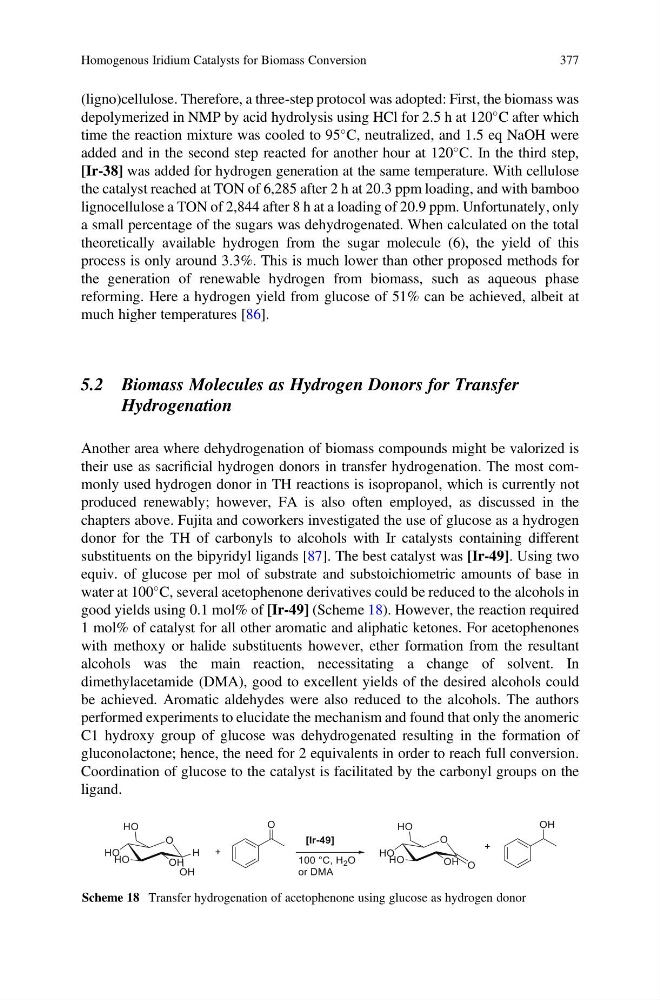
chapters above. Fujita and coworkers investigated the use of glucose as a hydrogen
donor for the TH of carbonyls to alcohols with Ir catalysts containing different
substituents on the bipyridyl ligands [87]. The best catalyst was [Ir-49]. Using two
equiv. of glucose per mol of substrate and substoichiometric amounts of base in
water at 100
C, several acetophenone derivatives could be reduced to the alcohols in
good yields using 0.1 mol% of [Ir-49] (Scheme 18). However, the reaction required
1 mol% of catalyst for all other aromatic and aliphatic ketones. For acetophenones
with methoxy or halide substituents however, ether formation from the resultant
alcohols was the main reaction, necessitating a change of solvent. In
dimethylacetamide (DMA), good to excellent yields of the desired alcohols could
be achieved. Aromatic aldehydes were also reduced to the alcohols. The authors
performed experiments to elucidate the mechanism and found that only the anomeric
C1 hydroxy group of glucose was dehydrogenated resulting in the formation of
gluconolactone; hence, the need for 2 equivalents in order to reach full conversion.
Coordination of glucose to the catalyst is facilitated by the carbonyl groups on the
ligand.
Scheme 18 Transfer hydrogenation of acetophenone using glucose as hydrogen donor
Homogenous Iridium Catalysts for Biomass Conversion
377
depolymerized in NMP by acid hydrolysis using HCl for 2.5 h at 120
C after which
time the reaction mixture was cooled to 95
C, neutralized, and 1.5 eq NaOH were
added and in the second step reacted for another hour at 120
C. In the third step,
[Ir-38] was added for hydrogen generation at the same temperature. With cellulose
the catalyst reached at TON of 6,285 after 2 h at 20.3 ppm loading, and with bamboo
lignocellulose a TON of 2,844 after 8 h at a loading of 20.9 ppm. Unfortunately, only
a small percentage of the sugars was dehydrogenated. When calculated on the total
theoretically available hydrogen from the sugar molecule (6), the yield of this
process is only around 3.3%. This is much lower than other proposed methods for
the generation of renewable hydrogen from biomass, such as aqueous phase
reforming. Here a hydrogen yield from glucose of 51% can be achieved, albeit at
much higher temperatures [86].
5.2 Biomass Molecules as Hydrogen Donors for Transfer
Hydrogenation
Another area where dehydrogenation of biomass compounds might be valorized is
their use as sacrificial hydrogen donors in transfer hydrogenation. The most commonly used hydrogen donor in TH reactions is isopropanol, which is currently not
produced renewably; however, FA is also often employed, as discussed in the
chapters above. Fujita and coworkers investigated the use of glucose as a hydrogen
donor for the TH of carbonyls to alcohols with Ir catalysts containing different
substituents on the bipyridyl ligands [87]. The best catalyst was [Ir-49]. Using two
equiv. of glucose per mol of substrate and substoichiometric amounts of base in
water at 100
C, several acetophenone derivatives could be reduced to the alcohols in
good yields using 0.1 mol% of [Ir-49] (Scheme 18). However, the reaction required
1 mol% of catalyst for all other aromatic and aliphatic ketones. For acetophenones
with methoxy or halide substituents however, ether formation from the resultant
alcohols was the main reaction, necessitating a change of solvent. In
dimethylacetamide (DMA), good to excellent yields of the desired alcohols could
be achieved. Aromatic aldehydes were also reduced to the alcohols. The authors
performed experiments to elucidate the mechanism and found that only the anomeric
C1 hydroxy group of glucose was dehydrogenated resulting in the formation of
gluconolactone; hence, the need for 2 equivalents in order to reach full conversion.
Coordination of glucose to the catalyst is facilitated by the carbonyl groups on the
ligand.
Scheme 18 Transfer hydrogenation of acetophenone using glucose as hydrogen donor
Homogenous Iridium Catalysts for Biomass Conversion
377