

5.1 Hydrogen Generation from Biomass
Based on their findings that the TH of LA by formic acid was for a large part due to a
hydrogenation reaction after a very fast dehydrogenation of FA, the Fischmeister
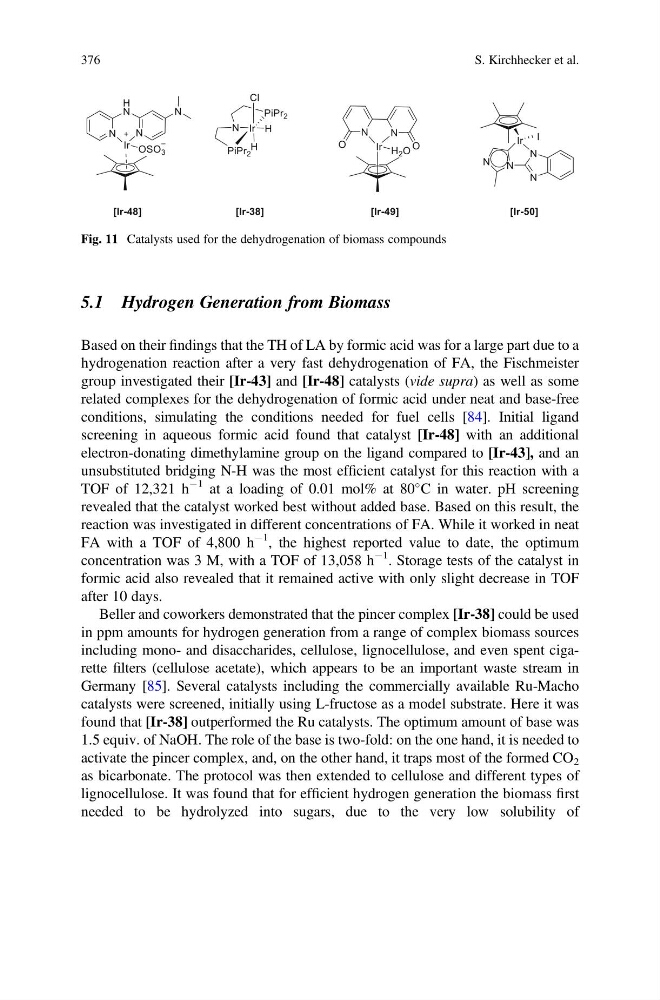
group investigated their [Ir-43] and [Ir-48] catalysts (vide supra) as well as some
related complexes for the dehydrogenation of formic acid under neat and base-free
conditions, simulating the conditions needed for fuel cells [84]. Initial ligand
screening in aqueous formic acid found that catalyst [Ir-48] with an additional
electron-donating dimethylamine group on the ligand compared to [Ir-43], and an
unsubstituted bridging N-H was the most efficient catalyst for this reaction with a
TOF of 12,321 h
À1 at a loading of 0.01 mol% at 80
C in water. pH screening
revealed that the catalyst worked best without added base. Based on this result, the
reaction was investigated in different concentrations of FA. While it worked in neat
FA with a TOF of 4,800 h
À1 , the highest reported value to date, the optimum
concentration was 3 M, with a TOF of 13,058 h
À1 . Storage tests of the catalyst in
formic acid also revealed that it remained active with only slight decrease in TOF
after 10 days.
Beller and coworkers demonstrated that the pincer complex [Ir-38] could be used
in ppm amounts for hydrogen generation from a range of complex biomass sources
including mono- and disaccharides, cellulose, lignocellulose, and even spent cigarette filters (cellulose acetate), which appears to be an important waste stream in
Germany [85]. Several catalysts including the commercially available Ru-Macho
catalysts were screened, initially using L-fructose as a model substrate. Here it was
found that [Ir-38] outperformed the Ru catalysts. The optimum amount of base was
1.5 equiv. of NaOH. The role of the base is two-fold: on the one hand, it is needed to
activate the pincer complex, and, on the other hand, it traps most of the formed CO 2
as bicarbonate. The protocol was then extended to cellulose and different types of
lignocellulose. It was found that for efficient hydrogen generation the biomass first
needed to be hydrolyzed into sugars, due to the very low solubility of
Fig. 11 Catalysts used for the dehydrogenation of biomass compounds
376
S. Kirchhecker et al.
Based on their findings that the TH of LA by formic acid was for a large part due to a
hydrogenation reaction after a very fast dehydrogenation of FA, the Fischmeister
group investigated their [Ir-43] and [Ir-48] catalysts (vide supra) as well as some
related complexes for the dehydrogenation of formic acid under neat and base-free
conditions, simulating the conditions needed for fuel cells [84]. Initial ligand
screening in aqueous formic acid found that catalyst [Ir-48] with an additional
electron-donating dimethylamine group on the ligand compared to [Ir-43], and an
unsubstituted bridging N-H was the most efficient catalyst for this reaction with a
TOF of 12,321 h
À1 at a loading of 0.01 mol% at 80
C in water. pH screening
revealed that the catalyst worked best without added base. Based on this result, the
reaction was investigated in different concentrations of FA. While it worked in neat
FA with a TOF of 4,800 h
À1 , the highest reported value to date, the optimum
concentration was 3 M, with a TOF of 13,058 h
À1 . Storage tests of the catalyst in
formic acid also revealed that it remained active with only slight decrease in TOF
after 10 days.
Beller and coworkers demonstrated that the pincer complex [Ir-38] could be used
in ppm amounts for hydrogen generation from a range of complex biomass sources
including mono- and disaccharides, cellulose, lignocellulose, and even spent cigarette filters (cellulose acetate), which appears to be an important waste stream in
Germany [85]. Several catalysts including the commercially available Ru-Macho
catalysts were screened, initially using L-fructose as a model substrate. Here it was
found that [Ir-38] outperformed the Ru catalysts. The optimum amount of base was
1.5 equiv. of NaOH. The role of the base is two-fold: on the one hand, it is needed to
activate the pincer complex, and, on the other hand, it traps most of the formed CO 2
as bicarbonate. The protocol was then extended to cellulose and different types of
lignocellulose. It was found that for efficient hydrogen generation the biomass first
needed to be hydrolyzed into sugars, due to the very low solubility of
Fig. 11 Catalysts used for the dehydrogenation of biomass compounds
376
S. Kirchhecker et al.