

The Fischmeister group also recently demonstrated the application of base free
transfer hydrogenation for the reductive amination of LEV [81]. Formic acid was
used as the renewable hydrogen donor together with an updated version of their
catalyst containing an electron-donating dimethylamine group in the ligand
([Ir-48]). At a catalyst loading of 0.05 mol% at 60
C using 2 equiv. of FA, a
range of aromatic amines with electronically and sterically demanding substituents
were converted in good to excellent yields, as well as some aliphatic and benzylic
amines (Table 6, Entry 4). Again, the researchers investigated the reaction starting
from glucose, using the FA formed as the side product as the hydrogen donor. The
yield over these two steps was 23%, which is comparable to other literature reports
but a bit lower than using their other hydrogenation procedure. The benefit here
however is that no additional hydrogen or hydrogen donor needs to be added.
5 Iridium-Catalyzed Dehydrogenation of Biomass
Compounds
Hydrogen has the potential to become a universal energy carrier in the future as it is
light and its combustion only creates water. However, a lot of research remains to be
done on the efficient generation and reversible storage of this gas.
Electrolysis of water is one way to generate renewable hydrogen; however, this is
currently still a very energy intensive process, so that researchers have been looking
into producing hydrogen from biomass sources via dehydrogenation reactions. In
addition, several small molecules are investigated as potential hydrogen carriers.
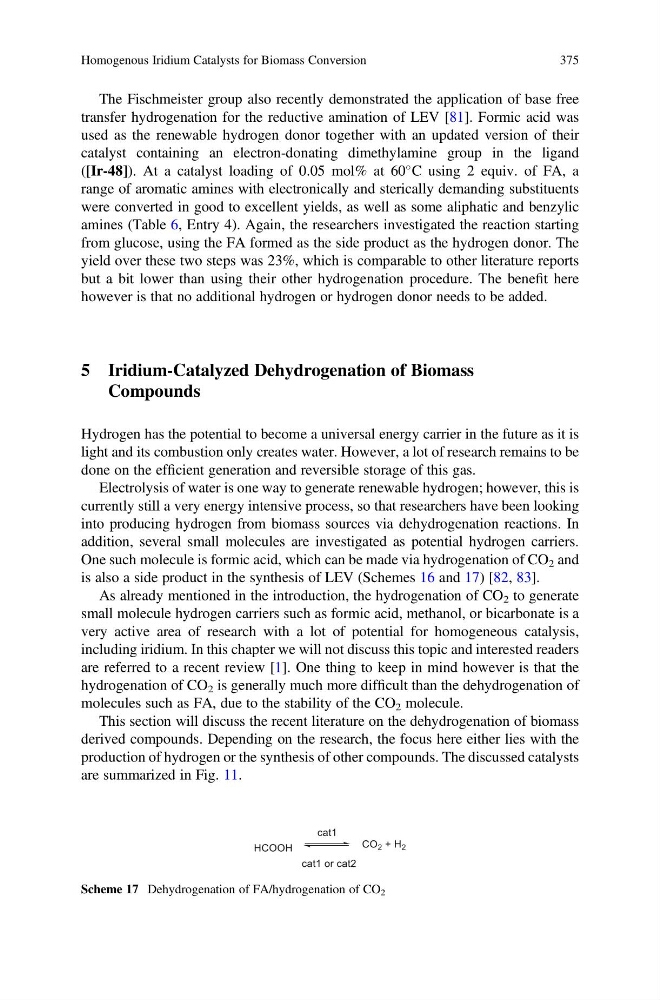
One such molecule is formic acid, which can be made via hydrogenation of CO 2 and
is also a side product in the synthesis of LEV (Schemes 16 and 17) [82, 83].
As already mentioned in the introduction, the hydrogenation of CO 2 to generate
small molecule hydrogen carriers such as formic acid, methanol, or bicarbonate is a
very active area of research with a lot of potential for homogeneous catalysis,
including iridium. In this chapter we will not discuss this topic and interested readers
are referred to a recent review [1]. One thing to keep in mind however is that the
hydrogenation of CO 2 is generally much more difficult than the dehydrogenation of
molecules such as FA, due to the stability of the CO 2 molecule.
This section will discuss the recent literature on the dehydrogenation of biomass
derived compounds. Depending on the research, the focus here either lies with the
production of hydrogen or the synthesis of other compounds. The discussed catalysts
are summarized in Fig. 11.
Scheme 17 Dehydrogenation of FA/hydrogenation of CO 2
Homogenous Iridium Catalysts for Biomass Conversion
375
transfer hydrogenation for the reductive amination of LEV [81]. Formic acid was
used as the renewable hydrogen donor together with an updated version of their
catalyst containing an electron-donating dimethylamine group in the ligand
([Ir-48]). At a catalyst loading of 0.05 mol% at 60
C using 2 equiv. of FA, a
range of aromatic amines with electronically and sterically demanding substituents
were converted in good to excellent yields, as well as some aliphatic and benzylic
amines (Table 6, Entry 4). Again, the researchers investigated the reaction starting
from glucose, using the FA formed as the side product as the hydrogen donor. The
yield over these two steps was 23%, which is comparable to other literature reports
but a bit lower than using their other hydrogenation procedure. The benefit here
however is that no additional hydrogen or hydrogen donor needs to be added.
5 Iridium-Catalyzed Dehydrogenation of Biomass
Compounds
Hydrogen has the potential to become a universal energy carrier in the future as it is
light and its combustion only creates water. However, a lot of research remains to be
done on the efficient generation and reversible storage of this gas.
Electrolysis of water is one way to generate renewable hydrogen; however, this is
currently still a very energy intensive process, so that researchers have been looking
into producing hydrogen from biomass sources via dehydrogenation reactions. In
addition, several small molecules are investigated as potential hydrogen carriers.
One such molecule is formic acid, which can be made via hydrogenation of CO 2 and
is also a side product in the synthesis of LEV (Schemes 16 and 17) [82, 83].
As already mentioned in the introduction, the hydrogenation of CO 2 to generate
small molecule hydrogen carriers such as formic acid, methanol, or bicarbonate is a
very active area of research with a lot of potential for homogeneous catalysis,
including iridium. In this chapter we will not discuss this topic and interested readers
are referred to a recent review [1]. One thing to keep in mind however is that the
hydrogenation of CO 2 is generally much more difficult than the dehydrogenation of
molecules such as FA, due to the stability of the CO 2 molecule.
This section will discuss the recent literature on the dehydrogenation of biomass
derived compounds. Depending on the research, the focus here either lies with the
production of hydrogen or the synthesis of other compounds. The discussed catalysts
are summarized in Fig. 11.
Scheme 17 Dehydrogenation of FA/hydrogenation of CO 2
Homogenous Iridium Catalysts for Biomass Conversion
375