

Fischmeister and coworkers employed the same catalyst [Ir-43] for the reductive
amination of LEV with a range of aliphatic and aromatic amines [78]. In neat
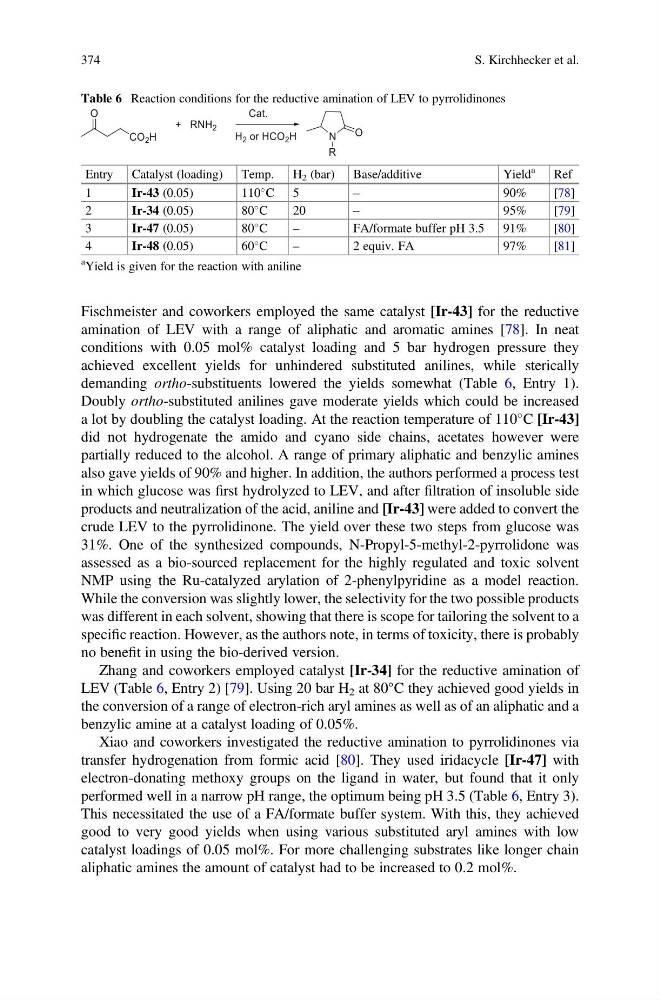
conditions with 0.05 mol% catalyst loading and 5 bar hydrogen pressure they
achieved excellent yields for unhindered substituted anilines, while sterically
demanding ortho-substituents lowered the yields somewhat (Table 6, Entry 1).
Doubly ortho-substituted anilines gave moderate yields which could be increased
a lot by doubling the catalyst loading. At the reaction temperature of 110
C [Ir-43]
did not hydrogenate the amido and cyano side chains, acetates however were
partially reduced to the alcohol. A range of primary aliphatic and benzylic amines
also gave yields of 90% and higher. In addition, the authors performed a process test
in which glucose was first hydrolyzed to LEV, and after filtration of insoluble side
products and neutralization of the acid, aniline and [Ir-43] were added to convert the
crude LEV to the pyrrolidinone. The yield over these two steps from glucose was
31%. One of the synthesized compounds, N-Propyl-5-methyl-2-pyrrolidone was
assessed as a bio-sourced replacement for the highly regulated and toxic solvent
NMP using the Ru-catalyzed arylation of 2-phenylpyridine as a model reaction.
While the conversion was slightly lower, the selectivity for the two possible products
was different in each solvent, showing that there is scope for tailoring the solvent to a
specific reaction. However, as the authors note, in terms of toxicity, there is probably
no benefit in using the bio-derived version.
Zhang and coworkers employed catalyst [Ir-34] for the reductive amination of
LEV (Table 6, Entry 2) [79]. Using 20 bar H 2 at 80°C they achieved good yields in
the conversion of a range of electron-rich aryl amines as well as of an aliphatic and a
benzylic amine at a catalyst loading of 0.05%.
Xiao and coworkers investigated the reductive amination to pyrrolidinones via
transfer hydrogenation from formic acid [80]. They used iridacycle [Ir-47] with
electron-donating methoxy groups on the ligand in water, but found that it only
performed well in a narrow pH range, the optimum being pH 3.5 (Table 6, Entry 3).
This necessitated the use of a FA/formate buffer system. With this, they achieved
good to very good yields when using various substituted aryl amines with low
catalyst loadings of 0.05 mol%. For more challenging substrates like longer chain
aliphatic amines the amount of catalyst had to be increased to 0.2 mol%.
Table 6 Reaction conditions for the reductive amination of LEV to pyrrolidinones
Entry Catalyst (loading) Temp. H 2 (bar) Base/additive
Yield
a
Ref
1
Ir-43 (0.05)
110
C 5
–
90%
[78]
2
Ir-34 (0.05)
80
C
20
–
95%
[79]
3
Ir-47 (0.05)
80
C
–
FA/formate buffer pH 3.5 91%
[80]
4
Ir-48 (0.05)
60
C
–
2 equiv. FA
97%
[81]
a Yield is given for the reaction with aniline
374
S. Kirchhecker et al.
amination of LEV with a range of aliphatic and aromatic amines [78]. In neat
conditions with 0.05 mol% catalyst loading and 5 bar hydrogen pressure they
achieved excellent yields for unhindered substituted anilines, while sterically
demanding ortho-substituents lowered the yields somewhat (Table 6, Entry 1).
Doubly ortho-substituted anilines gave moderate yields which could be increased
a lot by doubling the catalyst loading. At the reaction temperature of 110
C [Ir-43]
did not hydrogenate the amido and cyano side chains, acetates however were
partially reduced to the alcohol. A range of primary aliphatic and benzylic amines
also gave yields of 90% and higher. In addition, the authors performed a process test
in which glucose was first hydrolyzed to LEV, and after filtration of insoluble side
products and neutralization of the acid, aniline and [Ir-43] were added to convert the
crude LEV to the pyrrolidinone. The yield over these two steps from glucose was
31%. One of the synthesized compounds, N-Propyl-5-methyl-2-pyrrolidone was
assessed as a bio-sourced replacement for the highly regulated and toxic solvent
NMP using the Ru-catalyzed arylation of 2-phenylpyridine as a model reaction.
While the conversion was slightly lower, the selectivity for the two possible products
was different in each solvent, showing that there is scope for tailoring the solvent to a
specific reaction. However, as the authors note, in terms of toxicity, there is probably
no benefit in using the bio-derived version.
Zhang and coworkers employed catalyst [Ir-34] for the reductive amination of
LEV (Table 6, Entry 2) [79]. Using 20 bar H 2 at 80°C they achieved good yields in
the conversion of a range of electron-rich aryl amines as well as of an aliphatic and a
benzylic amine at a catalyst loading of 0.05%.
Xiao and coworkers investigated the reductive amination to pyrrolidinones via
transfer hydrogenation from formic acid [80]. They used iridacycle [Ir-47] with
electron-donating methoxy groups on the ligand in water, but found that it only
performed well in a narrow pH range, the optimum being pH 3.5 (Table 6, Entry 3).
This necessitated the use of a FA/formate buffer system. With this, they achieved
good to very good yields when using various substituted aryl amines with low
catalyst loadings of 0.05 mol%. For more challenging substrates like longer chain
aliphatic amines the amount of catalyst had to be increased to 0.2 mol%.
Table 6 Reaction conditions for the reductive amination of LEV to pyrrolidinones
Entry Catalyst (loading) Temp. H 2 (bar) Base/additive
Yield
a
Ref
1
Ir-43 (0.05)
110
C 5
–
90%
[78]
2
Ir-34 (0.05)
80
C
20
–
95%
[79]
3
Ir-47 (0.05)
80
C
–
FA/formate buffer pH 3.5 91%
[80]
4
Ir-48 (0.05)
60
C
–
2 equiv. FA
97%
[81]
a Yield is given for the reaction with aniline
374
S. Kirchhecker et al.