

substrate was found to be the optimum amount of additive, while the reaction was
carried out in excess glycerol mixed with an equal volume of water. The base is
needed to convert the dehydrogenated glycerol to LA, and to stabilize the formed
(GHV) as its salt. Coupling these two hydrogenation/dehydrogenation reactions
achieves the generation of two valuable products in one pot. The base concentration
was adjusted to achieve full conversion of LEV to GHV. Under these conditions, the
yield of LA was 2–3 equivalents due to additional acceptorless dehydrogenation of
glycerol. With the optimized conditions, quantitative conversion of LEV to GHV as
its potassium salt could be achieved at a very low catalyst loading of 1–10 ppm in 2 h
at 150
C under microwave heating. The maximum TOF achieved with 1 ppm
catalyst was 50,550 h
À1 . As in their previous report [31], these really high turnovers
appear to be due to the better heat and mass transfer due to microwave heating. When
the experiment was repeated under conventional heating, 24 h was required to reach
full conversion. Other hydrogen donors were screened but were not as efficient.
Although slower, using (bio-)ethanol, full conversion of LEV could be achieved
within 3 h. While this is an interesting report, it is not explained why in this case no
GVL is formed, even though it apparently happens in basic conditions in other
reports. Attempts were made to separate the two carboxylate products, which were
not successful due to the similar properties of the two compounds. However,
acidification of the reaction medium led to the cyclization of GHV to GVL which
could then be separated from the other product.
4.2 Reductive Amination to Pyrrolidinones
The reductive amination of LEV to N-substituted 5-methyl pyrrolidinones was also
investigated by several groups. These compounds are building blocks for inks,
pharmaceuticals, fibers, or surfactants and can be used as solvents, similar to the
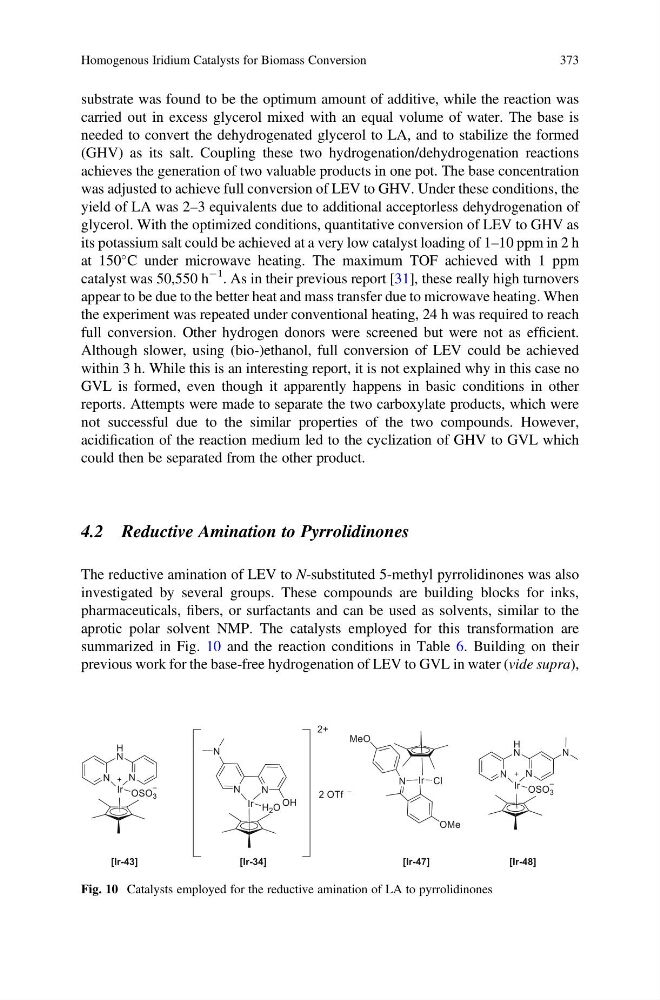
aprotic polar solvent NMP. The catalysts employed for this transformation are
summarized in Fig. 10 and the reaction conditions in Table 6. Building on their
previous work for the base-free hydrogenation of LEV to GVL in water (vide supra),
Fig. 10 Catalysts employed for the reductive amination of LA to pyrrolidinones
Homogenous Iridium Catalysts for Biomass Conversion
373
carried out in excess glycerol mixed with an equal volume of water. The base is
needed to convert the dehydrogenated glycerol to LA, and to stabilize the formed
(GHV) as its salt. Coupling these two hydrogenation/dehydrogenation reactions
achieves the generation of two valuable products in one pot. The base concentration
was adjusted to achieve full conversion of LEV to GHV. Under these conditions, the
yield of LA was 2–3 equivalents due to additional acceptorless dehydrogenation of
glycerol. With the optimized conditions, quantitative conversion of LEV to GHV as
its potassium salt could be achieved at a very low catalyst loading of 1–10 ppm in 2 h
at 150
C under microwave heating. The maximum TOF achieved with 1 ppm
catalyst was 50,550 h
À1 . As in their previous report [31], these really high turnovers
appear to be due to the better heat and mass transfer due to microwave heating. When
the experiment was repeated under conventional heating, 24 h was required to reach
full conversion. Other hydrogen donors were screened but were not as efficient.
Although slower, using (bio-)ethanol, full conversion of LEV could be achieved
within 3 h. While this is an interesting report, it is not explained why in this case no
GVL is formed, even though it apparently happens in basic conditions in other
reports. Attempts were made to separate the two carboxylate products, which were
not successful due to the similar properties of the two compounds. However,
acidification of the reaction medium led to the cyclization of GHV to GVL which
could then be separated from the other product.
4.2 Reductive Amination to Pyrrolidinones
The reductive amination of LEV to N-substituted 5-methyl pyrrolidinones was also
investigated by several groups. These compounds are building blocks for inks,
pharmaceuticals, fibers, or surfactants and can be used as solvents, similar to the
aprotic polar solvent NMP. The catalysts employed for this transformation are
summarized in Fig. 10 and the reaction conditions in Table 6. Building on their
previous work for the base-free hydrogenation of LEV to GVL in water (vide supra),
Fig. 10 Catalysts employed for the reductive amination of LA to pyrrolidinones
Homogenous Iridium Catalysts for Biomass Conversion
373