

Choudhury and coworkers employed an iridium catalyst with a strong sigma
donating abnormal imidazolydine NHC ligand, [Ir-50], for the transfer hydrogenation of CO 2 to formate, using glycerol as the hydrogen donor [88]. The authors
demonstrate that [Ir-50] is a very effective catalyst for the TH of CO 2 at ambient
pressure. They had previously shown that this catalyst is also very efficient in the
same reaction using dihydrogen gas [89]. Glycerol, which is generated as a side
product in the transesterification of vegetable oils to biodiesel (vide infra), was
determined to be the best hydrogen donor, giving better results than the common
reductant isopropanol. K 2 CO 3 was found to be a better base than KOH, and control
experiments were performed to exclude the generation of formate from K 2 CO 3 .
Within 12 h the catalyst reached a TOF of 90 h
À1 at 150
C reaction temperature. In
comparison, in their previous publication the same catalyst achieved a TOF of
58 h
À1 under atmospheric pressure and 30
C, while the reverse reaction, the
dehydrogenation of formic acid, proceeded with a TOF of 100,000 h
À1 at 90
C.
The use of glycerol as a hydrogen donor for TH in combination with iridium and
ruthenium catalysts has recently been reviewed [31].
5.3 Iridium-Catalyzed Dehydrogenation of Sugars
to Sugar Acids
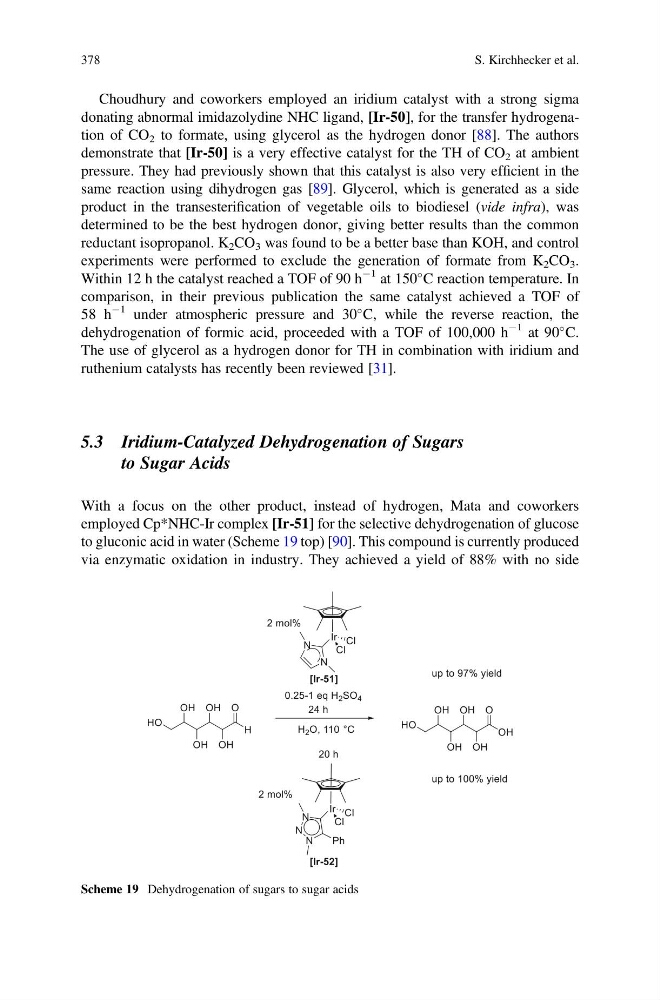
With a focus on the other product, instead of hydrogen, Mata and coworkers
employed Cp*NHC-Ir complex [Ir-51] for the selective dehydrogenation of glucose
to gluconic acid in water (Scheme 19 top) [90]. This compound is currently produced
via enzymatic oxidation in industry. They achieved a yield of 88% with no side
Scheme 19 Dehydrogenation of sugars to sugar acids
378
S. Kirchhecker et al.
donating abnormal imidazolydine NHC ligand, [Ir-50], for the transfer hydrogenation of CO 2 to formate, using glycerol as the hydrogen donor [88]. The authors
demonstrate that [Ir-50] is a very effective catalyst for the TH of CO 2 at ambient
pressure. They had previously shown that this catalyst is also very efficient in the
same reaction using dihydrogen gas [89]. Glycerol, which is generated as a side
product in the transesterification of vegetable oils to biodiesel (vide infra), was
determined to be the best hydrogen donor, giving better results than the common
reductant isopropanol. K 2 CO 3 was found to be a better base than KOH, and control
experiments were performed to exclude the generation of formate from K 2 CO 3 .
Within 12 h the catalyst reached a TOF of 90 h
À1 at 150
C reaction temperature. In
comparison, in their previous publication the same catalyst achieved a TOF of
58 h
À1 under atmospheric pressure and 30
C, while the reverse reaction, the
dehydrogenation of formic acid, proceeded with a TOF of 100,000 h
À1 at 90
C.
The use of glycerol as a hydrogen donor for TH in combination with iridium and
ruthenium catalysts has recently been reviewed [31].
5.3 Iridium-Catalyzed Dehydrogenation of Sugars
to Sugar Acids
With a focus on the other product, instead of hydrogen, Mata and coworkers
employed Cp*NHC-Ir complex [Ir-51] for the selective dehydrogenation of glucose
to gluconic acid in water (Scheme 19 top) [90]. This compound is currently produced
via enzymatic oxidation in industry. They achieved a yield of 88% with no side
Scheme 19 Dehydrogenation of sugars to sugar acids
378
S. Kirchhecker et al.