

on the bipyridine ligand was the most efficient and achieved 98% conversion of LEV
to GVL in 4 h at 120
C and 10 bar hydrogen pressure (Table 5, Entry 1). The TON of
this catalyst was determined to be 78,000, the highest reported figure for this reaction
up to this point. The researchers also tested its activity in the transfer hydrogenation
using formic acid (FA), as this compound is a commonly used hydrogen donor in
these procedures but is also produced in roughly equal amounts to LEV in the
synthesis from biomass. With two equivalents of FA they achieved a yield of 99%
GVL under the same reaction conditions (Table 5, Entry 2). Recycling experiments
were performed by extracting the GVL from the aqueous reaction mixture followed
by the addition of more substrate. After five runs no decrease in yield was detected.
After confirming the stability of the catalyst towards sulfuric acid, the researchers
also applied their hydrogenation methodology to a mixture of LEV and FA generated by the acid-catalyzed hydrolysis of glucose. The yield of GVL from glucose
was 45%. Using cellulose as the starting material, the GVL yield was 34%.
The same group developed a mixed hydrogenation/TH procedure by performing
the reaction under 10 bar of hydrogen in a formate buffer (Table 5, Entry 3) [63]. The
pH optimum was 4.5 and the contribution of formic acid to the hydrogenation
reaction was indicated by comparison to other buffer solutions at the same
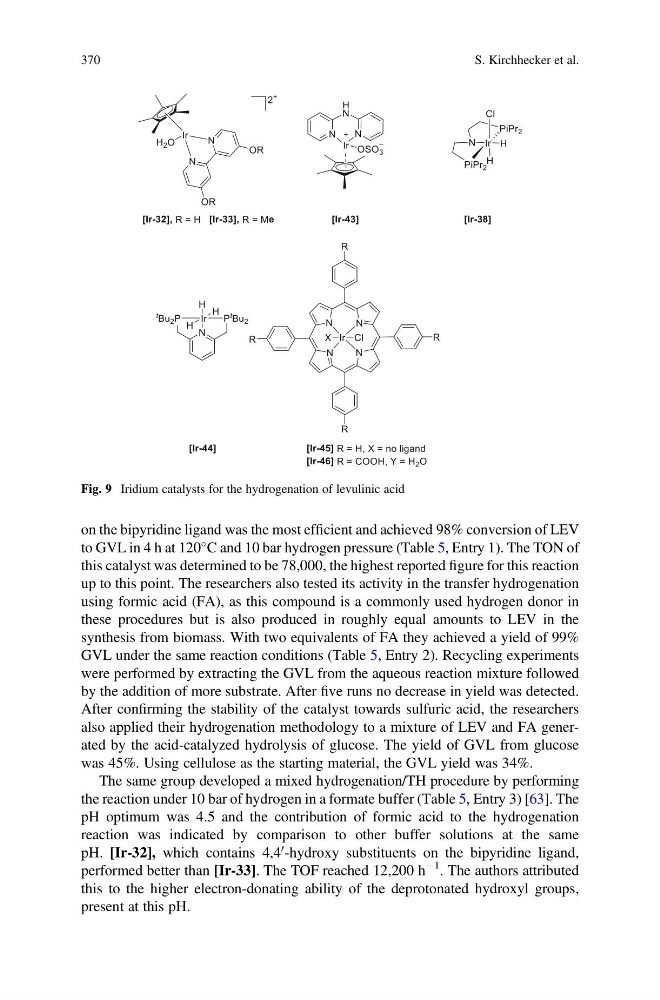
pH. [Ir-32], which contains 4,4
0 -hydroxy substituents on the bipyridine ligand,
performed better than [Ir-33]. The TOF reached 12,200 h
À1 . The authors attributed
this to the higher electron-donating ability of the deprotonated hydroxyl groups,
present at this pH.
Fig. 9 Iridium catalysts for the hydrogenation of levulinic acid
370
S. Kirchhecker et al.
to GVL in 4 h at 120
C and 10 bar hydrogen pressure (Table 5, Entry 1). The TON of
this catalyst was determined to be 78,000, the highest reported figure for this reaction
up to this point. The researchers also tested its activity in the transfer hydrogenation
using formic acid (FA), as this compound is a commonly used hydrogen donor in
these procedures but is also produced in roughly equal amounts to LEV in the
synthesis from biomass. With two equivalents of FA they achieved a yield of 99%
GVL under the same reaction conditions (Table 5, Entry 2). Recycling experiments
were performed by extracting the GVL from the aqueous reaction mixture followed
by the addition of more substrate. After five runs no decrease in yield was detected.
After confirming the stability of the catalyst towards sulfuric acid, the researchers
also applied their hydrogenation methodology to a mixture of LEV and FA generated by the acid-catalyzed hydrolysis of glucose. The yield of GVL from glucose
was 45%. Using cellulose as the starting material, the GVL yield was 34%.
The same group developed a mixed hydrogenation/TH procedure by performing
the reaction under 10 bar of hydrogen in a formate buffer (Table 5, Entry 3) [63]. The
pH optimum was 4.5 and the contribution of formic acid to the hydrogenation
reaction was indicated by comparison to other buffer solutions at the same
pH. [Ir-32], which contains 4,4
0 -hydroxy substituents on the bipyridine ligand,
performed better than [Ir-33]. The TOF reached 12,200 h
À1 . The authors attributed
this to the higher electron-donating ability of the deprotonated hydroxyl groups,
present at this pH.
Fig. 9 Iridium catalysts for the hydrogenation of levulinic acid
370
S. Kirchhecker et al.