

generally higher yields with respect to the use of H 2 (10 bar) in PBS. The latter
observation was explained with the high extent of degradation of BHMF in PBS and
with the poor solubility of H 2 in water. Additionally, the authors underlined the
importance of balancing the acidity of the reaction system. In fact, the presence of
FBS leads to a steadily growth in pH during the reaction and at a later stage of the
reaction prevents BHMF from degradation. Alternatively, to formic acid, the group
of O’Connor and coworkers used isopropanol as a transfer hydrogenation reagent
[64]. Under the same conditions used for the transfer hydrogenation of furfural (see
Table 3, Entry 4), BHMF was quantitatively formed from 5-HMF after 30 min at
85
C with 1 mol% of [Ir-37] (Table 4, Entry 2). The transfer hydrogenation with
[Ir-37] follows an outer sphere mechanism. In contrast, according to Fu and
coworkers, catalyst [Ir-32] forms an active hydride species which operates via an
inner sphere mechanism.
4 Iridium-Catalyzed Conversions of Levulinic Acid
4.1 Hydrogenation to GVL
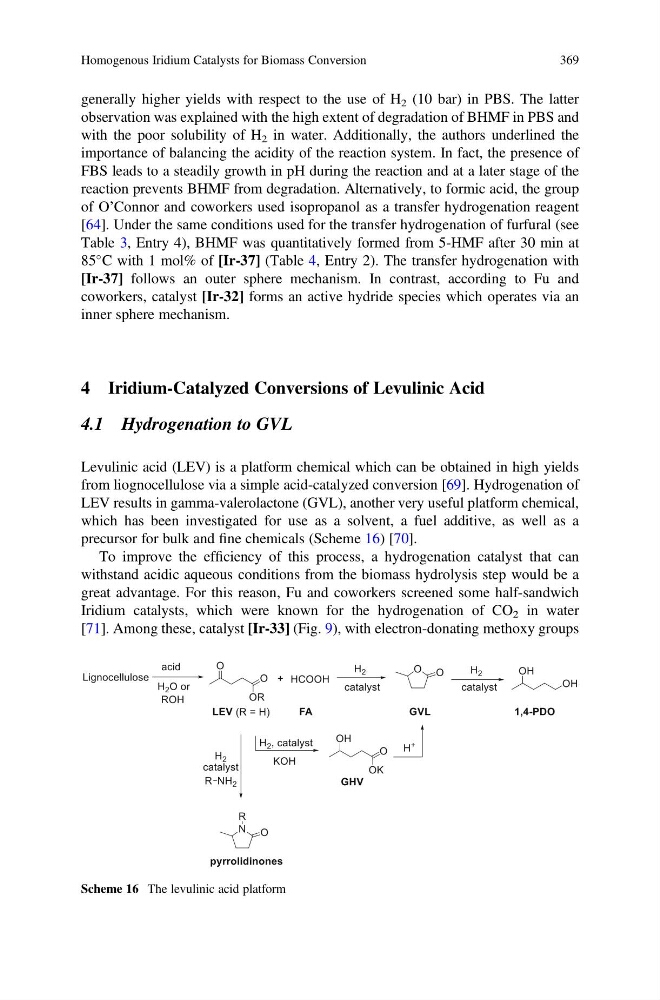
Levulinic acid (LEV) is a platform chemical which can be obtained in high yields
from liognocellulose via a simple acid-catalyzed conversion [69]. Hydrogenation of
LEV results in gamma-valerolactone (GVL), another very useful platform chemical,
which has been investigated for use as a solvent, a fuel additive, as well as a
precursor for bulk and fine chemicals (Scheme 16) [70].
To improve the efficiency of this process, a hydrogenation catalyst that can
withstand acidic aqueous conditions from the biomass hydrolysis step would be a
great advantage. For this reason, Fu and coworkers screened some half-sandwich
Iridium catalysts, which were known for the hydrogenation of CO 2 in water
[71]. Among these, catalyst [Ir-33] (Fig. 9), with electron-donating methoxy groups
Scheme 16 The levulinic acid platform
Homogenous Iridium Catalysts for Biomass Conversion
369
observation was explained with the high extent of degradation of BHMF in PBS and
with the poor solubility of H 2 in water. Additionally, the authors underlined the
importance of balancing the acidity of the reaction system. In fact, the presence of
FBS leads to a steadily growth in pH during the reaction and at a later stage of the
reaction prevents BHMF from degradation. Alternatively, to formic acid, the group
of O’Connor and coworkers used isopropanol as a transfer hydrogenation reagent
[64]. Under the same conditions used for the transfer hydrogenation of furfural (see
Table 3, Entry 4), BHMF was quantitatively formed from 5-HMF after 30 min at
85
C with 1 mol% of [Ir-37] (Table 4, Entry 2). The transfer hydrogenation with
[Ir-37] follows an outer sphere mechanism. In contrast, according to Fu and
coworkers, catalyst [Ir-32] forms an active hydride species which operates via an
inner sphere mechanism.
4 Iridium-Catalyzed Conversions of Levulinic Acid
4.1 Hydrogenation to GVL
Levulinic acid (LEV) is a platform chemical which can be obtained in high yields
from liognocellulose via a simple acid-catalyzed conversion [69]. Hydrogenation of
LEV results in gamma-valerolactone (GVL), another very useful platform chemical,
which has been investigated for use as a solvent, a fuel additive, as well as a
precursor for bulk and fine chemicals (Scheme 16) [70].
To improve the efficiency of this process, a hydrogenation catalyst that can
withstand acidic aqueous conditions from the biomass hydrolysis step would be a
great advantage. For this reason, Fu and coworkers screened some half-sandwich
Iridium catalysts, which were known for the hydrogenation of CO 2 in water
[71]. Among these, catalyst [Ir-33] (Fig. 9), with electron-donating methoxy groups
Scheme 16 The levulinic acid platform
Homogenous Iridium Catalysts for Biomass Conversion
369