

3.4 Selective Hydrogenation of 5-Hydroxymethyl Furfural
to 2,5-Bis(Hydroxymethyl)Furan
2,5-Bis(hydroxymethyl)furan (BHMF) is a key molecule for the preparation of
polymers, resins, crown ethers, and rayons and for this reason it is a potentially
promising downstream product of biorefineries [68]. Although both homogenous
and heterogenous catalysts are known for the selective hydrogenation of 5-HMF to
BHMF, the literature about homogenously catalyzed hydrogenation to form BHMF
is scarce [68]. The first example of homogenous iridium catalysts was reported by
Rauchfuss and coworkers [66]. The authors tested a range of Cp* iridium complexes
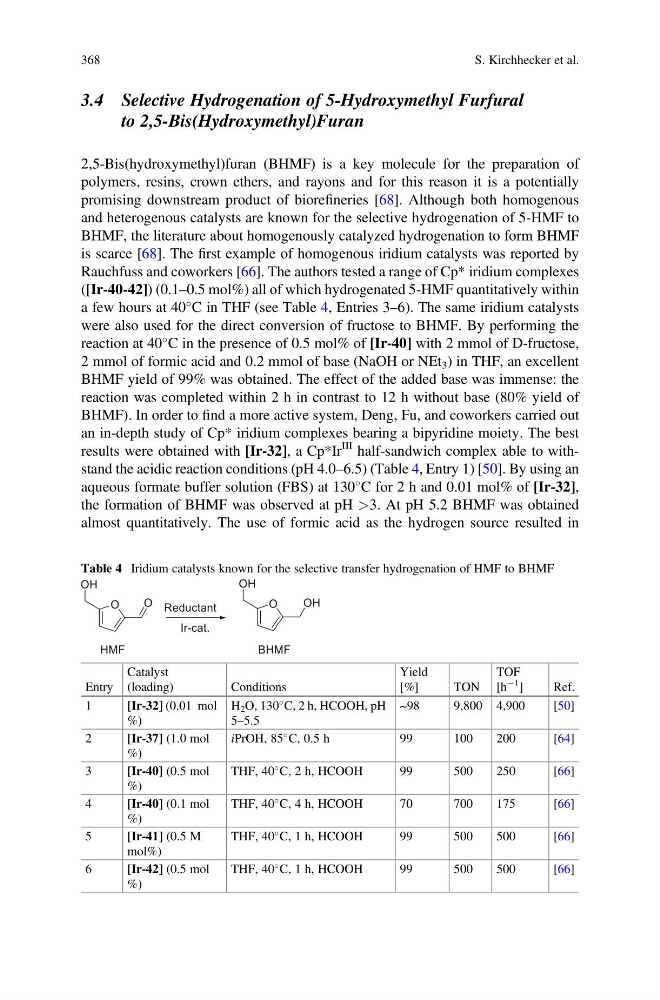
([Ir-40-42]) (0.1–0.5 mol%) all of which hydrogenated 5-HMF quantitatively within
a few hours at 40
C in THF (see Table 4, Entries 3–6). The same iridium catalysts
were also used for the direct conversion of fructose to BHMF. By performing the
reaction at 40
C in the presence of 0.5 mol% of [Ir-40] with 2 mmol of D-fructose,
2 mmol of formic acid and 0.2 mmol of base (NaOH or NEt 3 ) in THF, an excellent
BHMF yield of 99% was obtained. The effect of the added base was immense: the
reaction was completed within 2 h in contrast to 12 h without base (80% yield of
BHMF). In order to find a more active system, Deng, Fu, and coworkers carried out
an in-depth study of Cp* iridium complexes bearing a bipyridine moiety. The best
results were obtained with [Ir-32], a Cp*Ir
III half-sandwich complex able to withstand the acidic reaction conditions (pH 4.0–6.5) (Table 4, Entry 1) [50]. By using an
aqueous formate buffer solution (FBS) at 130
C for 2 h and 0.01 mol% of [Ir-32],
the formation of BHMF was observed at pH >3. At pH 5.2 BHMF was obtained
almost quantitatively. The use of formic acid as the hydrogen source resulted in
Table 4 Iridium catalysts known for the selective transfer hydrogenation of HMF to BHMF
Entry
Catalyst
(loading)
Conditions
Yield
[%]
TON
TOF
[h
À1
]
Ref.
1
[Ir-32] (0.01 mol
%)
H 2 O, 130
C, 2 h, HCOOH, pH
5–5.5
~98
9,800 4,900
[50]
2
[Ir-37] (1.0 mol
%)
iPrOH, 85
C, 0.5 h
99
100
200
[64]
3
[Ir-40] (0.5 mol
%)
THF, 40
C, 2 h, HCOOH
99
500
250
[66]
4
[Ir-40] (0.1 mol
%)
THF, 40
C, 4 h, HCOOH
70
700
175
[66]
5
[Ir-41] (0.5 M
mol%)
THF, 40
C, 1 h, HCOOH
99
500
500
[66]
6
[Ir-42] (0.5 mol
%)
THF, 40
C, 1 h, HCOOH
99
500
500
[66]
368
S. Kirchhecker et al.
to 2,5-Bis(Hydroxymethyl)Furan
2,5-Bis(hydroxymethyl)furan (BHMF) is a key molecule for the preparation of
polymers, resins, crown ethers, and rayons and for this reason it is a potentially
promising downstream product of biorefineries [68]. Although both homogenous
and heterogenous catalysts are known for the selective hydrogenation of 5-HMF to
BHMF, the literature about homogenously catalyzed hydrogenation to form BHMF
is scarce [68]. The first example of homogenous iridium catalysts was reported by
Rauchfuss and coworkers [66]. The authors tested a range of Cp* iridium complexes
([Ir-40-42]) (0.1–0.5 mol%) all of which hydrogenated 5-HMF quantitatively within
a few hours at 40
C in THF (see Table 4, Entries 3–6). The same iridium catalysts
were also used for the direct conversion of fructose to BHMF. By performing the
reaction at 40
C in the presence of 0.5 mol% of [Ir-40] with 2 mmol of D-fructose,
2 mmol of formic acid and 0.2 mmol of base (NaOH or NEt 3 ) in THF, an excellent
BHMF yield of 99% was obtained. The effect of the added base was immense: the
reaction was completed within 2 h in contrast to 12 h without base (80% yield of
BHMF). In order to find a more active system, Deng, Fu, and coworkers carried out
an in-depth study of Cp* iridium complexes bearing a bipyridine moiety. The best
results were obtained with [Ir-32], a Cp*Ir
III half-sandwich complex able to withstand the acidic reaction conditions (pH 4.0–6.5) (Table 4, Entry 1) [50]. By using an
aqueous formate buffer solution (FBS) at 130
C for 2 h and 0.01 mol% of [Ir-32],
the formation of BHMF was observed at pH >3. At pH 5.2 BHMF was obtained
almost quantitatively. The use of formic acid as the hydrogen source resulted in
Table 4 Iridium catalysts known for the selective transfer hydrogenation of HMF to BHMF
Entry
Catalyst
(loading)
Conditions
Yield
[%]
TON
TOF
[h
À1
]
Ref.
1
[Ir-32] (0.01 mol
%)
H 2 O, 130
C, 2 h, HCOOH, pH
5–5.5
~98
9,800 4,900
[50]
2
[Ir-37] (1.0 mol
%)
iPrOH, 85
C, 0.5 h
99
100
200
[64]
3
[Ir-40] (0.5 mol
%)
THF, 40
C, 2 h, HCOOH
99
500
250
[66]
4
[Ir-40] (0.1 mol
%)
THF, 40
C, 4 h, HCOOH
70
700
175
[66]
5
[Ir-41] (0.5 M
mol%)
THF, 40
C, 1 h, HCOOH
99
500
500
[66]
6
[Ir-42] (0.5 mol
%)
THF, 40
C, 1 h, HCOOH
99
500
500
[66]
368
S. Kirchhecker et al.