

catalyst [Ir-33] 30.4% yield was achieved at pH 4 and with catalyst [Ir-32] a yield
>99% was observed at pH 4.5. Finally, Fu and coworkers also reported the direct
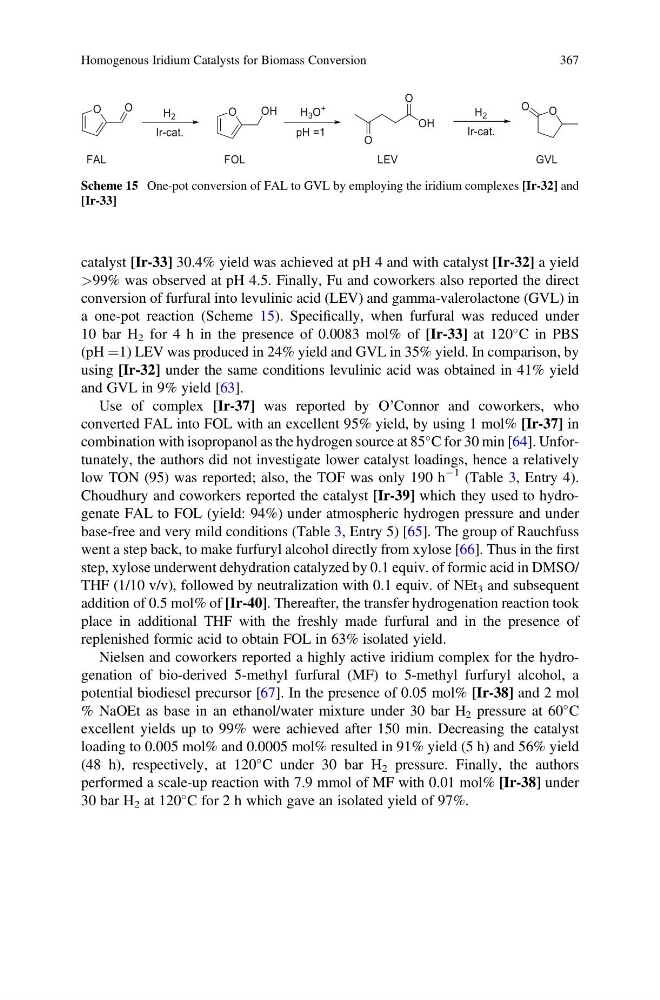
conversion of furfural into levulinic acid (LEV) and gamma-valerolactone (GVL) in
a one-pot reaction (Scheme 15). Specifically, when furfural was reduced under
10 bar H 2 for 4 h in the presence of 0.0083 mol% of [Ir-33] at 120
C in PBS
(pH ¼1) LEV was produced in 24% yield and GVL in 35% yield. In comparison, by
using [Ir-32] under the same conditions levulinic acid was obtained in 41% yield
and GVL in 9% yield [63].
Use of complex [Ir-37] was reported by O’Connor and coworkers, who
converted FAL into FOL with an excellent 95% yield, by using 1 mol% [Ir-37] in
combination with isopropanol as the hydrogen source at 85
C for 30 min [64]. Unfortunately, the authors did not investigate lower catalyst loadings, hence a relatively
low TON (95) was reported; also, the TOF was only 190 h
À1 (Table 3, Entry 4).
Choudhury and coworkers reported the catalyst [Ir-39] which they used to hydrogenate FAL to FOL (yield: 94%) under atmospheric hydrogen pressure and under
base-free and very mild conditions (Table 3, Entry 5) [65]. The group of Rauchfuss
went a step back, to make furfuryl alcohol directly from xylose [66]. Thus in the first
step, xylose underwent dehydration catalyzed by 0.1 equiv. of formic acid in DMSO/
THF (1/10 v/v), followed by neutralization with 0.1 equiv. of NEt 3 and subsequent
addition of 0.5 mol% of [Ir-40]. Thereafter, the transfer hydrogenation reaction took
place in additional THF with the freshly made furfural and in the presence of
replenished formic acid to obtain FOL in 63% isolated yield.
Nielsen and coworkers reported a highly active iridium complex for the hydrogenation of bio-derived 5-methyl furfural (MF) to 5-methyl furfuryl alcohol, a
potential biodiesel precursor [67]. In the presence of 0.05 mol% [Ir-38] and 2 mol
% NaOEt as base in an ethanol/water mixture under 30 bar H 2 pressure at 60
C
excellent yields up to 99% were achieved after 150 min. Decreasing the catalyst
loading to 0.005 mol% and 0.0005 mol% resulted in 91% yield (5 h) and 56% yield
(48 h), respectively, at 120
C under 30 bar H 2 pressure. Finally, the authors
performed a scale-up reaction with 7.9 mmol of MF with 0.01 mol% [Ir-38] under
30 bar H 2 at 120
C for 2 h which gave an isolated yield of 97%.
Scheme 15 One-pot conversion of FAL to GVL by employing the iridium complexes [Ir-32] and
[Ir-33]
Homogenous Iridium Catalysts for Biomass Conversion
367
>99% was observed at pH 4.5. Finally, Fu and coworkers also reported the direct
conversion of furfural into levulinic acid (LEV) and gamma-valerolactone (GVL) in
a one-pot reaction (Scheme 15). Specifically, when furfural was reduced under
10 bar H 2 for 4 h in the presence of 0.0083 mol% of [Ir-33] at 120
C in PBS
(pH ¼1) LEV was produced in 24% yield and GVL in 35% yield. In comparison, by
using [Ir-32] under the same conditions levulinic acid was obtained in 41% yield
and GVL in 9% yield [63].
Use of complex [Ir-37] was reported by O’Connor and coworkers, who
converted FAL into FOL with an excellent 95% yield, by using 1 mol% [Ir-37] in
combination with isopropanol as the hydrogen source at 85
C for 30 min [64]. Unfortunately, the authors did not investigate lower catalyst loadings, hence a relatively
low TON (95) was reported; also, the TOF was only 190 h
À1 (Table 3, Entry 4).
Choudhury and coworkers reported the catalyst [Ir-39] which they used to hydrogenate FAL to FOL (yield: 94%) under atmospheric hydrogen pressure and under
base-free and very mild conditions (Table 3, Entry 5) [65]. The group of Rauchfuss
went a step back, to make furfuryl alcohol directly from xylose [66]. Thus in the first
step, xylose underwent dehydration catalyzed by 0.1 equiv. of formic acid in DMSO/
THF (1/10 v/v), followed by neutralization with 0.1 equiv. of NEt 3 and subsequent
addition of 0.5 mol% of [Ir-40]. Thereafter, the transfer hydrogenation reaction took
place in additional THF with the freshly made furfural and in the presence of
replenished formic acid to obtain FOL in 63% isolated yield.
Nielsen and coworkers reported a highly active iridium complex for the hydrogenation of bio-derived 5-methyl furfural (MF) to 5-methyl furfuryl alcohol, a
potential biodiesel precursor [67]. In the presence of 0.05 mol% [Ir-38] and 2 mol
% NaOEt as base in an ethanol/water mixture under 30 bar H 2 pressure at 60
C
excellent yields up to 99% were achieved after 150 min. Decreasing the catalyst
loading to 0.005 mol% and 0.0005 mol% resulted in 91% yield (5 h) and 56% yield
(48 h), respectively, at 120
C under 30 bar H 2 pressure. Finally, the authors
performed a scale-up reaction with 7.9 mmol of MF with 0.01 mol% [Ir-38] under
30 bar H 2 at 120
C for 2 h which gave an isolated yield of 97%.
Scheme 15 One-pot conversion of FAL to GVL by employing the iridium complexes [Ir-32] and
[Ir-33]
Homogenous Iridium Catalysts for Biomass Conversion
367