

3.3 Iridium-Catalyzed (Transfer)Hydrogenation of Furfurals
Furfural (FAL) was isolated for the first time by Johann Wolfgang Döbereiner in
1831 and, due to the variety of possible transformations which it can undergo, has
become over the last century one of the most important biomass-based C 5 -platform
molecules [55]. Its wide range of applications can be found in the recently published
review article which summarizes the synthesis of more than 80 chemicals directly or
indirectly derived from FAL [62]. The production of FAL is currently carried out in
lignocellulosic biorefineries by using agricultural and forestry waste as starting
materials. Furfuryl alcohol (FOL) is by far the largest FAL derivative, with 65%
of the overall FAL production volume used for its synthesis. FOL is in fact an
important intermediate primarily used in the production of resins, pharmaceuticals,
and in the manufacture of fragrances. Currently, the gas-phase Cu-catalyzed hydrogenation of FAL is the major route towards FOL, because the reaction in liquid
phase is economically unattractive due to the high operating costs of batch
reactors [62].
Efficient iridium catalysts for the (transfer)hydrogenation of FAL to FOL were
reported by Deng, Fu, and coworkers. Their initial synthetic procedure required the
use of semi-sandwich iridium catalysts [Ir-32] or [Ir-33] in 0.0083 mol% under
10 bar H 2 at 120
C for one hour [63]. Subsequently, the effect of pH (adjusted by a
phosphate buffer solution (PBS) and H 3 PO 4 ) on catalytic activity for catalysts
[Ir-33] and [Ir-32] was examined. As a result, the highest TOF (1,600 h
À1 ) for
[Ir-33] was found at pH ¼ 3.5, while for [Ir-32] the highest TOF (7,340 h
À1 ) was
achieved at pH ¼ 5. The authors explained the higher activity of catalyst [Ir-32] with
respect to [Ir-33] with its ability to generate an electro-donating aryloxy anion which
is crucial for the performance of this type of catalyst. Transfer hydrogenation using
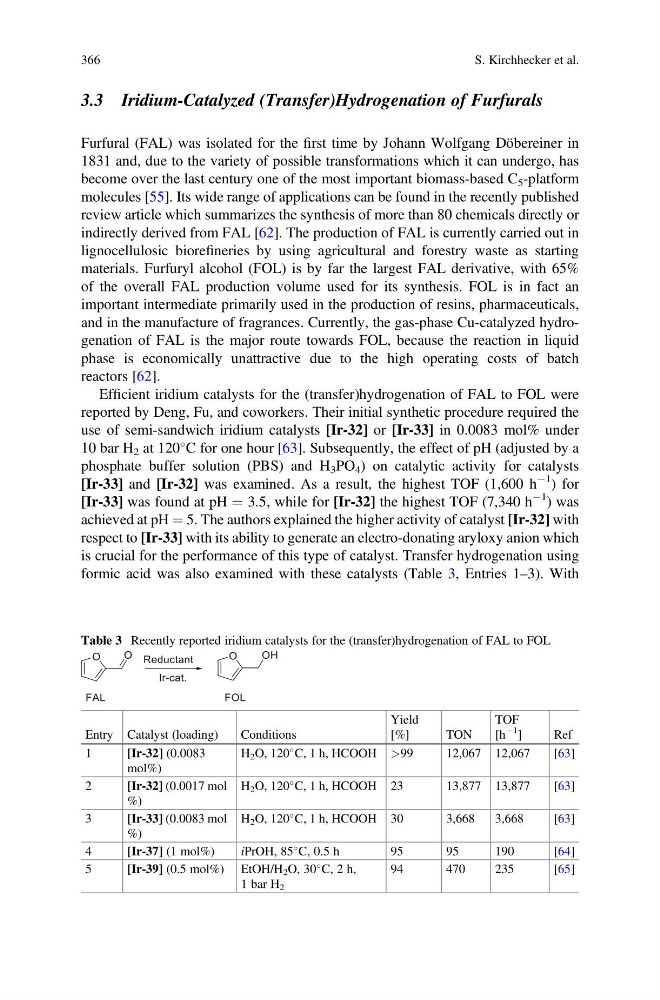
formic acid was also examined with these catalysts (Table 3, Entries 1–3). With
Table 3 Recently reported iridium catalysts for the (transfer)hydrogenation of FAL to FOL
Entry Catalyst (loading)
Conditions
Yield
[%]
TON
TOF
[h
À1
]
Ref
1
[Ir-32] (0.0083
mol%)
H 2 O, 120
C, 1 h, HCOOH >99
12,067 12,067
[63]
2
[Ir-32] (0.0017 mol
%)
H 2 O, 120
C, 1 h, HCOOH 23
13,877 13,877
[63]
3
[Ir-33] (0.0083 mol
%)
H 2 O, 120
C, 1 h, HCOOH 30
3,668
3,668
[63]
4
[Ir-37] (1 mol%)
iPrOH, 85
C, 0.5 h
95
95
190
[64]
5
[Ir-39] (0.5 mol%) EtOH/H 2 O, 30
C, 2 h,
1 bar H 2
94
470
235
[65]
366
S. Kirchhecker et al.
Furfural (FAL) was isolated for the first time by Johann Wolfgang Döbereiner in
1831 and, due to the variety of possible transformations which it can undergo, has
become over the last century one of the most important biomass-based C 5 -platform
molecules [55]. Its wide range of applications can be found in the recently published
review article which summarizes the synthesis of more than 80 chemicals directly or
indirectly derived from FAL [62]. The production of FAL is currently carried out in
lignocellulosic biorefineries by using agricultural and forestry waste as starting
materials. Furfuryl alcohol (FOL) is by far the largest FAL derivative, with 65%
of the overall FAL production volume used for its synthesis. FOL is in fact an
important intermediate primarily used in the production of resins, pharmaceuticals,
and in the manufacture of fragrances. Currently, the gas-phase Cu-catalyzed hydrogenation of FAL is the major route towards FOL, because the reaction in liquid
phase is economically unattractive due to the high operating costs of batch
reactors [62].
Efficient iridium catalysts for the (transfer)hydrogenation of FAL to FOL were
reported by Deng, Fu, and coworkers. Their initial synthetic procedure required the
use of semi-sandwich iridium catalysts [Ir-32] or [Ir-33] in 0.0083 mol% under
10 bar H 2 at 120
C for one hour [63]. Subsequently, the effect of pH (adjusted by a
phosphate buffer solution (PBS) and H 3 PO 4 ) on catalytic activity for catalysts
[Ir-33] and [Ir-32] was examined. As a result, the highest TOF (1,600 h
À1 ) for
[Ir-33] was found at pH ¼ 3.5, while for [Ir-32] the highest TOF (7,340 h
À1 ) was
achieved at pH ¼ 5. The authors explained the higher activity of catalyst [Ir-32] with
respect to [Ir-33] with its ability to generate an electro-donating aryloxy anion which
is crucial for the performance of this type of catalyst. Transfer hydrogenation using
formic acid was also examined with these catalysts (Table 3, Entries 1–3). With
Table 3 Recently reported iridium catalysts for the (transfer)hydrogenation of FAL to FOL
Entry Catalyst (loading)
Conditions
Yield
[%]
TON
TOF
[h
À1
]
Ref
1
[Ir-32] (0.0083
mol%)
H 2 O, 120
C, 1 h, HCOOH >99
12,067 12,067
[63]
2
[Ir-32] (0.0017 mol
%)
H 2 O, 120
C, 1 h, HCOOH 23
13,877 13,877
[63]
3
[Ir-33] (0.0083 mol
%)
H 2 O, 120
C, 1 h, HCOOH 30
3,668
3,668
[63]
4
[Ir-37] (1 mol%)
iPrOH, 85
C, 0.5 h
95
95
190
[64]
5
[Ir-39] (0.5 mol%) EtOH/H 2 O, 30
C, 2 h,
1 bar H 2
94
470
235
[65]
366
S. Kirchhecker et al.