

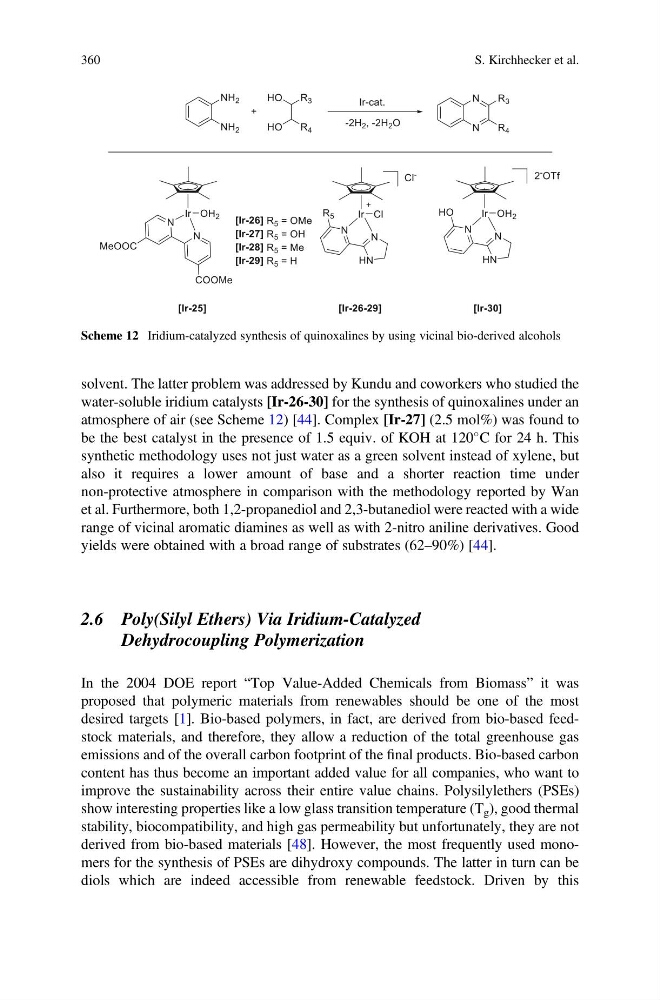
solvent. The latter problem was addressed by Kundu and coworkers who studied the
water-soluble iridium catalysts [Ir-26-30] for the synthesis of quinoxalines under an
atmosphere of air (see Scheme 12) [44]. Complex [Ir-27] (2.5 mol%) was found to
be the best catalyst in the presence of 1.5 equiv. of KOH at 120
C for 24 h. This
synthetic methodology uses not just water as a green solvent instead of xylene, but
also it requires a lower amount of base and a shorter reaction time under
non-protective atmosphere in comparison with the methodology reported by Wan
et al. Furthermore, both 1,2-propanediol and 2,3-butanediol were reacted with a wide
range of vicinal aromatic diamines as well as with 2-nitro aniline derivatives. Good
yields were obtained with a broad range of substrates (62–90%) [44].
2.6 Poly(Silyl Ethers) Via Iridium-Catalyzed
Dehydrocoupling Polymerization
In the 2004 DOE report “Top Value-Added Chemicals from Biomass” it was
proposed that polymeric materials from renewables should be one of the most
desired targets [1]. Bio-based polymers, in fact, are derived from bio-based feedstock materials, and therefore, they allow a reduction of the total greenhouse gas
emissions and of the overall carbon footprint of the final products. Bio-based carbon
content has thus become an important added value for all companies, who want to
improve the sustainability across their entire value chains. Polysilylethers (PSEs)
show interesting properties like a low glass transition temperature (T g ), good thermal
stability, biocompatibility, and high gas permeability but unfortunately, they are not
derived from bio-based materials [48]. However, the most frequently used monomers for the synthesis of PSEs are dihydroxy compounds. The latter in turn can be
diols which are indeed accessible from renewable feedstock. Driven by this
Scheme 12 Iridium-catalyzed synthesis of quinoxalines by using vicinal bio-derived alcohols
360
S. Kirchhecker et al.
water-soluble iridium catalysts [Ir-26-30] for the synthesis of quinoxalines under an
atmosphere of air (see Scheme 12) [44]. Complex [Ir-27] (2.5 mol%) was found to
be the best catalyst in the presence of 1.5 equiv. of KOH at 120
C for 24 h. This
synthetic methodology uses not just water as a green solvent instead of xylene, but
also it requires a lower amount of base and a shorter reaction time under
non-protective atmosphere in comparison with the methodology reported by Wan
et al. Furthermore, both 1,2-propanediol and 2,3-butanediol were reacted with a wide
range of vicinal aromatic diamines as well as with 2-nitro aniline derivatives. Good
yields were obtained with a broad range of substrates (62–90%) [44].
2.6 Poly(Silyl Ethers) Via Iridium-Catalyzed
Dehydrocoupling Polymerization
In the 2004 DOE report “Top Value-Added Chemicals from Biomass” it was
proposed that polymeric materials from renewables should be one of the most
desired targets [1]. Bio-based polymers, in fact, are derived from bio-based feedstock materials, and therefore, they allow a reduction of the total greenhouse gas
emissions and of the overall carbon footprint of the final products. Bio-based carbon
content has thus become an important added value for all companies, who want to
improve the sustainability across their entire value chains. Polysilylethers (PSEs)
show interesting properties like a low glass transition temperature (T g ), good thermal
stability, biocompatibility, and high gas permeability but unfortunately, they are not
derived from bio-based materials [48]. However, the most frequently used monomers for the synthesis of PSEs are dihydroxy compounds. The latter in turn can be
diols which are indeed accessible from renewable feedstock. Driven by this
Scheme 12 Iridium-catalyzed synthesis of quinoxalines by using vicinal bio-derived alcohols
360
S. Kirchhecker et al.