

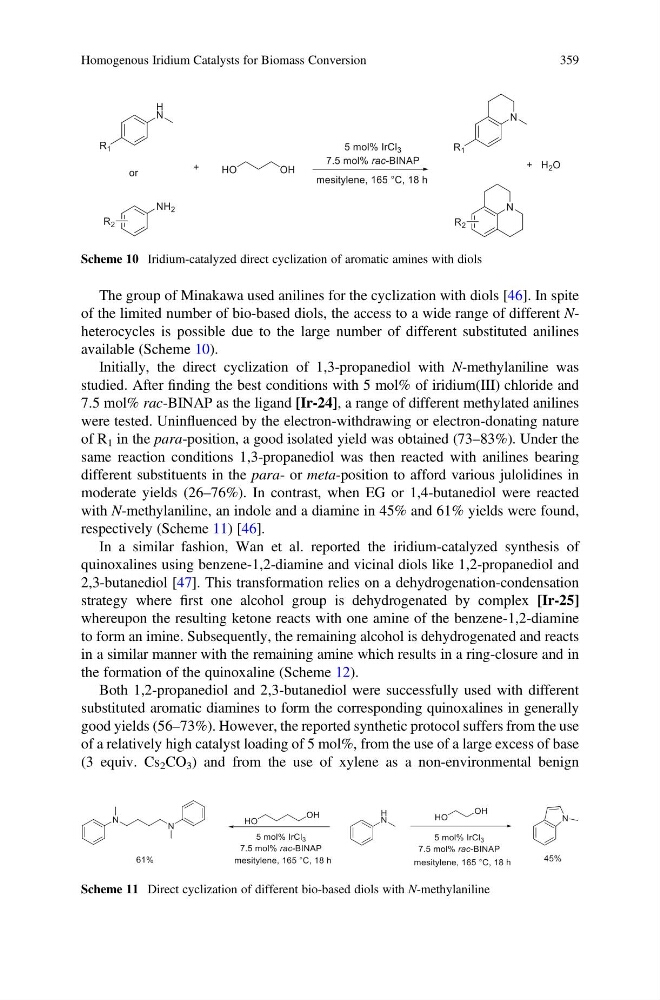
The group of Minakawa used anilines for the cyclization with diols [46]. In spite
of the limited number of bio-based diols, the access to a wide range of different Nheterocycles is possible due to the large number of different substituted anilines
available (Scheme 10).
Initially, the direct cyclization of 1,3-propanediol with N-methylaniline was
studied. After finding the best conditions with 5 mol% of iridium(III) chloride and
7.5 mol% rac-BINAP as the ligand [Ir-24], a range of different methylated anilines
were tested. Uninfluenced by the electron-withdrawing or electron-donating nature
of R 1 in the para-position, a good isolated yield was obtained (73–83%). Under the
same reaction conditions 1,3-propanediol was then reacted with anilines bearing
different substituents in the para- or meta-position to afford various julolidines in
moderate yields (26–76%). In contrast, when EG or 1,4-butanediol were reacted
with N-methylaniline, an indole and a diamine in 45% and 61% yields were found,
respectively (Scheme 11) [46].
In a similar fashion, Wan et al. reported the iridium-catalyzed synthesis of
quinoxalines using benzene-1,2-diamine and vicinal diols like 1,2-propanediol and
2,3-butanediol [47]. This transformation relies on a dehydrogenation-condensation
strategy where first one alcohol group is dehydrogenated by complex [Ir-25]
whereupon the resulting ketone reacts with one amine of the benzene-1,2-diamine
to form an imine. Subsequently, the remaining alcohol is dehydrogenated and reacts
in a similar manner with the remaining amine which results in a ring-closure and in
the formation of the quinoxaline (Scheme 12).
Both 1,2-propanediol and 2,3-butanediol were successfully used with different
substituted aromatic diamines to form the corresponding quinoxalines in generally
good yields (56–73%). However, the reported synthetic protocol suffers from the use
of a relatively high catalyst loading of 5 mol%, from the use of a large excess of base
(3 equiv. Cs 2 CO 3 ) and from the use of xylene as a non-environmental benign
Scheme 10 Iridium-catalyzed direct cyclization of aromatic amines with diols
Scheme 11 Direct cyclization of different bio-based diols with N-methylaniline
Homogenous Iridium Catalysts for Biomass Conversion
359
of the limited number of bio-based diols, the access to a wide range of different Nheterocycles is possible due to the large number of different substituted anilines
available (Scheme 10).
Initially, the direct cyclization of 1,3-propanediol with N-methylaniline was
studied. After finding the best conditions with 5 mol% of iridium(III) chloride and
7.5 mol% rac-BINAP as the ligand [Ir-24], a range of different methylated anilines
were tested. Uninfluenced by the electron-withdrawing or electron-donating nature
of R 1 in the para-position, a good isolated yield was obtained (73–83%). Under the
same reaction conditions 1,3-propanediol was then reacted with anilines bearing
different substituents in the para- or meta-position to afford various julolidines in
moderate yields (26–76%). In contrast, when EG or 1,4-butanediol were reacted
with N-methylaniline, an indole and a diamine in 45% and 61% yields were found,
respectively (Scheme 11) [46].
In a similar fashion, Wan et al. reported the iridium-catalyzed synthesis of
quinoxalines using benzene-1,2-diamine and vicinal diols like 1,2-propanediol and
2,3-butanediol [47]. This transformation relies on a dehydrogenation-condensation
strategy where first one alcohol group is dehydrogenated by complex [Ir-25]
whereupon the resulting ketone reacts with one amine of the benzene-1,2-diamine
to form an imine. Subsequently, the remaining alcohol is dehydrogenated and reacts
in a similar manner with the remaining amine which results in a ring-closure and in
the formation of the quinoxaline (Scheme 12).
Both 1,2-propanediol and 2,3-butanediol were successfully used with different
substituted aromatic diamines to form the corresponding quinoxalines in generally
good yields (56–73%). However, the reported synthetic protocol suffers from the use
of a relatively high catalyst loading of 5 mol%, from the use of a large excess of base
(3 equiv. Cs 2 CO 3 ) and from the use of xylene as a non-environmental benign
Scheme 10 Iridium-catalyzed direct cyclization of aromatic amines with diols
Scheme 11 Direct cyclization of different bio-based diols with N-methylaniline
Homogenous Iridium Catalysts for Biomass Conversion
359