

Their approach uses bio-derived 1,3-propanediol as a reagent, and it meets
several criteria of the twelve principles of green chemistry: it avoids the use of
halogenated reagents, it is a catalytic process, and it generates water as an
ecofriendly by-product. For their study, they synthesized and tested a range of
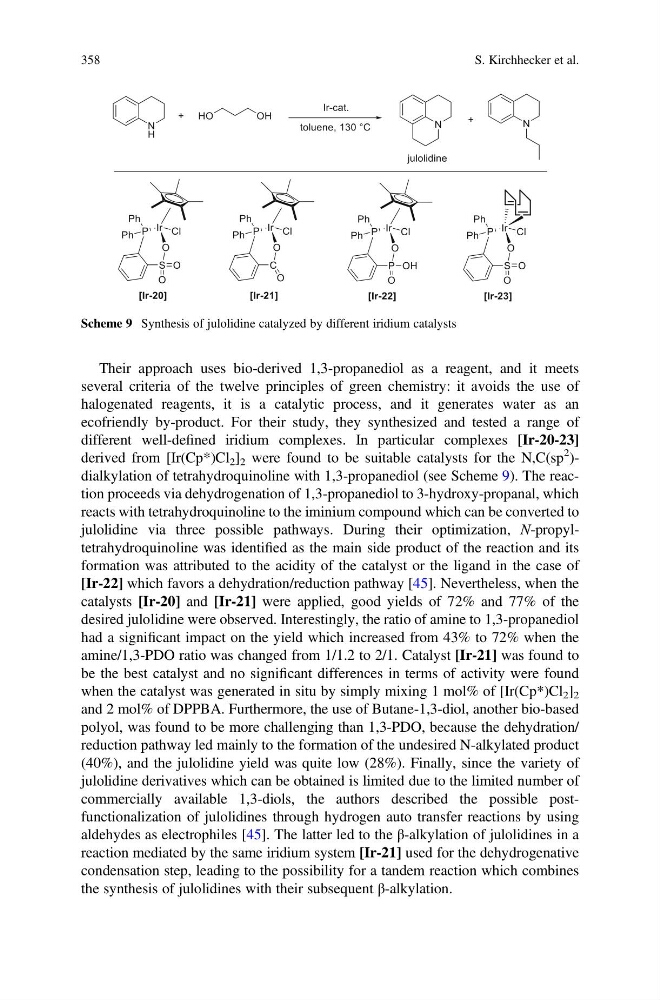
different well-defined iridium complexes. In particular complexes [Ir-20-23]
derived from [Ir(Cp*)Cl 2 ] 2 were found to be suitable catalysts for the N,C(sp
2 )dialkylation of tetrahydroquinoline with 1,3-propanediol (see Scheme 9). The reaction proceeds via dehydrogenation of 1,3-propanediol to 3-hydroxy-propanal, which
reacts with tetrahydroquinoline to the iminium compound which can be converted to
julolidine via three possible pathways. During their optimization, N-propyltetrahydroquinoline was identified as the main side product of the reaction and its
formation was attributed to the acidity of the catalyst or the ligand in the case of
[Ir-22] which favors a dehydration/reduction pathway [45]. Nevertheless, when the
catalysts [Ir-20] and [Ir-21] were applied, good yields of 72% and 77% of the
desired julolidine were observed. Interestingly, the ratio of amine to 1,3-propanediol
had a significant impact on the yield which increased from 43% to 72% when the
amine/1,3-PDO ratio was changed from 1/1.2 to 2/1. Catalyst [Ir-21] was found to
be the best catalyst and no significant differences in terms of activity were found
when the catalyst was generated in situ by simply mixing 1 mol% of [Ir(Cp*)Cl 2 ] 2
and 2 mol% of DPPBA. Furthermore, the use of Butane-1,3-diol, another bio-based
polyol, was found to be more challenging than 1,3-PDO, because the dehydration/
reduction pathway led mainly to the formation of the undesired N-alkylated product
(40%), and the julolidine yield was quite low (28%). Finally, since the variety of
julolidine derivatives which can be obtained is limited due to the limited number of
commercially available 1,3-diols, the authors described the possible postfunctionalization of julolidines through hydrogen auto transfer reactions by using
aldehydes as electrophiles [45]. The latter led to the β-alkylation of julolidines in a
reaction mediated by the same iridium system [Ir-21] used for the dehydrogenative
condensation step, leading to the possibility for a tandem reaction which combines
the synthesis of julolidines with their subsequent β-alkylation.
Scheme 9 Synthesis of julolidine catalyzed by different iridium catalysts
358
S. Kirchhecker et al.
several criteria of the twelve principles of green chemistry: it avoids the use of
halogenated reagents, it is a catalytic process, and it generates water as an
ecofriendly by-product. For their study, they synthesized and tested a range of
different well-defined iridium complexes. In particular complexes [Ir-20-23]
derived from [Ir(Cp*)Cl 2 ] 2 were found to be suitable catalysts for the N,C(sp
2 )dialkylation of tetrahydroquinoline with 1,3-propanediol (see Scheme 9). The reaction proceeds via dehydrogenation of 1,3-propanediol to 3-hydroxy-propanal, which
reacts with tetrahydroquinoline to the iminium compound which can be converted to
julolidine via three possible pathways. During their optimization, N-propyltetrahydroquinoline was identified as the main side product of the reaction and its
formation was attributed to the acidity of the catalyst or the ligand in the case of
[Ir-22] which favors a dehydration/reduction pathway [45]. Nevertheless, when the
catalysts [Ir-20] and [Ir-21] were applied, good yields of 72% and 77% of the
desired julolidine were observed. Interestingly, the ratio of amine to 1,3-propanediol
had a significant impact on the yield which increased from 43% to 72% when the
amine/1,3-PDO ratio was changed from 1/1.2 to 2/1. Catalyst [Ir-21] was found to
be the best catalyst and no significant differences in terms of activity were found
when the catalyst was generated in situ by simply mixing 1 mol% of [Ir(Cp*)Cl 2 ] 2
and 2 mol% of DPPBA. Furthermore, the use of Butane-1,3-diol, another bio-based
polyol, was found to be more challenging than 1,3-PDO, because the dehydration/
reduction pathway led mainly to the formation of the undesired N-alkylated product
(40%), and the julolidine yield was quite low (28%). Finally, since the variety of
julolidine derivatives which can be obtained is limited due to the limited number of
commercially available 1,3-diols, the authors described the possible postfunctionalization of julolidines through hydrogen auto transfer reactions by using
aldehydes as electrophiles [45]. The latter led to the β-alkylation of julolidines in a
reaction mediated by the same iridium system [Ir-21] used for the dehydrogenative
condensation step, leading to the possibility for a tandem reaction which combines
the synthesis of julolidines with their subsequent β-alkylation.
Scheme 9 Synthesis of julolidine catalyzed by different iridium catalysts
358
S. Kirchhecker et al.