

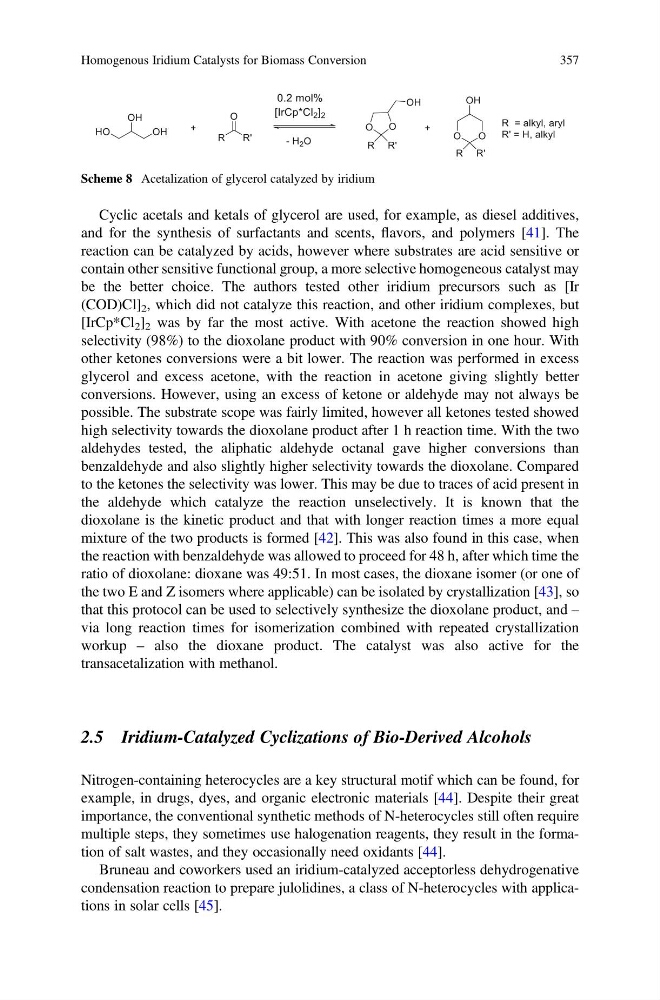
Cyclic acetals and ketals of glycerol are used, for example, as diesel additives,
and for the synthesis of surfactants and scents, flavors, and polymers [41]. The
reaction can be catalyzed by acids, however where substrates are acid sensitive or
contain other sensitive functional group, a more selective homogeneous catalyst may
be the better choice. The authors tested other iridium precursors such as [Ir
(COD)Cl] 2 , which did not catalyze this reaction, and other iridium complexes, but
[IrCp*Cl 2 ] 2 was by far the most active. With acetone the reaction showed high
selectivity (98%) to the dioxolane product with 90% conversion in one hour. With
other ketones conversions were a bit lower. The reaction was performed in excess
glycerol and excess acetone, with the reaction in acetone giving slightly better
conversions. However, using an excess of ketone or aldehyde may not always be
possible. The substrate scope was fairly limited, however all ketones tested showed
high selectivity towards the dioxolane product after 1 h reaction time. With the two
aldehydes tested, the aliphatic aldehyde octanal gave higher conversions than
benzaldehyde and also slightly higher selectivity towards the dioxolane. Compared
to the ketones the selectivity was lower. This may be due to traces of acid present in
the aldehyde which catalyze the reaction unselectively. It is known that the
dioxolane is the kinetic product and that with longer reaction times a more equal
mixture of the two products is formed [42]. This was also found in this case, when
the reaction with benzaldehyde was allowed to proceed for 48 h, after which time the
ratio of dioxolane: dioxane was 49:51. In most cases, the dioxane isomer (or one of
the two E and Z isomers where applicable) can be isolated by crystallization [43], so
that this protocol can be used to selectively synthesize the dioxolane product, and –
via long reaction times for isomerization combined with repeated crystallization
workup – also the dioxane product. The catalyst was also active for the
transacetalization with methanol.
2.5 Iridium-Catalyzed Cyclizations of Bio-Derived Alcohols
Nitrogen-containing heterocycles are a key structural motif which can be found, for
example, in drugs, dyes, and organic electronic materials [44]. Despite their great
importance, the conventional synthetic methods of N-heterocycles still often require
multiple steps, they sometimes use halogenation reagents, they result in the formation of salt wastes, and they occasionally need oxidants [44].
Bruneau and coworkers used an iridium-catalyzed acceptorless dehydrogenative
condensation reaction to prepare julolidines, a class of N-heterocycles with applications in solar cells [45].
Scheme 8 Acetalization of glycerol catalyzed by iridium
Homogenous Iridium Catalysts for Biomass Conversion
357
and for the synthesis of surfactants and scents, flavors, and polymers [41]. The
reaction can be catalyzed by acids, however where substrates are acid sensitive or
contain other sensitive functional group, a more selective homogeneous catalyst may
be the better choice. The authors tested other iridium precursors such as [Ir
(COD)Cl] 2 , which did not catalyze this reaction, and other iridium complexes, but
[IrCp*Cl 2 ] 2 was by far the most active. With acetone the reaction showed high
selectivity (98%) to the dioxolane product with 90% conversion in one hour. With
other ketones conversions were a bit lower. The reaction was performed in excess
glycerol and excess acetone, with the reaction in acetone giving slightly better
conversions. However, using an excess of ketone or aldehyde may not always be
possible. The substrate scope was fairly limited, however all ketones tested showed
high selectivity towards the dioxolane product after 1 h reaction time. With the two
aldehydes tested, the aliphatic aldehyde octanal gave higher conversions than
benzaldehyde and also slightly higher selectivity towards the dioxolane. Compared
to the ketones the selectivity was lower. This may be due to traces of acid present in
the aldehyde which catalyze the reaction unselectively. It is known that the
dioxolane is the kinetic product and that with longer reaction times a more equal
mixture of the two products is formed [42]. This was also found in this case, when
the reaction with benzaldehyde was allowed to proceed for 48 h, after which time the
ratio of dioxolane: dioxane was 49:51. In most cases, the dioxane isomer (or one of
the two E and Z isomers where applicable) can be isolated by crystallization [43], so
that this protocol can be used to selectively synthesize the dioxolane product, and –
via long reaction times for isomerization combined with repeated crystallization
workup – also the dioxane product. The catalyst was also active for the
transacetalization with methanol.
2.5 Iridium-Catalyzed Cyclizations of Bio-Derived Alcohols
Nitrogen-containing heterocycles are a key structural motif which can be found, for
example, in drugs, dyes, and organic electronic materials [44]. Despite their great
importance, the conventional synthetic methods of N-heterocycles still often require
multiple steps, they sometimes use halogenation reagents, they result in the formation of salt wastes, and they occasionally need oxidants [44].
Bruneau and coworkers used an iridium-catalyzed acceptorless dehydrogenative
condensation reaction to prepare julolidines, a class of N-heterocycles with applications in solar cells [45].
Scheme 8 Acetalization of glycerol catalyzed by iridium
Homogenous Iridium Catalysts for Biomass Conversion
357