

34% after 180 min, while the selectivity of glycerol towards dihydroxyacetone
dropped in total by 43% during the same period of time. Raising the temperature
could further improve the conversion of acetophenone up to 47%, however again a
low yield of dihydroxyacetone of only 12% was obtained. A possible explanation for
this poor selectivity to dihydroxyacetone is its further base-catalyzed conversion to
lactate, as seen before in several dehydrogenation reactions of glycerol [33]. In order
to address this problem, Crotti and co. performed the same reaction in the absence of
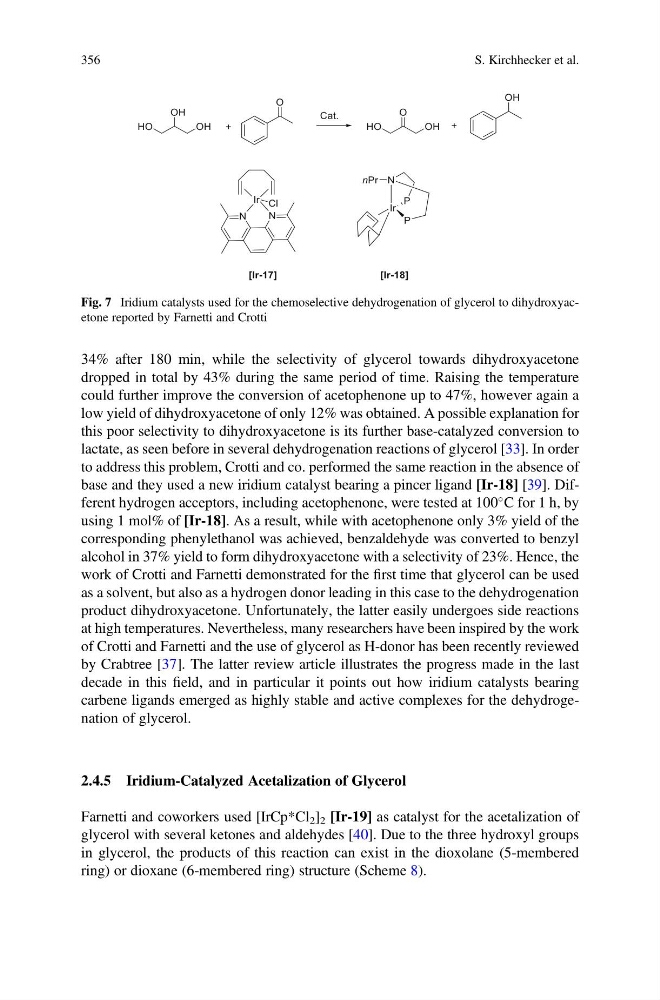
base and they used a new iridium catalyst bearing a pincer ligand [Ir-18] [39]. Different hydrogen acceptors, including acetophenone, were tested at 100
C for 1 h, by
using 1 mol% of [Ir-18]. As a result, while with acetophenone only 3% yield of the
corresponding phenylethanol was achieved, benzaldehyde was converted to benzyl
alcohol in 37% yield to form dihydroxyacetone with a selectivity of 23%. Hence, the
work of Crotti and Farnetti demonstrated for the first time that glycerol can be used
as a solvent, but also as a hydrogen donor leading in this case to the dehydrogenation
product dihydroxyacetone. Unfortunately, the latter easily undergoes side reactions
at high temperatures. Nevertheless, many researchers have been inspired by the work
of Crotti and Farnetti and the use of glycerol as H-donor has been recently reviewed
by Crabtree [37]. The latter review article illustrates the progress made in the last
decade in this field, and in particular it points out how iridium catalysts bearing
carbene ligands emerged as highly stable and active complexes for the dehydrogenation of glycerol.
2.4.5 Iridium-Catalyzed Acetalization of Glycerol
Farnetti and coworkers used [IrCp*Cl 2 ] 2 [Ir-19] as catalyst for the acetalization of
glycerol with several ketones and aldehydes [40]. Due to the three hydroxyl groups
in glycerol, the products of this reaction can exist in the dioxolane (5-membered
ring) or dioxane (6-membered ring) structure (Scheme 8).
Fig. 7 Iridium catalysts used for the chemoselective dehydrogenation of glycerol to dihydroxyacetone reported by Farnetti and Crotti
356
S. Kirchhecker et al.
dropped in total by 43% during the same period of time. Raising the temperature
could further improve the conversion of acetophenone up to 47%, however again a
low yield of dihydroxyacetone of only 12% was obtained. A possible explanation for
this poor selectivity to dihydroxyacetone is its further base-catalyzed conversion to
lactate, as seen before in several dehydrogenation reactions of glycerol [33]. In order
to address this problem, Crotti and co. performed the same reaction in the absence of
base and they used a new iridium catalyst bearing a pincer ligand [Ir-18] [39]. Different hydrogen acceptors, including acetophenone, were tested at 100
C for 1 h, by
using 1 mol% of [Ir-18]. As a result, while with acetophenone only 3% yield of the
corresponding phenylethanol was achieved, benzaldehyde was converted to benzyl
alcohol in 37% yield to form dihydroxyacetone with a selectivity of 23%. Hence, the
work of Crotti and Farnetti demonstrated for the first time that glycerol can be used
as a solvent, but also as a hydrogen donor leading in this case to the dehydrogenation
product dihydroxyacetone. Unfortunately, the latter easily undergoes side reactions
at high temperatures. Nevertheless, many researchers have been inspired by the work
of Crotti and Farnetti and the use of glycerol as H-donor has been recently reviewed
by Crabtree [37]. The latter review article illustrates the progress made in the last
decade in this field, and in particular it points out how iridium catalysts bearing
carbene ligands emerged as highly stable and active complexes for the dehydrogenation of glycerol.
2.4.5 Iridium-Catalyzed Acetalization of Glycerol
Farnetti and coworkers used [IrCp*Cl 2 ] 2 [Ir-19] as catalyst for the acetalization of
glycerol with several ketones and aldehydes [40]. Due to the three hydroxyl groups
in glycerol, the products of this reaction can exist in the dioxolane (5-membered
ring) or dioxane (6-membered ring) structure (Scheme 8).
Fig. 7 Iridium catalysts used for the chemoselective dehydrogenation of glycerol to dihydroxyacetone reported by Farnetti and Crotti
356
S. Kirchhecker et al.